Category Archives: Anti-occupation

To be Jewish and in support of Palestine

This blog is an extract from a draft of my autobiographical book about my life and Israel-Palestine. From 1995 – 2006 I lived in Nottingham, UK, where I taught at the University of Nottingham. I was active in the Nottingham Jewish Peace Campaign, from which developed a Muslim-Jewish dialogue group. Occasionally we were asked to provide speakers for events. A panel on ‘In Support of Palestine’ was organised in March 2005 by Sherwood for Global Justice and Peace. The other panel members were Caroline Lucas, then a member of the European Parliament for the Green Party, before becoming leader of that party and now its only MP. The other speaker was Hasan Patel from Friends of al-Aqsa, an organisation I knew little about, but neither I nor others in our group felt a need to check their credentials.
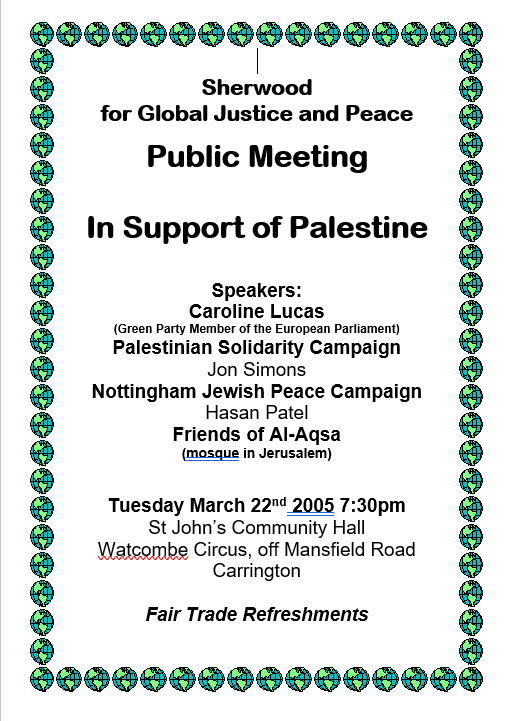
The text of my speech, which shows my adherence to a two-state solution at the time, included the following:

“What does it mean for a Jewish group, and in my case also an Israeli citizen, to be speaking in support of Palestine? It means above all that in spite of the conflict between two peoples over the same land, it is possible to support the best interests of the people of Israel while supporting the Palestinian people. It means that it is possible for the two peoples to make a historic compromise and share this small stretch of land between the Mediterranean and the Jordan River. It means that it is possible for the two peoples to live in peace. But it does not mean that compromise and getting to peace is easy.

To be Jewish and in support of Palestine means to be against the occupation of the West Bank and Gaza. It means to believe in the self-determination of the Israeli people, and at the same time of the Palestinian people. It means that that the pull-out from Gaza and a few settlements in the northern West Bank can be only the first step, not a measure that can excuse the building of more new Jewish neighbourhoods to secure a ‘greater Jerusalem’. It means denying that the ideological Israeli settlers are today’s Zionist pioneers, denying that the removal of settlements is like the expulsion of Jews from Spain, and instead believing that the settlers are being returned home.

To be Jewish and in support of Palestine means recognising the enormous costs that the conflict has on both peoples. There is no need for altruism in acknowledging the costs born by the Palestinians, because there are so many costs for Israelis too. The huge military budget drains resources from social budgets, and compulsory military service weighs heavily on citizens, especially reserve duty, which has prompted hundreds of thousand of Israelis to leave the country. The conflict has also overshadowed ethnic relations within Israel. The children of Jewish immigrants to Israel from Arab countries grew up ashamed that their parents spoke the language of the enemy, losing the connection with the cultural heritage of their diaspora. Arab or Palestinian citizens of Israel feel they are treated as a fifth column, as second class citizens. The hatred that conflict brings has bred an endemic racism in Israel that shames the memory of the racism in Europe of which Jews were so recently victims. To be Jewish and in support of Palestine means not giving on the demand for security for Israel, but insisting that the only security that is meaningful is the security that comes with a just and lasting peace agreement.

To be Jewish and in support of Palestine means accepting that there are difficult choices ahead if peace is to be achieved. It means accepting that Israel does have responsibility for the flight of Palestinian refugees in 1948 and 1967, that the myths we were told about Israelis begging them to stay are precisely that, myths; that our great national leader Ben Gurion did order the expulsion of Palestinians from Lydda and Ramle during the 1948 war with a wave of his hand. It means acknowledging that the famous Zionist slogan from the early 20th century, ‘a land without a people for a people without a land’ did a great injustice to the Palestinians in order to find a solution for Jewish homelessness. But it also means that homes for Palestinian refugees cannot be made in Israel at the cost of a new wave of homelessness for those who live now where there were once Palestinian villages and neighbourhoods. To be Jewish and in support of Palestine means accepting that Jerusalem, the city that is holy to Judaism, Islam and Christianity does not belong to one people, that its sites and ruins, its alleys and highways must be shared.

To be Jewish and in support of Palestine means to resolve the conflict while acting according to teachings of the great Jewish Rabbi Hillel, who lived and taught in Jerusalem in the years before the temple was destroyed by the Romans. He said:

‘If I am not for myself, who will be for me?

               But if I am only for myself, who am I?

               And if not know, then when?’

He also summarised the whole Jewish teaching, the Torah, as: ‘What is hateful to you, do not do to your neighbour’. The Palestinians are our neighbours, so why do we do them what is hateful to us? It also means to understand the line from the Israeli national anthem, ‘To be a free people in our land’, means that we cannot be a free people in our land until the Palestinians are free in their land too. That’s what it means to be Jewish and in support of Palestine.”

The Village of the Bulldozers

Palestinians emerge from the Nusseirat refugee camp during the uprising

This is an excerpt from chapter 7 of the book I am writing about how my life and Israel-Palestine have intertwined

I could not tell you when the Arabic word intifada (uprising, literally “shaking off”) entered the Hebrew lexicon and Israeli news discourse. In my memory there is no point at which I understood that a series of incidents of unrest and protest in the Palestinian Occupied Territories, the West Bank, Gaza Strip and East Jerusalem, which began on December 9th 1987, amounted to something qualitatively and quantitatively different to the constant incidents of Palestinian resistance to occupation that preceded it. No doubt it happened gradually rather than as a sudden insight. I was already prone to abhor what I took to be “excessive” Israeli military violence in the state’s handling of Palestinians civilians, even those who protested by throwing stones. So, when protests began to be organized by Israeli groups such as Peace Now, I was a willing participant. Yet, I cannot remember the first protest I attended, whether I held a placard, who I knew at the event, or what the focus of attention was. A month after the start of the intifada, which subsequently became known as the first intifada, I wrote a poem about studying in the library on Mt. Scopus while Palestinians were demonstrating in the neighbouring village of Issawiya:

My tower
Is not ivory
And the local stone
Is only a façade.
It is concrete,
Glass and aluminium
That keep the tear gas out

My conscience
Is not quite pure
And my innocence
Is only disinterest.
It is smugness,
Fear and apathy
That keep the guilt away.


Whether or not I had already been on a demonstration or not at that point I cannot say, but there must have been a transition period during which I focused less on my internal feelings, expressed in mawkish poetry, as well as the intellectual demands of my studies, and more on what was happening around me. I did not have a television at home when the intifada began so I relied on radio news and newspapers. The local Jerusalem paper, Kol Ha’ir, which came free with Ha’aretz on Friday was a source not only for news but also announcements about demonstrations. There is one report from Kol Ha’ir which has always stood out in my mind, though I have never been able to locate a copy of it to test my memory against it. It was written, probably in 1988, by two journalists, one a Jewish Israeli and the other a Palestinian from the East Jerusalem refugee camp, Shu’afat, Bassam Eid. Both of the journalists subsequently became human rights workers at B’Tselem, while Bassam Eid went on to establish the Palestinian Human Rights Monitoring Group in 1996, to keep a check on the Palestinian Authority’s abuses of power. The two journalists had gone to investigate reports from a village in the West Bank that a Border Police unit had buried some locals alive while using a bulldozer to erect an earth barrier. The Border Police had a reputation for brutality, while earth and other barriers were a form of collective punishment, preventing road traffic to and from villages. The piece was written, at least in my memory, in a way that appealed to Jewish Israeli scepticism that such an atrocity could have happened. It resonated with a belief that while awful things were happening, the Palestinians were exaggerating. The Israeli Jewish journalist wanted to verify what the locals told them about rushing to pull out those on whom earth had been poured, to save their lives. One Palestinian had been dragged out without a shoe. In that case, said the journalist, the other shoe should still be there. The locals dug around until they found the shoe and the Israeli Jewish journalist was satisfied that the story of what became known as the “village of the bulldozers” was true. I had also not wanted to believe that the story was true. Even though there were more fatal incidents in which hundreds of Palestinians were killed, this one crossed a line of cruelty and callousness. Surely “we” could not behave this way? From that point on I knew that “we” could and did.

The incident was referred to in a 1988 protest song about the intifada by pop star Si Heyman, “Shooting and Crying.” Among the lively beats on her second album, the song stands out for its quiet, evocative tone, her voice, full of pain, serving as the main, stark instrument accompanied only by a piano. The title refers to a well-known barb about Israeli self-righteousness towards their Palestinian victims, the self-justifying expressions of bad conscience after the fact. One feature of the mournful lyrics is a feminist refusal to identify with her nation as the side which must vanquish its enemy: “It doesn’t matter to me at all who wins now,” changing in another refrain to “it doesn’t matter to me at all who is the strong one.” Rather than a battle between two sides, “on both sides, people just want to live.” The phrase about the “village of the bulldozers” incident is in the chorus:

Shooting and crying
Burning and laughing
Whenever did we learn
How to bury people alive?

The two lines then repeat, followed by the phrase, “when did we forget that our children were also killed?” The oblique reference to the Holocaust says it all. I came to learn that this extreme discomfort about becoming the oppressor of another people so soon after the Nazi genocide is repeated in Israeli anti-occupation and human rights activism. It is too much to bear. It was also too much for the Israeli military’s radio station, Galei T’zahal, which banned the song at the end of March 1988.[1]


[1] Avi Morgenstern and Ilana Baum, “Sarid to protest to Rabin the IDF’s ban on Si Heyman’s song.” (in Hebrew) Ma’ariv newspaper, 29/3/1988.https://www.nli.org.il/he/newspapers/mar/1988/03/29/01/article/56/?e=——-he-20–1–img-txIN%7ctxTI————–1 Accessed 19/12/2021.