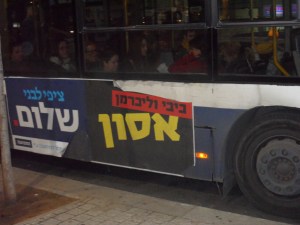
Hatnu’a election poster: Bibi & Lieberman – disaster; Tzipi Livni – peace.
Israeli electoral politics shift quicker than sand dunes in a storm. At almost the last minute, before the lists of candidates for Israel’s general election for the 19th Knesset on January 22nd 2013, a new electoral slate was established. Tzipi Livni, former, deposed chair of the centrist Kadima party, announced her latest centrist political vehicle, minimally called Hatnua (the movement) on November 27th. Her move made Israel’s political centre even more crowded, competing with not only the sorry remnants of Kadima (most of its remaining members of Knesset switched to join Livini), but also the Labour Party, and Yesh Atid (There is a Future), headed by former media personality Yair Lapid. Yet, Livni’s campaign planning was clearly not last minute, as soon enough billboards, bus stops and buses were bearing Hatnua’s election posters. The basis of the campaign, visually and conceptually, is to focus negatively on the dangers posed by the likely winners, Likud Beitenu, while presenting Livni as a sensible, saner alternative to another term of premiership by Benjamin Netanyahu, as Walla! News has noted.
The most recent of Hatnua’s posters continues the contrasting colour scheme, using alarming black, red and yellow lettering for Likud Beitenu and a gentler font, along with the calmer blue and white national colours, for the text referring to Livni. But it goes one step further, contrasting Netanyahu and Lieberman as a disaster (ason) and associating Livni with peace (shalom). Does this mean that the next Israeli elections will come to focus on the stalled Israeli-Palestinian peace talks, on ending the occupation? Should we have a little hope that the Israeli electorate will focus for a while on peace, that the growing desperation of Palestinians in the occupied territories will be addressed, that a third intifada will be averted?
For sure, Hatnua’s campaign is designed to distinguish it clearly from the Labour Party, whose leader Shelly Yachimovich is convinced (following the advice of American campaign strategist Stanley Greenberg) that her party’s best chances depend on emphasizing social justice issues in the light of the massive social protests of the summer of 2011, while downplaying diplomatic and security issues. This strategy is causing consternation in the Labour ranks, according to Ha’aretz, as it doesn’t seem to be working, and also was a significant factor in the defection of a former Labour leader, Amir Peretz, to Livni’s list days after it was set up. Yossi Beilin, a former Deputy Foreign Minister closely associated with the Oslo accords, delivered a scathing, humorous analysis of Yachimovich’s doomed adherence to the campaign strategy, pointing out that each time Labour had won in 1984, 1992 and 1999 it had been on a promise of peace. His address to an audience at an event of the Geneva Initiative was well-received, but the chair of the subsequent election panel about the parties’ political positions on peace and security issues found it hard to pin them down to anything specific.
Hatnua’s election poster doesn’t indicate an opening of political space for peace and the ending of Israeli occupation. Livni is an heir to Kadima’s founder, Ariel Sharon, who established it as a vehicle to drive forward his plan for unilateral Israeli withdrawal from Gaza, with the aid of high-level defectors from the Labour Party and much of the business, military and media elite, and as a way of avoiding negotiating further with the Palestinian Authority following the death of Arafat. As Israeli sociologist Lev Grinberg notes in his book Politics and Violence in Israel/Palestine, the Gaza “disengagement” signaled the reappearance in Israel of an ‘imagined peace’, a peace figured as Israel’s separation from Palestine, it’s maintenance of a ‘Jewish democracy’ within (more or less) the 1967 borders. The peace promised on the side of a bus in Tel Aviv is also imaginary, but in a different way that figures peace as diplomatic process, without explaining why renewed talks would succeed this time when they failed previously. The ‘peace’ on the side of the bus remains an empty word, a hope for something better, but not a willingness to engage in the painful, frustrating yet necessary process of making peace between Israelis and Palestinians. The bus pulled away from the stop just as I photographed it, becoming a dim shape in the Tel Aviv twilight.


 Picturing Peace