Tag Archives: B’tzelem

The Qana Moment: When the Israeli government falls off its Protective Edge

When the Israeli government and military began Operation Protective Edge, they must have known that the moment would come. I’ll call it the Qana moment after the incident on April 18, 1996, during Operation Grapes of Wrath, a round of the war between Israel (with its proxy, the South Lebanon Army) and Lebanon (in the form of Hezbollah). Then, as now with the hostilities between Israel and Gaza, an undercurrent of violence flared up into open warfare, with each side blaming the other for starting it. Then, as now, Israeli authorities accused their opponents of using civilians as human shields.
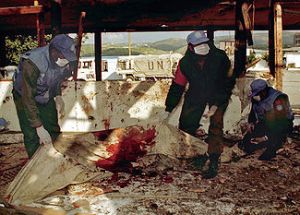
UNIFIL Peacekeepers (Qana 1996) Remove Artillery Attack Victim Remains

UNIFIL Peacekeepers (Qana 1996) Remove Artillery Attack Victim Remains

Then, as now, Israeli authorities called on civilians to leave the area in which they were going to attack, and hundreds of thousands did flee. Some 800 of them took refuge in a UN compound, nearby from which Hezbollah fighters fired rockets and mortar rounds towards Israeli military positions. In the response, Israeli artillery shells struck the compound, killing 106 and injuring many more. International outrage did not immediately halt the military campaign, although on the same day the UN Security Council passed resolution 1052 calling for an immediate ceasefire, which was not reached until ten days later. A subsequent UN investigation concluded that it was extremely unlikely that the Israeli shells had hit the compound by accident, and in its rejection of the report the Israeli government continued to claim that it had not intended to hit the compound.

The Qana moment is not an isolated incident in Israel’s asymmetrical wars against non-state foes, when “by accident” a horrific number of civilians are killed by Israeli munitions. In the last round of the Israel-Gaza war in 2012, the moment was the Al-Dalu family killing on 18 November, in which twelve people died in an attack on a home.
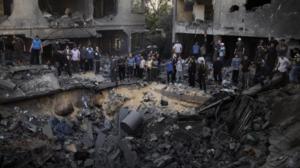
Palestinian men gather around a crater caused by an Israeli air strike on the al-Dalu family's home in Gaza City on November 18, 2012. (AFP Photo / Marco Longari)

Palestinian men gather around a crater caused by an Israeli air strike on the al-Dalu family’s home in Gaza City on November 18, 2012. (AFP Photo / Marco Longari)

In Cast Lead, in 2009, it was the shelling on January 6 of the al-Fakhura school in which hundreds of people were sheltering, killing more than 40 of them. The story is always the same. The Israeli authorities say that they were targeting a source of fire or some armed people or installation, and that the civilians were too close to the target, or there was some technical error. As Moriel Rothman-Zecher put it on his Leftern Wall blog, the Israeli authorities’ intention matters less than the consequences of their action. The killing of civilians is not an incidental by-product of this sort of asymmetrical warfare: it is an inevitable element of it, just as the deaths of Israeli soldiers, some by “friendly-fire,” are inevitable when the air war becomes a ground war. When Israeli authorities wage war in this way, it simply means that they intend to hit their targets. That is a military, not a moral, stance.

The Qana moment may already have happened in this bout of hostilities, Protective Edge. It might have been the bombing of the Abu Jameh family home on July 20th, killing 25, apparently without warning. As I write, details are emerging of another deadly strike that is eerily similar to the al-Fakhura incident: an UNWRA school in Beit Hanoun in which people had sought shelter but were apparently trying to evacuate, was hit by shells, killing about 10-15 and injuring many more.

The Qana moments don’t stop the violence (or bring the Western governments that support Israel’s “right to self-defense to withdraw their public support), nor does media attention to them address the whole range of death and destruction. At this point, unlike in the actual Qana moment, the UN Security Council has not resolved that there be an immediate ceasefire, although the UN human rights council has formed a commission to look into possible Israeli war crimes. The Israeli response has been dismissive, with Justice Minister Tzipi Livni saying “get lost” and Prime Minister Netanyahu calling it a travesty, given Hamas’ war crimes. In all probability, when the UN completes its report, the Israeli government will reject it, just as they after Grapes of Wrath, and for the same reasons. And when civilians are killed again in the next operation, and the one after that, and so on, they will repeat the same talking points as civilians die.

The deadly repetition of inevitable civilian casualties might perhaps be slowed if not halted by an Israeli public opinion that is as appalled by them as much as public opinion is elsewhere. But unless Israelis are seeking out alternative news to that provided by their mainstream media, they will see and hear little about the Palestinian casualties. Surely if Israeli authorities were as confident in the “righteousness of our way” as they claim to be, as in the new President Reuven Rivlin’s swearing in speech, then there would be no problem for the Israeli public to be fully aware of each “justified” death, each “justified” injury, each “justified” destruction of homes, and hospitals, and mosques. As a way of bringing the public’s attention to that for which they bear responsibility but do not hear, Israeli human rights groups B’tselem tried to pay for a spot on Israeli public radio in which the names of some of the dead Palestinian are read out. But the Israeli Broadcasting Authority rejected the group’s appeal to place the spot, so instead it can be found on social media, out of sight and mind of most of the Israeli public and its sphere of ethical responsibility.

“Every person has a name” goes the Hebrew song that is used on memorial days for soldiers and the Holocaust. And indeed, everyone does have a name, and the taking of that name cannot be excused by talking points. The cost of the Qana moments is horrendous, but they have the power to remind all of us of our ethical responsibility.

Cease-force now: practising peace by documenting violence

The big news this weekend about peace between Israel and Palestine is US Secretary of State, John Kerry’s announcement that Israeli and Palestinian leaders have reached an agreement that ‘establishes a basis for resuming direct final status negotiations’. Big news, then, that there might be another breath of life left in the Oslo process, and that if the direct talks actually start, at some point Israel will release some long term Palestinian security prisoners. At present there is much speculation and comment about the character of this agreement, about whether the talks about talks will even get as far as a meeting between Israeli Prime Minister Netanyahu and Palestinian Authority President Mahmoud Abbas, and as to whether the discussions will do more harm than good. Earlier in Kerry’s intensive diplomatic process, I suggested that it promotes only pseudo-peace, turning peace into a dirty word.

Rather than focusing on the ‘big news’, I prefer to pay some attention to events over the week that attracted much less attention. During the recent build up to Kerry’s announcement, there were two small achievements in efforts to build a just peace through non-violent action. Video footage of the detention of five-year old Palestinian boy Wadi’ Maswadeh in Hebron, recorded by fieldworker Manal al-Ja’bari for B’tselem, kicked up enough of a storm on conventional as well as social media for the Israeli army to admit that:

“We made a mistake during the event, both in detaining the boy and detaining his father,” GOC Central Command Maj. Gen. Nitzan Alon told commanders during an operational assessment conducted in the command.

The Israeli army’s acknowledgement of its error, reported in Ha’aretz a week over so after the incident, differs significantly from its initial response to the video:

We regret that B’Tselem has chosen – on a regular basis – to distribute videos of this kind to the media before clarifying the issue with the army first.

The military’s admission of error in this incident also comes after B’Tselem Director Jessica Montell sent a letter to the Legal Adviser to Judea and Samaria, stating:

The footage clearly shows that this was not a mistake made by an individual soldier, but rather conduct that, to our alarm, was considered reasonable by all the military personnel involved, including senior officers.

Border Police statement on Channel 10 news.

Border Police statement on Channel 10 news.

A second small achievement last week was also the fruit of video documentation by activists of the excessive use of force by Israeli occupation forces, which was then circulated more broadly. On July 15th there were protests across Israel and Palestine against the Prawer plan, approved by the Israeli Knesset on June 24th 2013. The plan will result in the destruction of 35 ‘unrecognized’ Arab Bedouin villages, the forced displacement of about 40,000 Arab Bedouin citizens of Israel, and the dispossession of their historical lands in the Negev, in the south of Israel. Most of those demonstrations were met with violence by the authorities, including one held at Damascus Gate. In a video recorded by a Ta’ayush activist, military border police run amok in East Jerusalem, knock over food stalls set up during the Ramadan fast, bust into people waiting in a bus queue, and push into a group of medical workers on stand-by. The video was picked up by Israel’s Channel 10 news, which pressed the Border Police for a response. Not quite an admission of fault, their statement notes that the behaviour of some of the soldiers does not match the values expected of the Border Police, promising a further enquiry.

In both cases, the achievement is quite minor. Despite acknowledgement that detaining children below the age of criminal responsibility is illegal, the army continues to do so in Hebron, as this video shows.  As for changing the intense restrictions on Palestinians in Hebron that stifle civic life – that is not even on the agenda of the occupation authorities. Moreover, as Gideon Levy reports, Wadi’ Maswadeh has already been traumatised by his experience. It is doubtful that the Border Police’s internal inquiry will change how they respond to demonstrations in East Jerusalem. Perhaps coincidentally, B’tselem spokesperson Sarit Michaeli was shot at close range and injured by a rubber-coated bullet fired by the Border Police while documenting a weekly demonstration at Nebi Saleh, in the West Bank, on Friday July 19th. Nor has there been any backtracking by the Israeli government on the Prawer plan. Instead, on July 16th, the day of the Jewish 9th of Av fast that commemorates the destruction of the temples in Jerusalem, another unrecognized Bedouin village in the Negev, Al-Arakib, was demolished for the 53rd time.

In both cases, activist documentation of the use of force by occupation authorities has not only exposed that violence locally and internationally, but has prompted those authorities to admit that something is amiss. The activists, who practice non-violence and uphold human rights, have taken a small step in decreasing state violence. In doing so, they bring peace closer by a small increment, because they open up a non-violent path out of the conflict between Israelis and Palestinians. They increase the chances for a future peace by practicing and promoting peaceful ways not only of resisting the occupation, but also for the occupation forces to counter that opposition. Non-violent action is an embodiment of the peace that negotiators try to achieve. It is also an education for the occupation forces, a set of small lessons about acknowledging the humanity of the Palestinians and other protestors, about treating five year old boys as children not weapons, and about allowing people on an East Jerusalem street to eat and travel at the end of a fast day.

One would hope that such lessons could be learned and implemented while negotiations about peace negotiations are being held in Jerusalem, Amman, Ramallah and Washington. Just as we expect there to be a ‘cease-fire’ as diplomatic efforts to end the conflict go on, we should expect and demand that all use of force to carry on the occupation – demolitions, expulsions, arrests, travel restrictions – also be suspended. There is no such ‘cease-force’, and hence the small, non-violent steps to peace taken by activists to reduce repression by occupation forces are more concrete steps to peace than those reported in the main headlines.