Tag Archives: Extinction Rebellion

It’s 1933. Some of us will survive.

It’s 1933. Some of us will survive. In the German elections in March 1933 the democratic system of the Weimar Republic created a parliamentary majority for the Nazi Party’s coalition headed by Hitler. In the 2024 US elections the democratic system has selected a president with, at least, fascist tendencies and given his political party a majority in the Senate and quite likely also the House of Representatives.

This piece is neither a prediction of what Trump will do in power nor an analysis of how he won the elections. It is an attempt to turn the deep pit of dread, fear and foreboding in my stomach into the hope contained in the acknowledgement that however bad it will be – and it will be bad – some of us will survive.
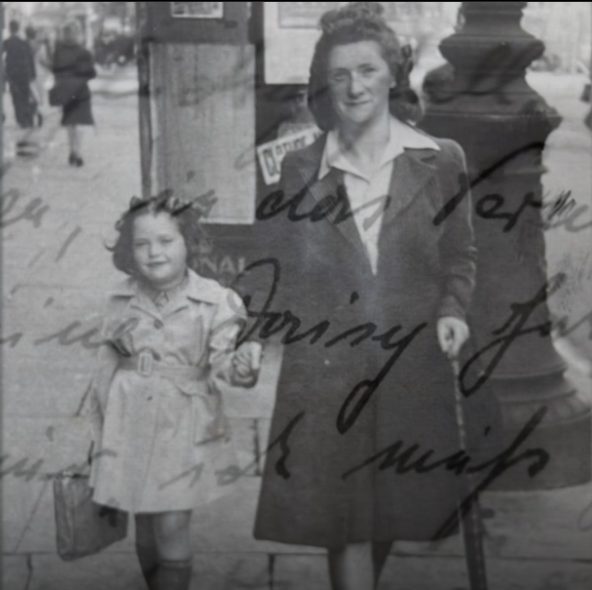
Ursula and Daisy after the wat. Still from BBC A House through Time Series 5, Episode 4.

By chance, my partner and I had just finished watching Series 5: Two Cities at War of the BBC history series A House through Time presented by David Olusoga. Following the stories of the residents of two apartment buildings in London and Berlin from the 1920s to the end of the Second World War, we watch German tanks rolling first into Poland and then France, the bombing Blitz of London and then the Allies’ bombing of Berlin. Of the Jewish families in Berlin, one – parents with a two year-old daughter – escapes only as far as Belgium. The records show the parents being transported to Auschwitz, where the father perished but the mother survived the Death March from there to Ravensbrück. Having witnessed the brutalities of war and being reminded that the fate of the Jewish families is interwoven with the Holocaust, the viewer is left willing for a happy ending for them in the archives. And there is one – a record of mother Ursula and daughter Daisy (who had been placed in hiding by her mother) living together in Brussels, a photo of them after the war and another of them at Daisy’s daughter’s wedding. That is all I needed for the last episode to be bearable – that Ursula and Daisy survived, that they went on to thrive.

Today’s democratically chosen tyrant may be not end up being as responsible for as much human suffering as Hitler. But as Moira Donegan wrote the morning after his election, “For those of us aware of what Trump is capable of, this morning has plunged us into a cold kind of anticipatory grief.” Mass deportations, vast cuts to welfare and health services and “the persecution of dissidents and violent suppression of Trump’s political enemies.”

Trump’s election makes individual and collective survival for millions of Palestinians, especially those in Gaza, an even more acute issue than it has been for decades and since the murderous attacks by Hamas on October 7th 2023. Israel’s vengeful response has already killed as many Palestinians as the German Blitz on Britain, more than 43,000. Its current phase in the north of Gaza that began on October 5th 2024 threatens the lives of some 400,000 people who remain in the area, unwilling or unable to be driven out to the south. A combination of military fire power, from bombs to sniper bullets, starvation, wrecking buildings, and destruction of the last vestiges of a health system, are, writes Idan Landau, “an embodiment of the spirit of ethnic cleansing and resettlement from day one,” paving the way for new Israeli settlements. The pre-US election period was already providing the government and military with a window of opportunity to pursue this particularly vicious operation, but “If Trump wins, the Israeli leadership can breathe a sigh of relief. He will not stop any Israeli plan, however brutal.” Indeed, Netanyahu was quick to congratulate Trump who is an ally of the settler movement, at ease with annexation of Occupied Territories. Thus far US exhortation to Israel to minimise civilian casualties and allow humanitarian relief has had no teeth. Trump will not even encourage such restraint, nor (as did Biden) will he remind the Israeli government of its own duty to protect its citizens held hostage in Gaza for 401 days (as I write this).
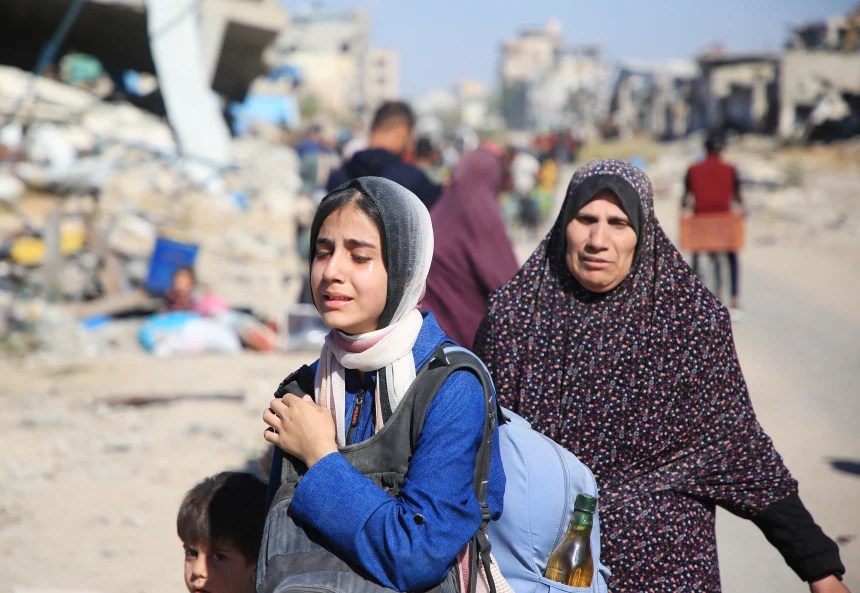
A Palestinian girl cries as the Israeli army forcibly moves civilians from the outskirts of the Jabalia refugee camp in northern Gaza on Tuesday.Mahmoud Sleem / Anadolu via Getty Images

Yet however awful the outcome of the latest Israeli onslaught on Gaza, just as some Palestinians survived the 1948 Nakba and remained tsumud, steadfast on their land, some will survive. Palestinians have survived in Gaza since the blockade began after Hamas took over in 2007 and survived the series of Israeli armed assaults since then, as told in a profound anthology I am currently reading, Daybreak in Gaza: Stories of Palestinian Lives and Culture. Some will survive and then thrive this time as before. And even if the Israeli government abandons the hostages in Gaza to their horrible fate, some were released last November and have survived, and the grieving families of those who perish will survive.

The biggest threat to survival that Trump’s election poses is to the natural environment that sustains humankind. According to The Guardian:

Trump’s agendaanalysts have found, risks adding several billion tonnes of extra heat-trapping gases to the atmosphere, further imperiling goals to stave off disastrous global heating that governments are already failing to meet

As I’m active in Extinction Rebellion I might be expected to believe that the climate and ecological crisis is an existential threat to whole human species. But I believe that global heating and nature loss will destroy human civilisation, leaving a few of us to survive in lives that are for many generations nasty, poor, brutish and short. But some of will survive well enough to build new societies in which some of us can thrive.
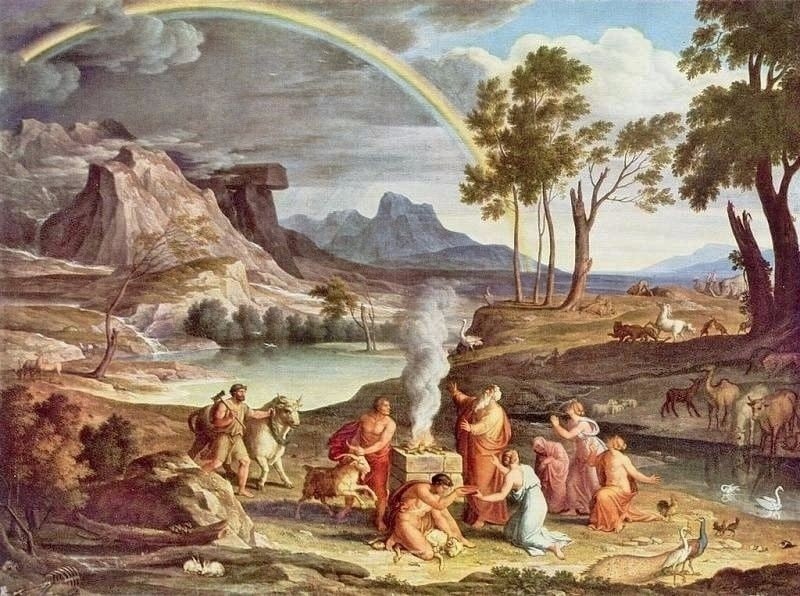
Artist Joseph Anton Koch (1768–1839)

That narrative arc, from impending doom, to catastrophe, through to survival and thriving, which Ursula and Daisy lived through, is grounds for hope. The catastrophe is not averted, many are lost, but something rises from the ashes. Survival cannot bring back all that was lost in the catastrophe, but it is a partial redemption, like the dove that returns with an olive branch to Noah’s ark after the flood. God promises there were never be another flood and commands Noah’s family – all that is left of humanity – to be fruitful and multiply, signifying the covenant with a rainbow. A passage by Rebecca Solnit has been circulated a lot in the days since Trumpism triumphed at the polls, in which she writes :

The fact that we cannot save everything does not mean we cannot save anything and everything we can save is worth saving… A lot of us are going to come under direct attack, and a lot of us are going to resist by building solidarity and sanctuary… People kept the faith in the dictatorships of South America in the 1970s and 1980s, in the East Bloc countries and the USSR… There is no alternative to persevering, and that does not require you to feel good.

We are not passive spectators in the narrative arc from catastrophe to survival. Noah had to be righteous and build an ark. Ursula’s mother had to find solidarity with the good souls who risked their lives by giving sanctuary to Daisy. Hope is a verb, not a passive state of waiting for better times. As Kamala Harris put it in her concession speech:

Don’t ever give up… do not despair. This is not a time to throw up our hands. This is a time to roll up our sleeves. This is a time to organize, to mobilize and to stay engaged for the sake of freedom and justice and the future that we all know we can build together.

Joe Biden offered similar active hope in his address to the nation:

Setbacks are unavoidable, but giving up is unforgivable… A defeat does not mean we are defeated. We lost this battle… We’re going to be OK, but we need to stay engaged. We need to keep going. And above all: we need to keep the faith.

Perhaps those are the clichéd remarks of politicians, but in these dark days I am receptive to those clichés. Even if today I cannot see the rainbow after the flood, survival after catastrophe, I know the narrative arc was fulfilled before and will be again. Trumpism is not forever. Some of us will survive.

The last light of Hanukkah

As a child I loved to watch as the Hanukkah candles burned down, guessing which would be the last one to give up its flame. Not having had any of my own children, I remain that child. This year the extinction of the last candles on the eighth evening of Hanukkah seemed especially poignant. The light gone, the darkness smothering all hope. More than 20,000 Palestinians and Israelis have been killed since October 7th, mostly civilians. Who knows how many more Palestinians lie under the rubble. There are still about 130 Israeli hostages somewhere in Gaza, imperilled by the bombardments and assaults of the military forces that are supposed to defend them as well as by their captors. More then 3,000 Palestinians from the West Bank and Gaza have been imprisoned by Israel since October 7th, subject to military courts, administrative detention and abusive and lethal conditions. The injured in Gaza are denied the medical resources for their recovery by an unrelenting invading army. Countless others, as many as 80% of the population, are homeless, the descendants of refugees displaced from their homes, finding no shelter in tents on flooded ground, increasingly vulnerable to hunger and disease. The returned hostages confront their trauma. There is so much trauma, so many bereaved, so many maimed, so much ruin. So little hope.

A boy lights a Hanukkah candle as relatives and friends of hostages held in the Gaza Strip by Hamas call for their release, on the first night of Hanukkah, in the Hostages Square at the Museum of Art in Tel Aviv, December 7, 2023. (AP/Ariel Schalit)

By chance, it was the candle to the furthest on the left that obstinately kept burning the longest. It is the obstinacy of the Left that gives me some hope. I do not mean the ideological Left of the UK, where I live, the adherents of various forms of political Marxism. The most influential of those, the Socialist Worker’s Party, issued a statement including this clause:

Too many on the liberal and reformist left have been quick follow their governments in condemning Hamas and affirming Israel’s right to self-defence. The flood of media atrocity stories has obscured what actually happened on 7 October. But when oppressor and oppressed clash there can be no neutrality or equivalence. We support the right of self-determination of the Palestinian people and their right to wage armed struggle against the Israeli settler colonial state.

1

Hamas atrocities, according to the SWP, are legitimate anti-colonial armed struggle and its Islamist ideology somehow enables the SWP’s goal of of a secular, democratic state in all of Israel and the Occupied Territories. I’m happy to be liberal and reformist if that’s the cost of remaining ethical. But the SWP sound moderate in comparison to the Revolutionary Communist Group whose statement on the horrors of October 7th begins with:

Early on the morning of 7 October an audacious and unprecedented military action by Palestinian Resistance forces, Operation Al-Aqsa Flood, was launched from Gaza into the occupied territory of the Israeli state. The Revolutionary Communist Group (RCG) and our Fight Racism! Fight Imperialism! (FRFI) Supporter Groups extend our unconditional support to the Palestinians in their struggle to liberate themselves from illegal occupation by any means necessary.2

By any means necessary on this account includes rape and torture as well as murder and hostage taking of civilians. Unable to grasp that even Marxist dialectics cannot make two wrongs a right, this branch of the ideological Left sees a valid path to Palestinian liberation that, contrary to Palestinian journalist Rajaa Natour‘s brave statement, “include[s] a speeding jeep in the streets of Gaza with a half-naked Jewish woman strapped to its front.”

I am also not speaking of the less ideological left in the UK, the progressive left who have been moved by the horrific scenes of Israel’s assault on Gaza to join the massive demonstrations of solidarity with Palestine, organised by the Palestine Solidarity Campaign. Protests of that size attract people and organisations of a broad range of opinions, including the ideological Left. It would be hard to disagree with the PSC’s announcement before their first major protest on October 14th that:

Every humanitarian will be appalled and horrified, as we are, at the scenes we are witnessing of a severe escalation of violence since October 7th… International law makes it clear that the deliberate killing of civilians, hostage-taking and collective punishment are war crimes. Such crimes must be condemned no matter who perpetrates them.3 

Yet, less than a week after October 7th, the PSC was unable to name some of the perpetrators of those crimes as Palestinians, or some of the victims as Israelis. The day after the PSC’s first march, in my home town as well as London, I wrote on my Facebook page :

Yesterday I couldn’t bring myself to join in the protest organised by the Palestinian Solidarity Campaign, even though it has never been more urgent and vital to demonstrate solidarity with Palestinians. … For the most part, I can join in the chant of “From the river to the sea, Palestine will be free” as a call to end occupation and apartheid, for Palestinian independence. But I cannot shout it when I think that even one other person also shouting it sees a way to freedom through the brutal massacre of civilians.

There has been a left, anti- and non-Zionist Jewish bloc on the PSC rallies in London, including an organisation in which I’m still active, Na’amod. I went on one myself in Nottingham, on a week in which I felt the need to call for a ceasefire outweighed my desire to feel comfortable at a protest. I did not join in the chants of “From the River,” only the calls for a ceasefire. During the march I stayed close the drummers from the environmental group I’m active in, Extinction Rebellion, glad to be close to familiar people as I carried a sign with Na’amod’s logo, marking me out as Jewish and calling for the release of the hostages as well as a ceasefire.

Like many progressive organisations, Extinction Rebellion is pro-Palestinian by default. Its statement about the war claims that “The climate and ecological emergency has roots in centuries of colonial violence, exploitation and oppression – for which the UK bears a disproportionate share of responsibility.” In a over-simplification, Israel – often regarded as a colonial-settler state – becomes a root cause of the climate crisis. The statement about the war, which otherwise is generally thoughtful, ends with the phrase: “Only a just peace can secure a liveable future.”

But one sentence upset me because of a small omission. “We are horrified by the atrocities committed on October 7th, and the rapidly escalating violence and humanitarian crisis inflicted on the people of Gaza.” Why, I wondered, could it not say that atrocities had been committed against Israelis, against Jews? In a message to XR’s press team asking if the omission could be corrected, I wrote that “One of my reactions was ‘it doesn’t matter, don’t make trouble’ but that is a learned reaction from a long history of oppression, and it doesn’t help others to unlearn their oppressive behaviours to keep quiet about it.” I never got further than a response that it had taken a long time to arrive at this agreed statement after consultation with unnamed stakeholders, so the statement could not be changed. That was disappointing.  

I was happier to join a silent vigil organised locally under the umbrella of UK Friends of Standing Together, held on November 19th, mourning all the victims and calling for a ceasefire and release of the hostages. I helped organise a second vigil by the group on December 10th, adapting a script from an earlier vigil held by Na’amod. On both occasions fellow activists from Nottingham XR were there too. The slogans on the banners were written to suit the Standing Together movement. These events felt very different to the marches and rallies organised by the ideological or progressive UK left, though one of the ideological left groups, Workers’ Liberty, has led this initiative. The vigils had something of the spirit of a Left that does give me hope, the Israeli Left that is also an Israeli-Palestinian Left.

Nottingham Peace Vigil 10th December 2023

It is something of a Hanukkah miracle the Israel’s Left is still burning obstinately as the country moves ever further to the Right. Since the start of the war, its opponents have faced a police and judicial crackdown, having to fight for the right to protest and hold political meetings. Protests during wartime have been a feature of Israeli politics since the disastrous 1982 Lebanon War, a disaster which look set to be repeated with Gaza. This Left has issued a Jewish-Arab peace declaration condemning the atrocities by both Hamas and Israeli forces. It repeats the truths we should all have learned long ago:

there is no military solution to this conflict, nor can there ever be one. The only way to stop the bloodshed is a political agreement that will guarantee security, justice and freedom for both nations. There are no winners in war. Only peace will bring security.

The obstinate flame, the obstinate Left, the obstinate hope.

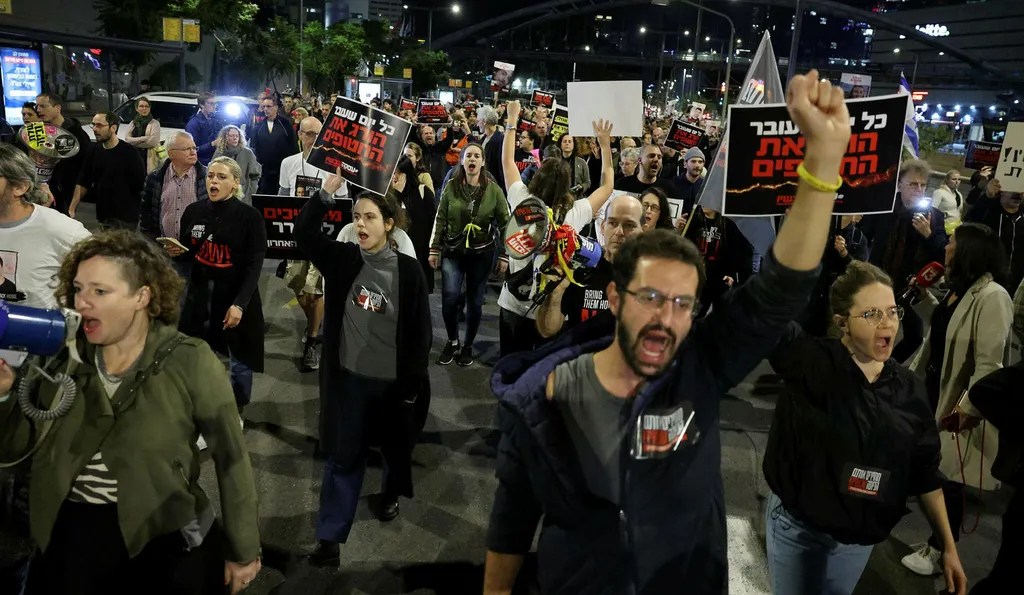
Protestors for hostage release in Tel Aviv 15.12.2023. Photo: Tomer Appelbaum

  1. IST statement on the new war in the Middle East ↩︎
  2. RCG statement on the military action of the Palestinian Resistance ↩︎
  3. Press Release: March for Palestine ↩︎