Tag Archives: Gaza

Ceasefire on social media (part two)

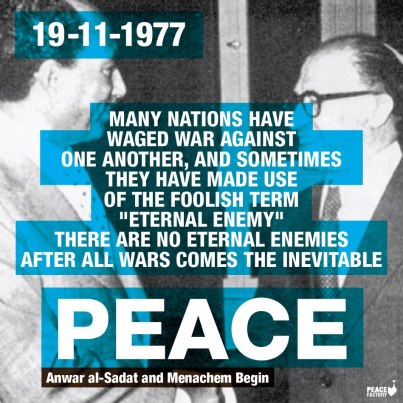
Sadat and Begin image by Peace Factory on facebook

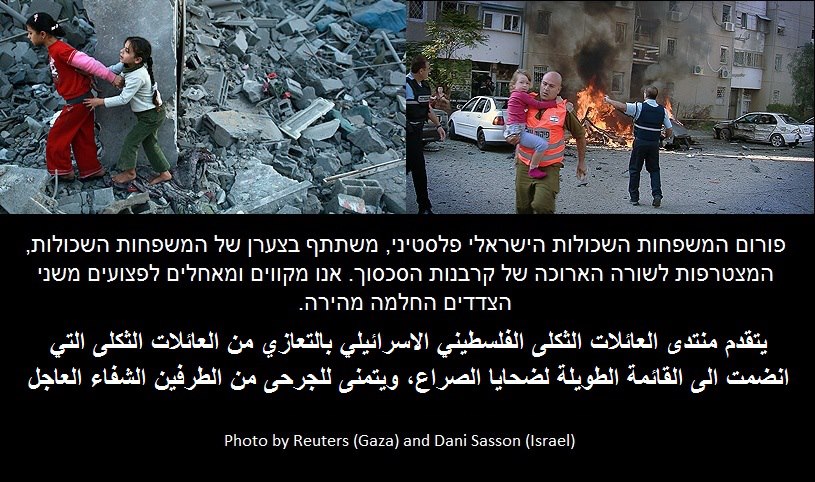
Parents Circle image on Crack in Wall facebook page

Peace Factory image on facebook

There is thunder in Tel Aviv as I write this piece, but not the thunder of war, only of the heavens. The ceasefire between Israel and Gaza that began at 9 pm last night is still just about holding (there is a report on twitter already of a Palestinian shot and injured by Israeli troops as he approached the security fence), and the stormy weather can become news again. In my last post, I called for a ceasefire on social media, for an end to the exchange of hostile, hateful imagery of Israelis and Palestinians targeted at each other on facebook and twitter. From what I see on blogs, tweets and sites that I follow, that has to a large extent happened for now, in the wake of the military ceasefire. The Palestinians have more mourning and rebuilding to do than Israelis, among whom there is some disappointment that the army didn’t reinvade Gaza to end the missile threat once and for all. The conflict between Israelis and Palestinians is far from over, whether on the ground or on social media, and so the demonization of the Other as hateful by nature, and thus undeserving of peace, will go on too.

Social media during the war have not only been the terrain of hostile electronic propagandizing, the waging of war through hateful images. Social media have also been a field for peace-making, not only for explicit calls for a ceasefire, but also for images of peace between Israelis and Palestinians. One of the Israeli-Palestinian groups that called for an immediate ceasefire is The Parents Circle – Family Forum (PCFF, also called Israeli Palestinian Bereaved Families for Peace). It is a joint Palestinian Israeli grassroots organization of over 600 families, all of whom have lost a close family member as a result of the prolonged conflict. Through their facebook page titled A Crack in the Wall, PCFF kept up their strategy of seeking peace through reconciliation. They recirculated their slogan “it won’t stop until we talk” (in Hebrew this rhymes as: ze lo y’gamer im lo n’daber) and asked visitors to use it as their cover picture. While the electronic propagandists were circulating photographs of casualties on “their” side, PCFF posted pictures that juxtaposed the suffering and destruction on both sides, underlined with the message that:

“The Israeli Palestinian Bereaved Families Forum shares in the grief of the bereaved families, who join a long line of victims of the conflict. We hope and wish the injured on both sides a speedy recovery.”

In their express call for a ceasefire, PCFF expressed concern for the civilians on both sides, pointing out that “anger and frustration only fuel the already existing fire of fear and hatred.”  The families hope to “serve as a bridge beyond hatred and fear by declaring their willingness to work together towards reconciliation between peoples despite their deep loss.”

Another constant stream of images of people refusing to see each other as enemies came through the “Israel-Loves-Iran” facebook page, along with its various offshoots, “Palestine-Loves-Israel” and “Israel-Loves-Palestine.” Following their typical format, there were lots of photographs of Israelis, Palestinians and others bearing the words: “Please stop the war.” They also marked the anniversary of President Sadat’s visit to Jerusalem in 1977 with a photograph of him meeting Prime Minister Begin, and a series of superimposed statements they made about war and peace.

The images of Israelis and Palestinians recognizing each other’s grief, pain, aspirations and hopes, acknowledging that the other wants peace, independence and security as much as one’s own side, were not those most visible amid the explosive flashes of the war. They may seem naïve, kitschy, obvious. Doesn’t everyone prefer peace to war? Isn’t the problem far more complex than a simple demand to ceasefire and live in peace can address? True, peace-making isn’t simple, and it’s proved elusive between Israel and Palestine in spite of the hope raised by the 1993 Oslo agreements. But to make peace we have to picture it, and we have to see, to imagine those we call our enemies as people who deserve peace as much as we do. See the peace you want there to be.


Ceasefire on social media (part one)

Golda Meir saying on Arabs’ lack of love for children

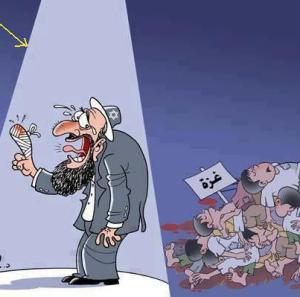
Anti-Semitic images posted by GYBO on 19 November

Lior Arditi’s cartoon of “Israel in the jungle”

It is wearying, dispiriting, often sickening to be immersed in social media these days, as the Gaza “pillar of cloud” war is waged through it. There is nothing new in the media being used as weapons of war, the display of blooded bodies of dead babies as justifications for the righteousness of our way and the demonization of the evil enemy. As the state of Israel and the armed groups in Gaza battle each other, unevenly and unsymmetrically, with rockets, shells, bombs and missiles through the sky, each is also fighting and mobilizing its supporters to capture as much as possible of that vague territory called “world public opinion.” Or maybe that’s not the best analogy, as much of this propagandizing impacts only those already allied to one side – the tweets you follow and your facebook friends. Anshel Pfeffer, writing in the liberal Israeli newspaper Ha’aretz, refers to Israel’s “electronic propaganda (hasbara) army” acting as a “virtual ‘Iron Dome’,” responding rapidly to criticism of Israeli military attacks on Gaza, yet only persuading the persuaded.

I have friends and family who have been mobilized into the Israelis state’s electronic army, who share facebook postings from the Israeli military and other sources, while I also follow the sites of Palestinians in Gaza and elsewhere, as well as Israeli and Israeli/Palestinian peace groups who forward reports and postings from Palestinian sources. The latter are vital for getting a fuller picture of what’s going while in Israel, since the mainstream media here are also mobilized for the war effort, as the Israeli Keshev organization for democratic media points out in its Hebrew blog.

Yet, along with the stream of disturbing, painful reports about the terrifying sounds of Israel’s ongoing aerial attack on Gaza, civilian casualties, destroyed homes and public infrastructure – of a whole, trapped society hostage to violence –  there is also a flow of angry hatred that leaves little room for the negotiation and dialogue needed to stop the violence. It’s understandable that Palestinians – and Israelis – subject to attack respond with hate and disgust themselves. Fear, violence, and grief nurture hate. But much of the condemnation, hatred and racist demonization directed against Israelis and Palestinians in this electronic propaganda war is promoted and circulated by “victims by proxy,” identification with the pain of others, but only those who are “the same side.”

A key trope of the demonization of the Other – Palestinian or Israeli – is to figure “them” as full of hatred, not “us.”  Palestinian blogger Ali Abunimah titled a blog that I’ve been following in which he posted a video report of a demonstration against the war in Tel Aviv organized by Hadash, as well as right-wing counter demonstration, on November 14th, as: “’May your children die, you dogs’: As Gaza burns, Israelis bay for blood in streets of Tel Aviv.” He focused on the right-wing messages of hate – to Israeli leftists as much as to Palestinians – at this event, not the often repeated slogan chanted at this and other Hadash demonstrations; “Israelis and Arabs refuse to be enemies.” Ali Abunimah is right that “much of the Israeli Jewish population stands behind Israel’s attack on Gaza, believing the government propaganda that Palestinians are firing rockets at Israel unprovoked while Israel seeks peace and quiet.” I and the other Israeli demonstrators there don’t speak for a consensus, even if we outnumbered the right on this occasion. And the world should be aware that such murderous speech circulates freely in Israeli culture and politics. But amplifying the message of racist hate at the expense of the voices calling not only for a cease fire but a negotiated end to the whole conflict misses an opportunity – however slight – to bring an end to the killing and injury.

On facebook I’ve been following the page of Gaza Youth Breaks Out. On Monday most of their posts were simply the names of the Palestinian casualties in Gaza – names that seldom appear in the Israeli press – as well as reports about where and whom Israeli air strikes were actually hitting. But they also posted an unattributed image, containing a stereotypical anti-Semitic image, to draw attention to the huge disparity between Israeli and Palestinian casualties.  It’s a fair point to make, given that the Israeli media directs attention only to Israeli casualties. Tens of comments on GYBO’s facebook page objected to the anti-Semitic imagery while expressing sympathy with Palestinian plight, as well as pointing to the damage such racist imagery does to the Palestinian cause. But the picture is till up there.

Such imagery and discourse does circulate in the Arab and Muslim world, providing plenty of ammunition for the Israeli electronic army’s charge that Hamas and the Palestinians are driven by racist hatred, being by nature implacable enemies of Israel and Jews. An image and saying of former Israeli Prime Minister Golda Meir circulating among the Israeli electronic army illustrates clearly the sense of moral superiority that accrues from considering the other to be hateful and oneself peaceful. It goes further than to say that the main obstacle to peace is “Arab” (Meir notoriously refused to acknowledge the existence of the Palestinian people) hatred. It dehumanizes all Arabs by implying that they don’t love their children the way “we” do, an absurd and foul generalization.

Another example of racist dehumanization in the Israeli electronic army’s arsenal is to figure Israel as the civilized human living in a dangerous jungle. While the cartoon by Lior Arditi uses Disneyesque figures rather than depicting Arabs as frightening wild beasts, and unwittingly lends support to the argument that Zionism is colonialism by picturing the Israeli in a pith helmet (as Arditi later realised), it’s racist connotation that justifies killing the “Arab animals” is clear.

Lost in this exchange of hostile, hateful imagery is the capacity to feel the pain of others, of those on the “other side.” Without empathy for suffering across the lines of hostility, without the capacity to imagine our foes as deserving peace, we are condemned to continue to justify our own hate, anger and violence by projecting all that ill-feeling onto the other side. Without dwelling on the grounds and contexts for the levels of hatred, fear and mistrust that do exist, we trap ourselves in a cage with an enemy we believe to be hateful by nature. So, along with a ceasefire of rockets and bombs between the actual (but asymmetrical) armed forces, we also need a ceasefire of the exchange of hostile imagery. No more warfare, no more image-fare.