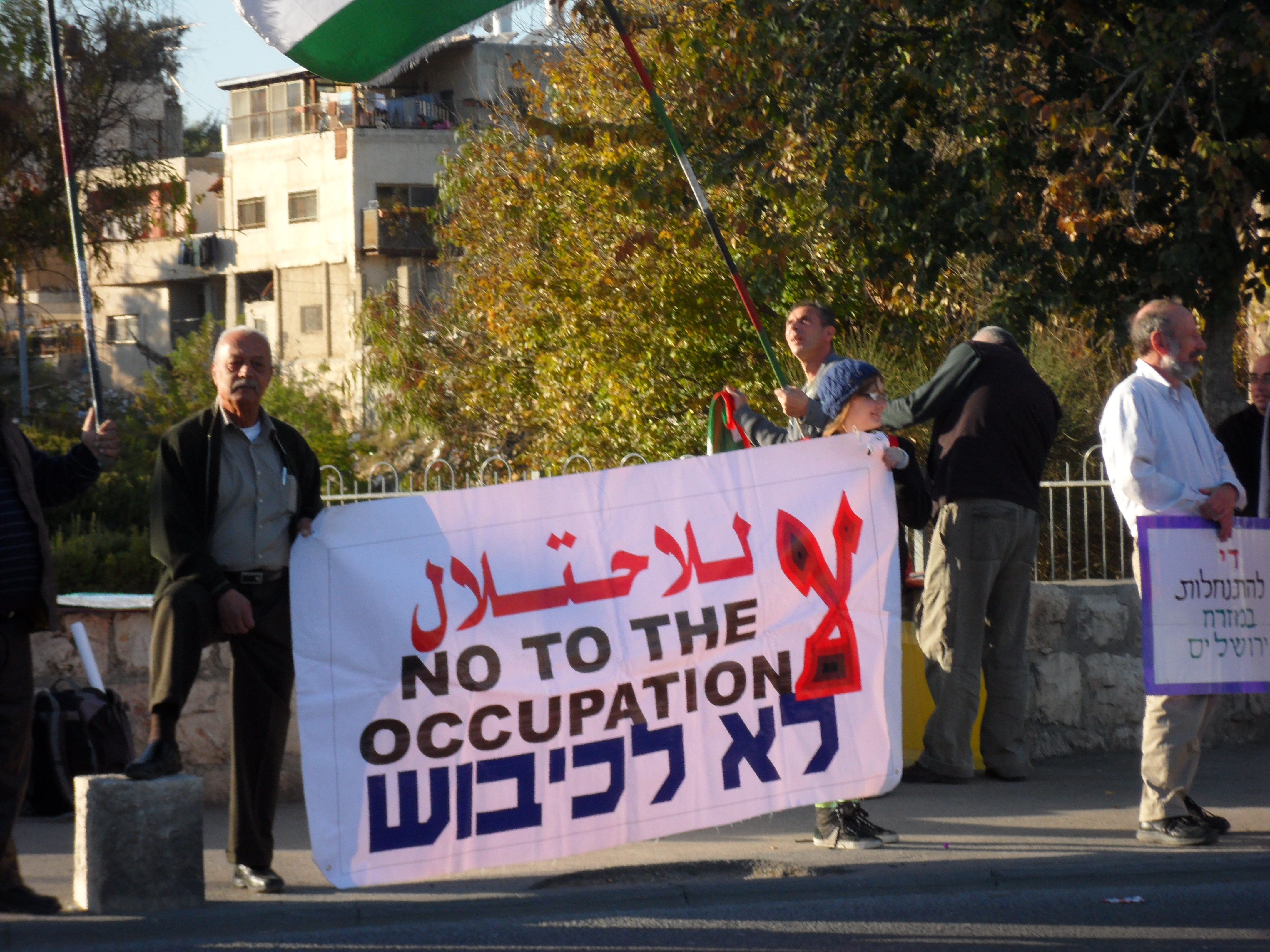
Sheikh Jarrah vigil, November 30. 2012

10.5.2013 No to another eviction from Sheikh Jarrah (Guy Butavia)
If there were peace, there would be no need for peace activists to demonstrate against the desire of some Israeli Jews to live in a particular neighbourhood of Jerusalem. But if there were peace, the Shamasneh family would not be facing eviction from its home in the East Jerusalem area of Sheikh Jarrah to make room for Jewish families. If there were peace, Palestinians could live where they liked in Jerusalem too, including in their former homes in the neighbourhoods of Baka, Talbiyeh, the Katamonim, from which they were driven by Israeli conquest in 1948. According to the structural injustice of Israeli law, specifically the Absentees’ Property Law (1950), former Palestinian owners of homes in West Jerusalem, now refugees, have no rights to their property. Yet, Jewish owners do have rights to their land in East Jerusalem that came under control of the Jordanian Custodian for Enemy Properties after 1948, which used the land to settle Palestinian refugees. Following the 1967 war the land and homes built on it were taken over by the Israeli General Custodian. Although Israeli law does grant protected tenancy to Palestinians who had rental agreements prior to 1968, the Shamasne family have been unable to prove to the satisfaction of the Jerusalem magistrates court that they have such status. Their case comes before the Israeli High Court on May 20th 2013, which explains why there was a demonstration last Friday (May 10th 2013) to raise awareness about the impending eviction.
This is not an isolated incident, but part of an ongoing campaign to ‘Judaize’ East Jerusalem, to erase the Palestinian presence there and to deny its status as a key Palestinian city, if not its capital. The State of Israel annexed Arab East Jerusalem in the wake of the 1967 war, then began a massive programme building twelve suburbs there such as Pisgat Ze’ev, Gilo, and most recently Har Homa, in which about 190,000 Israelis now live. Again, there is nothing in itself wrong with the housing developments in Jerusalem, but as neither the national or local Israeli government enabled or permitted development of the Palestinian areas of Jerusalem, such building must be understood as part of a process to privilege Jewish sovereignty over the city. The building projects are concrete, financial and bureaucratic aspects of the ethnocentric superiority that was evident in last week’s Jerusalem Day parade, an annual event that marks the ‘liberation’ of East Jerusalem through Israeli conquest in 1967. For the right-wing, religious march to proceed, Palestinian and Israeli leftist had to be cleared by police from the Damascus Gate entrance into the Old City of Jerusalem.
Another way that Israeli government obstructs Palestinian development in East Jerusalem is to declare as yet undeveloped areas to be parks that may not be built on, as is the case of the Slopes of Mt. Scopus National Park that hems in the villages of Issawiya and A-Tur. Even more destructive is the building of large roads through Palestinian areas, notably the evisceration of Beit Safafa and Beit Hanina as reported recently by Nir Hasson in Ha’aretz. Yet, the most contentious of the steps to ‘Judaize’ Jerusalem are the small settlement compounds in Palestinian neighbourhods, in which some 2,300 Jews now live, such as the Muslim Quarter of the Old City, Silwan, and since 2008, Sheikh Jarrah.
The Israeli peace camp had consistently joined in solidarity with Palestinians to protest these inflammatory settlements, which are maintained only by a massive and intrusive security presence. But the attempt to move into Sheikh Jarrah provoked not merely a few demonstrations but a sustained campaign of determined resistance to threats of evictions, settler violence, and police partisanship, Sheikh Jarrah Solidarity. As this video chronicle shows, the efforts of the police to suppress the legal demonstrations with arrests backfired, encouraging more mainstream participants, such as the Israeli author David Grossman, to join in the growing events. Eventually, the police backed off after being reprimanded by the courts for some of the arrests they made and their infringements of the rights of protestors. The campaign did lose some steam, as some activists burnt out and others shifted their attention to other hotspots in Jerusalem or elsewhere. But the campaign did not die, maintaining a weekly vigil in Sheikh Jarrah, one of which I participated in on November 30th, 2012. That day, two or three score Jewish Israelis and Palestinians stood by the roadside, holding banners with slogans such as ‘No to Occupation’ and ‘End the Settlement in East Jerusalem, along with Palestinian flags, accompanied by a steady drum beat. There were no police present (though some did pass occasionally), and most of the passing traffic was supportive, often honking horns. Ultra-orthodox Jewish men seemed unafraid to walk alone or in pairs to and from the Tomb of Shimon the Righteous that is in the neighbourhood. As an event, it was unremarkable, but the vigil was less a spectacle than a meeting or networking site. Some guys remained in a huddle near a low wall, discussing their upcoming court cases ensuing from earlier incidents in which they had been arrested. Some of the conversation going on was about a local committee being established to represent all of the residents and business owners in the neighbourhood. These were the conversations that create and sustain solidarity.
In other respects, the single event itself was very similar to demonstrations against East Jerusalem settlements I had attended some twenty years previously – the same slogans were held up, and even some of the same faces were there. It is the nurturing of solidarity between Israelis and Palestinians that is different. This ongoing campaign not only says ‘no to occupation’, but also ‘yes’ to ‘partnership between Arabs and Jews, Palestinians and Israelis’, yes to ‘an alternative to the hatred and suspicion, which are imprisoning us all behind walls’. Essential to such solidarity is recognition that Palestinian ‘refugees from 1948 have been expelled from their homes in 2010 and turned into refugees for a second time’, and thus that the just political arrangement that the settlement tries to block must take into account not only what happened in 1967, but also in 1948. And this is not only solidarity of Israelis with Palestinians, but a mutual solidarity, in which the struggle to overcome discriminatory land laws and arbitrary police suppression of demonstrations is a struggle to realize democracy and equality. The peace of Jerusalem is not a matter of which people hold rights to which pieces of it; it is in the fabric of the patient solidarity that stands consistently, weaving relationships of justice and equality between those for whom the Shamasne family matters.
 Picturing Peace