Tag Archives: Israeli peace activism

Refusal

Here is another extract from an autobiographical book I am writing about how my life has crossed paths with Israel-Palestine. In this passage I recount my refusal to serve in the in the Israeli army in the Palestinian Occupied Territories in 1995.

Having remained a temporary resident in Israel for as long as I could, I had delayed my compulsory service. By the time I became a citizen I was only required to serve three months, but I had postponed even that duty by going away for a year for my postdoctorate. In 1994 the army caught up with me again and I was due to serve in early 1995. It was already very clear in my mind that I would refuse to serve in the Occupied Territories, which would mean spending some time in military jail. There was no way I was going to become the military occupier of my Palestinian dialogue partners. I knew people who had been through the experience, especially Lev Grinberg, who had refused to serve in Lebanon, and Ofer Cassif, the first reservist to refuse to serve in the Occupied Territories during the intifada. Lev also put me in touch with other members of Yesh Gvul so I could hear from others, including one person who had become fairly well-known because the army insisted on calling him up again as soon as he was released, meaning he was given repeated sentences of imprisonment. I also read accounts by a couple of refuseniks who had been jailed. Having put off my service so long, I was already classed as a reservist, so I knew I would be locked up with other reservists, mostly people who had tried to evade service, not facing the scarier prospect of jail for regular recruits. It was, nonetheless, a worrying scenario, so I did not know how I would cope. Even up until the day I reported for duty at the local recruitment office in Jerusalem, I was trying to get through to an intelligence officer whose number I had been given by a university colleague who thought I might find an option there.

The evening before I had to report for duty I took quiet time to reflect on what I was about to do, turning to the pages of my book about Foucault for passages to strengthen my resolve:

Foreswear the dream of a perfect world in which all has been done and all is safe, but cherish the agonism of open strategic games in which everything remains to be done. Love your liberty, which you have when you can act and do so. Take care of yourself; know ‘yourself’ by transgressing your limits; practise liberty.[1]

It made sense to me at the time, realising I was the intended audience for my own book. Refusal would be the practice of my liberty, an option for action available to me. By refusing, I was transgressing the limits of the Zionist subject as which I had been constituted by my background and participation in Habonim-Dror, a Zionist youth movement. I would become a different self.

My brother came to the recruitment centre to see me off as I got onto a bus to the main recruitment camp, Bakum, the reception and sorting base in the centre of the country. The first stage was some form-filling, where I hesitated about refusing to sign some sort of declaration about agreeing to follow orders. I spent the rest of the day avoiding being recruited by any of the units looking for reliable new members – medics, military engineers, home front – by telling them I intended to find work abroad. At the end of the day I found myself with a large crowd of Russian-speakers, fed, given blankets and sent to sleep in tents. I did not sleep well, both because I had underestimated how cold it would be and because I was anxious about what faced me the next day. I was awake very early, found some hot water and took a shower before anyone else was awake.

We were organised into groups to walk down to the car park where buses were waiting, though we did not know where they were headed. I told the corporal in charge of my group that I would not get onto a bus going to the Occupied Territories. He told me not to worry, just to walk down with everyone else. When we got there, I saw a sign on the bus reading Bahad 4, a base which I knew was close to Ramallah and the settlement of Beit El. So, I refused to get on the bus. Over the next hour, I was variously cajoled and yelled at in an effort to get me on the bus. Someone told me that he worked on the base and also hated the settlers, but I did not need to have anything to do with them. Another person tried to make me afraid of what would happen to me in jail, telling me I would be made another prisoner’s bitch. An officer from the base grabbed my backpack and went to put it on the bus, which was distressing as I had borrowed it from my roommate. We tussled over the backpack and at one point I realised that if I let go, the officer would fall backwards, so I held on as I did not want to annoy him any further.

Eventually, another officer approached me, spoke to me gently, explained that he was in charge of the whole recruitment process that day, that if I refused to get on the bus I would be sent to jail, but then added that if I had any problems I wanted to discuss with him, he would be available in the next ten minutes. After a poor night’s sleep the penny was slow to drop, but I realised I was being offered a way out, so I repeated the story about looking for work abroad. I barely finished the sentence when he told me to join a small group of other new recruits waiting at the side. It turned out that there were about dozen more of us than places on the training programmes, so we were to serve on the sorting base for the week, which meant that those of us who could get home and back for an early morning start were free to go. I had woken up in the morning expecting to be in jail that evening and instead was back home in Jerusalem.

At the end of the week I spent on the base I met the officer from the parking lot again. He was intelligent and calm, interested in studying Political Science at university and curious about that. We chatted about the prospects for peace and the likelihood that Bahad 4 and other training bases would be withdrawn from the West Bank. Bahad 4 was indeed later moved from near Ramallah to Zikim, near Ashkelon, under the terms of Oslo II, the Interim Agreement on the West Bank and Gaza, signed in September 1995. I fed him my narrative about needing time to look for work overseas at that time of the year, which he accepted as grounds not to serve my three months then. He asked me to agree that if he gave me a deferment until a date in July, I would agree to go wherever I was sent, but did not ask me to sign anything. I did have the opportunity both in the parking lot and in his office to be adamant about my refusal to serve in the Occupied Territories and be sent to jail. Yet, it was also true that I was looking for a job overseas and that I was not being ordered to serve in the Territories at that point. I had no desire to be a hero, to go to jail when I did not need to in order to avoid becoming a military occupier. So, I was part of the ‘grey refusal,’ the undocumented cases of recruits and reservists who found a way to be selective conscientious objectors, unwilling to serve in the army of occupation in the Territories.


[1] Jon Simons, Foucault and the Political (London: Routledge, 1995), pp. 124-25.

The last light of Hanukkah

As a child I loved to watch as the Hanukkah candles burned down, guessing which would be the last one to give up its flame. Not having had any of my own children, I remain that child. This year the extinction of the last candles on the eighth evening of Hanukkah seemed especially poignant. The light gone, the darkness smothering all hope. More than 20,000 Palestinians and Israelis have been killed since October 7th, mostly civilians. Who knows how many more Palestinians lie under the rubble. There are still about 130 Israeli hostages somewhere in Gaza, imperilled by the bombardments and assaults of the military forces that are supposed to defend them as well as by their captors. More then 3,000 Palestinians from the West Bank and Gaza have been imprisoned by Israel since October 7th, subject to military courts, administrative detention and abusive and lethal conditions. The injured in Gaza are denied the medical resources for their recovery by an unrelenting invading army. Countless others, as many as 80% of the population, are homeless, the descendants of refugees displaced from their homes, finding no shelter in tents on flooded ground, increasingly vulnerable to hunger and disease. The returned hostages confront their trauma. There is so much trauma, so many bereaved, so many maimed, so much ruin. So little hope.

A boy lights a Hanukkah candle as relatives and friends of hostages held in the Gaza Strip by Hamas call for their release, on the first night of Hanukkah, in the Hostages Square at the Museum of Art in Tel Aviv, December 7, 2023. (AP/Ariel Schalit)

By chance, it was the candle to the furthest on the left that obstinately kept burning the longest. It is the obstinacy of the Left that gives me some hope. I do not mean the ideological Left of the UK, where I live, the adherents of various forms of political Marxism. The most influential of those, the Socialist Worker’s Party, issued a statement including this clause:

Too many on the liberal and reformist left have been quick follow their governments in condemning Hamas and affirming Israel’s right to self-defence. The flood of media atrocity stories has obscured what actually happened on 7 October. But when oppressor and oppressed clash there can be no neutrality or equivalence. We support the right of self-determination of the Palestinian people and their right to wage armed struggle against the Israeli settler colonial state.

1

Hamas atrocities, according to the SWP, are legitimate anti-colonial armed struggle and its Islamist ideology somehow enables the SWP’s goal of of a secular, democratic state in all of Israel and the Occupied Territories. I’m happy to be liberal and reformist if that’s the cost of remaining ethical. But the SWP sound moderate in comparison to the Revolutionary Communist Group whose statement on the horrors of October 7th begins with:

Early on the morning of 7 October an audacious and unprecedented military action by Palestinian Resistance forces, Operation Al-Aqsa Flood, was launched from Gaza into the occupied territory of the Israeli state. The Revolutionary Communist Group (RCG) and our Fight Racism! Fight Imperialism! (FRFI) Supporter Groups extend our unconditional support to the Palestinians in their struggle to liberate themselves from illegal occupation by any means necessary.2

By any means necessary on this account includes rape and torture as well as murder and hostage taking of civilians. Unable to grasp that even Marxist dialectics cannot make two wrongs a right, this branch of the ideological Left sees a valid path to Palestinian liberation that, contrary to Palestinian journalist Rajaa Natour‘s brave statement, “include[s] a speeding jeep in the streets of Gaza with a half-naked Jewish woman strapped to its front.”

I am also not speaking of the less ideological left in the UK, the progressive left who have been moved by the horrific scenes of Israel’s assault on Gaza to join the massive demonstrations of solidarity with Palestine, organised by the Palestine Solidarity Campaign. Protests of that size attract people and organisations of a broad range of opinions, including the ideological Left. It would be hard to disagree with the PSC’s announcement before their first major protest on October 14th that:

Every humanitarian will be appalled and horrified, as we are, at the scenes we are witnessing of a severe escalation of violence since October 7th… International law makes it clear that the deliberate killing of civilians, hostage-taking and collective punishment are war crimes. Such crimes must be condemned no matter who perpetrates them.3 

Yet, less than a week after October 7th, the PSC was unable to name some of the perpetrators of those crimes as Palestinians, or some of the victims as Israelis. The day after the PSC’s first march, in my home town as well as London, I wrote on my Facebook page :

Yesterday I couldn’t bring myself to join in the protest organised by the Palestinian Solidarity Campaign, even though it has never been more urgent and vital to demonstrate solidarity with Palestinians. … For the most part, I can join in the chant of “From the river to the sea, Palestine will be free” as a call to end occupation and apartheid, for Palestinian independence. But I cannot shout it when I think that even one other person also shouting it sees a way to freedom through the brutal massacre of civilians.

There has been a left, anti- and non-Zionist Jewish bloc on the PSC rallies in London, including an organisation in which I’m still active, Na’amod. I went on one myself in Nottingham, on a week in which I felt the need to call for a ceasefire outweighed my desire to feel comfortable at a protest. I did not join in the chants of “From the River,” only the calls for a ceasefire. During the march I stayed close the drummers from the environmental group I’m active in, Extinction Rebellion, glad to be close to familiar people as I carried a sign with Na’amod’s logo, marking me out as Jewish and calling for the release of the hostages as well as a ceasefire.

Like many progressive organisations, Extinction Rebellion is pro-Palestinian by default. Its statement about the war claims that “The climate and ecological emergency has roots in centuries of colonial violence, exploitation and oppression – for which the UK bears a disproportionate share of responsibility.” In a over-simplification, Israel – often regarded as a colonial-settler state – becomes a root cause of the climate crisis. The statement about the war, which otherwise is generally thoughtful, ends with the phrase: “Only a just peace can secure a liveable future.”

But one sentence upset me because of a small omission. “We are horrified by the atrocities committed on October 7th, and the rapidly escalating violence and humanitarian crisis inflicted on the people of Gaza.” Why, I wondered, could it not say that atrocities had been committed against Israelis, against Jews? In a message to XR’s press team asking if the omission could be corrected, I wrote that “One of my reactions was ‘it doesn’t matter, don’t make trouble’ but that is a learned reaction from a long history of oppression, and it doesn’t help others to unlearn their oppressive behaviours to keep quiet about it.” I never got further than a response that it had taken a long time to arrive at this agreed statement after consultation with unnamed stakeholders, so the statement could not be changed. That was disappointing.  

I was happier to join a silent vigil organised locally under the umbrella of UK Friends of Standing Together, held on November 19th, mourning all the victims and calling for a ceasefire and release of the hostages. I helped organise a second vigil by the group on December 10th, adapting a script from an earlier vigil held by Na’amod. On both occasions fellow activists from Nottingham XR were there too. The slogans on the banners were written to suit the Standing Together movement. These events felt very different to the marches and rallies organised by the ideological or progressive UK left, though one of the ideological left groups, Workers’ Liberty, has led this initiative. The vigils had something of the spirit of a Left that does give me hope, the Israeli Left that is also an Israeli-Palestinian Left.

Nottingham Peace Vigil 10th December 2023

It is something of a Hanukkah miracle the Israel’s Left is still burning obstinately as the country moves ever further to the Right. Since the start of the war, its opponents have faced a police and judicial crackdown, having to fight for the right to protest and hold political meetings. Protests during wartime have been a feature of Israeli politics since the disastrous 1982 Lebanon War, a disaster which look set to be repeated with Gaza. This Left has issued a Jewish-Arab peace declaration condemning the atrocities by both Hamas and Israeli forces. It repeats the truths we should all have learned long ago:

there is no military solution to this conflict, nor can there ever be one. The only way to stop the bloodshed is a political agreement that will guarantee security, justice and freedom for both nations. There are no winners in war. Only peace will bring security.

The obstinate flame, the obstinate Left, the obstinate hope.

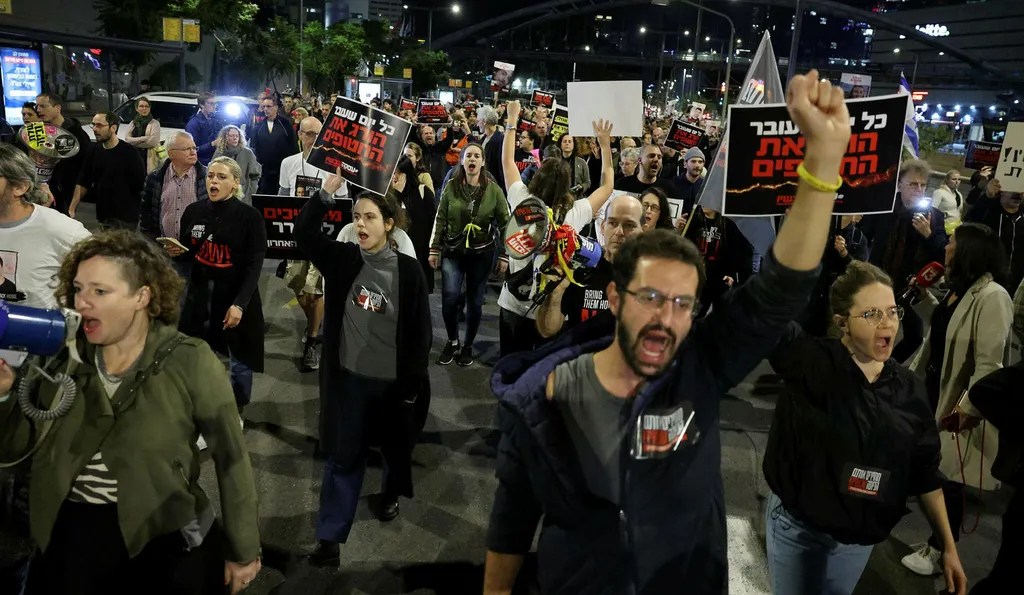
Protestors for hostage release in Tel Aviv 15.12.2023. Photo: Tomer Appelbaum

  1. IST statement on the new war in the Middle East ↩︎
  2. RCG statement on the military action of the Palestinian Resistance ↩︎
  3. Press Release: March for Palestine ↩︎