The phrase “antisemitism is the socialism of fools,” was widely used by German social democrats in the 1890s. The aphorism means that Jews are scapegoated for the social evils of capitalism. Antisemites hold to a distorted, foolish, irrational form of anti-capitalism that identifies Jewish people as the sole or primary cause of societal and economic evils and overlook those evils perpetrated by gentiles. They attribute to Jews immense, demonic, global power, especially financial power, deployed conspiratorially. The irrationalism of the unconscious operates as in dreams, by displacing, condensing and symbolizing the structural power of capital and class domination onto and as Jews, as well as antisemitism as class struggle. The irrationalism of antisemitism is at the same consciously elaborated into a seemingly logical and causative account of society and history in “a view of the world based on myths and fantasies.” “Antisemitism … offers conspiracy theories in place of political analysis, and bigoted scapegoating rather than political solutions,” says Ben White, who has been accused of antisemitism himself by the Anti-Defamation League. Obviously, the genocide of the entire Jewish people would not eliminate capitalism any more than the Holocaust undermined it. The “socialism of fools” instead contributed to the enormous social evil of the Holocaust.
Condemnation of the State of Israel and its practice of Zionism as Jewish supremacy, particularly its vengeful, genocidal onslaught on Gaza following the Hamas atrocities of October 7th 2023, is justified, as is solidarity with the Palestinian cause. Yet, some of that condemnation from the pro-Palestine movement is antisemitic. It becomes “the anti-colonialism of fools,” scapegoating Israel’s and Zionism’s settler colonialism, while tending to overlook the responsibility of Western (and other) colonialism and imperialism, in the present as well as the past, for the evils happening in the Middle East and beyond. As I live in the UK and mix in British leftist circles in my home city of Nottingham, the wonderful city of rebels, I will focus on this “anticolonialism of fools” as I have experienced it, although as a retired academic I also feel compelled to delve into some of the vast literature about antisemitism on the Left in the future.
What have I experienced? Recently I went to hear veteran environmental campaigner Jonathon Porritt speak to promote his new book, Love, Anger and Betrayal: Just Stop Oil’s Young Campaigners at the Friends’ Meeting House, an event organised by Nottingham’s excellent independent bookshop Five Leaves in conjunction with the local branch of Extinction Rebellion in which I am active. Porritt had less to say about the book and Just Stop Oilthan he did about more recent protests. He and hundreds of others have been arrested, under the umbrella of Defend Our Juries, for defying the UK government’s draconian and somewhat hysterical banning of Palestine Action as a terrorist organisation. At one point, he added that not only other governments but also the UK government is corrupt – for taking money from Israel that explains its complicity in Israel’s genocide.
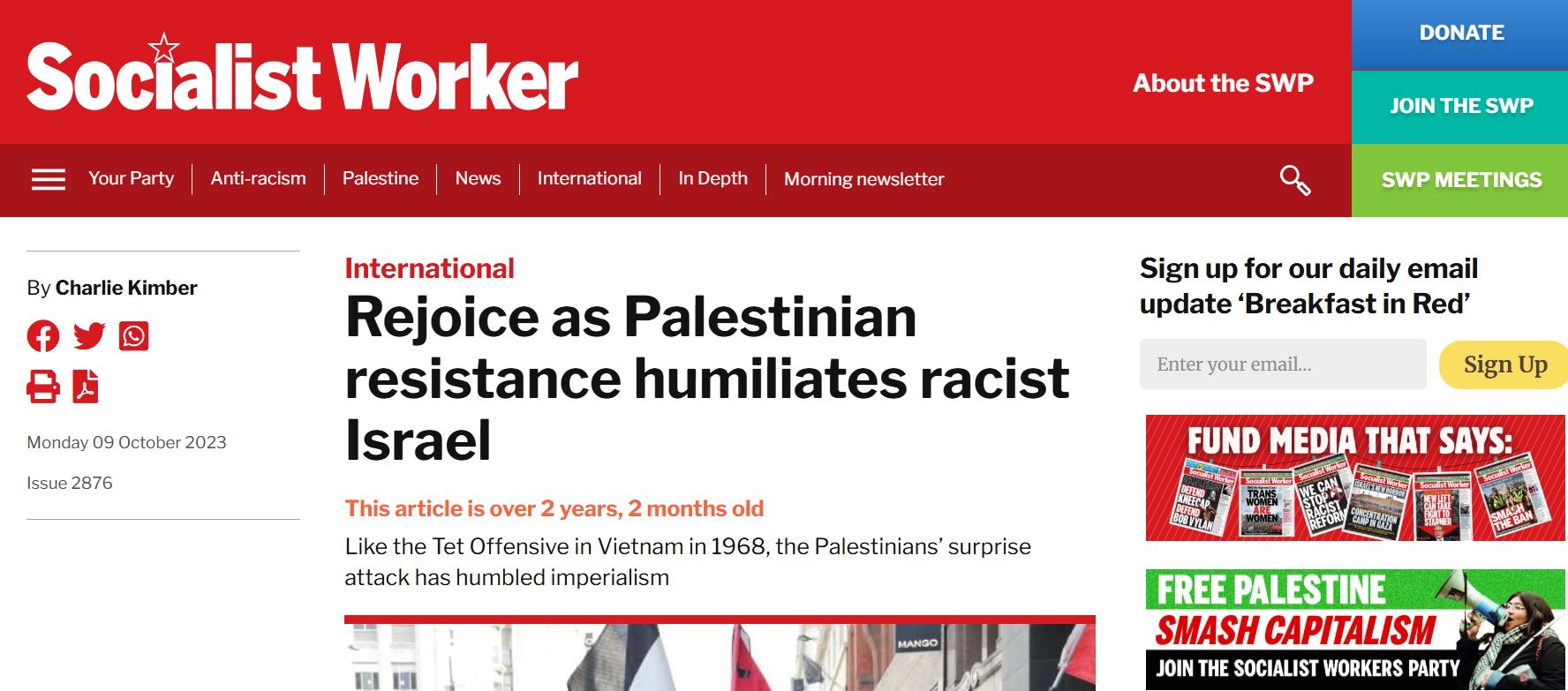
I was already primed to take especial note of this particular point – that the British government’s policy has been set and corrupted by Israeli money – because of an exchange I was having online with someone from an anti-racist activist network. I had questioned why he had ended a thread which began about Reform and Russian foreign influence operation with an off-hand comment about this Labour government not doing anything about political donations from foreign donors because their pockets are full of Israeli cash. Why, I asked, did he mention only Israeli cash? Was it only this cash that determined government inaction on this issue? I pointed out the racist connotations of ascribing Israel’s influence to money. Fortunately, that exchange ended well, with agreement that it was wrong to single out Israeli funding in that context. On another occasion I was staffing a stall of Nottingham Friends of Standing Together at a Muslim cultural festival where our request to people to sign a letter demanding action about Gaza to their MPs was generally well-received. But one person told me it would not help because Keir Starmer’s wife is Jewish. I told him I am Jewish too and asked him if he thought the reason he gave for the UK’s policy in the Middle East was the issue or whether it had more to do with the history of British imperialism and colonialism. He responded that the British were responsible for the destruction of Muslim civilization in the Middle East and left without signing the letter. I hope he thought a little more about the issue later. Finally, it is hard to pass over the infamous headline on October 9th 2023 of the newspaper of the Socialist Worker’s Party, “Rejoice as Palestinian resistance humiliates racist Israel” and the subheading “Like the Tet Offensive in Vietnam in 1968, the Palestinians’ surprise attack has humbled imperialism.”
Why are these examples of antisemitism as the anti-colonialism of fools? Not because any of these people are fools but because they foolishly (irrationally and perniciously) mistake the underlying motivations for British policy. They foolishly attribute the UK government’s unwillingness to halt all arms sales to Israel and to fulfil its obligations under international law to prevent the genocide in Gaza to the power of the Zionist or Israel lobby. Since the fiasco of Suez in 1956 the UK is no longer a leading imperial power in the Middle East, but it has hitched its wagon to the US which still regards Israel as an enormous strategic asset for sustaining Western hegemony in the region. As eminent Palestinian historian Rashid Khalidi said in an interview with Ha’aretz in November 2024, Palestine does not perform any US interests. Britain does not fail to sanction Israeli war crimes because its politics have been corrupted by Israel but because it still perceives its interests imperialistically as a junior partner to the US. As a different piece in Socialist Worker put it: “To say that an Israeli lobby is in control of what Western governments do or say is to get things the wrong way around … It’s more accurate to say that Israel is used as an important part of the West’s wider imperialist project.” The same piece argues that imagining that “an “Israeli Lobby” is controlling and influencing Western leaders to do its bidding … can echo antisemitic tropes about how a small number of Jews secretly control everything from the media to politics.” Not “can” but “does”. When the reasons given for Israel’s success in directing British policy rely on antisemitic tropes of money, media control and secretive power or influence, we know we have gone down a nasty old racist rabbit hole. When the conspiratorial, malevolent power of the Jews is displaced onto Zionists, we are still within the classic structure of antisemitism.
A key consequence of this antisemitic foolishness is “magical thinking” about how to end or moderate the British state’s support of the Israeli state. If the reason for that support is mistaken as the £300,000 or so donated to 13 out of Labour’s 25 cabinet members from pro-Israel sources since they were first elected to parliament (Yvette Cooper was elected in 1997), it could be fantasized that all is needed is to stop that funding or raise matching funding. Both historically and in the present, the biggest donors to the Labour Party have been trades unions, from which the party has received £147,389,234.81 since 2010, and they might have a thing or two to say about how big a bang they get for their buck. Or perhaps the argument is that it is not that pro-Israel funding is relatively high but that it takes a particularly influential form, by paying for MPs and political advisers to take trips to Israel. A BBC report in 2018 showed that although Israel was not in the top ten funders of free overseas trips for MPs over the previous two years, Israel-Palestine (including occupied territories) was the top destination, with nearly double the second most frequent destination, the USA. Yet, a report in which a political adviser on one of the trips was interviewed showed that the guests were well aware of the “clear and obvious [pro-Israel] agenda,” adding that “We were all sitting there thinking ‘what the fuck?’.” Again, Zionist money does not have magical powers to change the minds of people unsympathetic to Israel’s actions. British allyship with the US and Israel is historical and systemic, not a result of the weak-mindedness of politicians who have gone on “fact-finding” freebies to Israel. It will take a paradigm shift in British international policy to change it. Perhaps that might be happening because of a Trumpist realignment of US foreign policy and reassessment of what is in US interests, but a paradigm shift is not a fickle change of mind.
Antisemitism is also at work when Israel and Zionism are conceived as settler-colonialism for which a form of decolonisation is required that is not required in other cases, namely the departure of some or all of the Zionist settlers from a future Palestine established from the Jordan River to the Mediterranean Sea. I spent about a month in a pro-Palestinian online forum in Nottingham (at the invitation of its initiator) in which many participants called for the “complete decolonization” of Palestine. When pressed on what this meant for the seven million or so Jewish Israelis I was told that all those serving in the military (including reservists) and the roughly 10% of the population with dual citizenship should go, but children and Jews who unlearn Zionism and chant “from the river to the sea, Palestine will be free” could stay. I responded that this formula involved an unthought through “political selection” that did not account for most of today’s Israeli Jews having grown up in Israel. I argued that the injustice of the Nakba cannot be addressed by creating another injustice of uprooting other people, mostly Jews, from their place of birth or refuge. I did not point out that “complete decolonization” bears a disturbing resemblance to the expulsion of Jews from Spain unless they converted to Christianity, except this time Israeli Jews would have to renounce their right to self-determination as a people rather than their religion. As has been said about the banning of Jewish authors from publishing in the British feminist publication Spare Rib unless they espoused anti-Zionist views, the “demand that Jews uphold a specific, deemed ‘correct’, position because they are Jews … is antisemitic.”
Criticising Zionism as settler colonialism, however, is neither antisemitic nor inaccurate, though it is open to question. But Zionism is not only or simply settler colonialism, as Rashid Khalidi points out in a post-October 7 interview with Ha’aretz that discusses in part his book The Hundred Years’ War on Palestine:
Zionism began as a national project, and then it found a patron and used the means of settler colonialism. That is unique. None of the other projects began as a national project. The settler-colonialism paradigm is useful only up to a certain point, and Israel is the most unique case one can imagine: without a mother country, with almost the entire population arriving as a result of persecution, and with the connection to the Holy Land. The Bible, for God’s sake.
It makes the Palestinian anti-colonial struggle the most difficult of those struggles because the colonisers cannot go home and they frame every attack on them within their hereditary fear of persecution. The British brought their expertise in repressing anti-colonial movements in Ireland, India, Sudan and elsewhere, and the Zionists learned from them all too well, especially Orde Wingate (whose character features in the recent film Palestine 1936). Although without much optimism, Khalidi hopes that the Palestinian anti-colonial struggle will end neither with the annihilation of one people by the other, nor with expulsion of one people by the other, but when Israel accepts that it must exist in complete equality with Palestinians. Decolonisation as equalisation, not elimination.
Antisemitic foolishness also takes the form of thoughtlessness about settler colonialism in the comparative mode indicated by Khalidi and more especially in thoughtlessness about the persecution of the Jews who settled in what became the State of Israel and their descendants. In contrast to that thoughtlessness, in that same online forum, someone thoughtfully pointed out that without European antisemitism and fascism, Zionism would have remained a fringe movement among Jews. (I should point out that another person in the forum also immediately took down a post after I told him was from an antisemitic site). That takes some thinking about, because even when Zionism is viewed as an example of racist European settler colonialism it is or was also a collective movement of the victims of European racism. As Steve Cohen explained forty years ago, “Zionism was an attempted liberation struggle by the Jewish people … to free themselves from the noose of antisemitism.” More recently, Cohen reformulated his position as being “an anti-Zionist Zionist,” because “Zionism is racist and anti-racist,” racist towards Palestinians but anti-racist towards Jews.
The Palestinian cause has rightly captured the attention of progressives around the world and in the UK. No anti-racist rally in support of asylum seekers, no climate protest against the insurers of fossil fuel extractors and arms suppliers, no silent sit-in against draconian anti-protest legislation is complete without some Palestinian flags and chants of “Free Palestine.” “Globalize the intifada” is taken by those who have adopted it to mean not only global support for the Palestinian struggle against occupation but also global resistance to all colonialism, oppression and capitalism. However, there is a difference between Palestine becoming a nodal point for global social justice movements, a point which articulates them together and enables all demands to be heard, and it becoming the vehicle through which all those movements can be fulfilled. For example, when Socialist Worker displays a graphic in the colours of the Palestinian flag that says “Free Palestine, Smash Capitalism” the impression is given that by doing the former, the latter is achieved. It is not. That is only possible if only one case of settler colonialism is at the root not only of all the other cases, from the USA to Argentina and Tibet, but also of all the social injustices and oppressions in the world, including class domination. We are back to the displacement and condensation of the “socialism of fools,” blaming all social evils on a single cause, for which one set of people, Jews, are collectively responsible.
The ideology at work here is not Marxism-Leninism or anticolonialism. It is the mythology of antisemitism, according to which shadowy, conspiratorial Jewish power, in the form of Zionism, dominates the world and determines history. It sounds ridiculous when it is spelled out as starkly as that – because it is. Antisemitism is always irrational. Instead of forging a global, progressive alliance of articulated struggles for social justice into an unstoppable force to change human destiny, an alliance in which Palestine is a nodal point, it is enough in the anticolonialism of fools to scapegoat Zionism as the demonic force behind all injustice. We are back then, to the Soviet, Stalinist form of antisemitism which dressed itself up as socialist anti-imperialism, a socialism of deadly fools, according to which the USA is not in its own right a genocidal settler colony but a “Zionist colony”. As Cohen remarked, it is Zionism “expanded to equate it with world domination,” Zionism “as a form of world domination that is on even higher level than imperialism itself.” And again a couple of decades ago he wrote: “The equation of Zionism with world domination … is the anti-Zionism of fools.”

Today’s foolish antizionists on the Left might seem to have an easy retort to this account, because they do not equate Zionism or Israel with Jews. They eagerly embrace anti-Zionist Jews such as Jewish Voice for Liberation (previously Labour) and ultra-orthodox antizionist Jews of the Satmar sect in the UK, as well as antizionist Israeli Jews, while pointing out that the majority of Zionists globally are Christians, about 30 million of them in the USA. They are aware that it is antisemitic to hold all Jews responsible for the actions of the Israeli government. So, are claims – which employ antisemitic tropes that there is a pro-Israel lobby with undue and underhand influence on British (and world) politics and media – kosher because they are not “prejudice, hostility or hatred against Jews as Jews” but as Zionists, whether British or Israeli? Cohen argues that antisemitism on the Left “is a combination of the conspiracy theory with … collective guilt.” If the guilt is laid at the door of Zionists but not Jews as Jews, is it maybe only half antisemitic? Given that two thirds of UK Jews still identify as Zionists, there is clearly something askew. What is askew is that while most of those Jews ignore the oppressive impact of their chosen remedy for antisemitism (Zionism) on Palestinians, the antisemitic perversion of antizionism ignores antisemitism, the oppression of the Jews, as a key factor in Jewish support for Zionism. And the foolish, antisemitic perversion of that anticolonialism variously expects Jews to convert to their perversion (thereby disavowing their own oppression) in order to be saved (assimilated into the global movement for social justice); or blames Zionism and Israel for antisemitism (which long preceded the emergence of Zionism).
Sometimes the antizionism of fools (antisemitism presented as antizionism) is explained as unacknowledged gentile guilt about not having done enough to counter antisemitism, to defeat barriers to immigration to the UK by Jews fleeing Russian, Eastern European and then Nazi persecution. Given the extent of antisemitism within English socialism in its formative years, including opposition to Jewish immigration, that is to be expected. Also unacknowledged is guilt for British imperialism’s historic contribution to the ongoing disaster of Israel-Palestine (and the surrounding region). How much easier to blame all that on Zionism and Israel, acting as a shadowy influence responsible for Britain’s continuing commitment to Western hegemony in the Middle East. How much harder to take full cognisance of how entrenched British foreign policy is and accept national responsibility for at least some of the conditions that have led to Israel’s genocidal war on Gaza. It is speculative to argue that collective postcolonial guilt is at work, but for me it answers why this anticolonialism of fools, or antisemitism masquerading as antizionism, has some appeal in the anti-racist Left.
There is much I have not written about in this essay, such as the toxic context of any discussion about antisemitism in the Left at any time, but especially after the bitterness of the factional struggles within and around the Labour Party in and since the Corbyn years. I have also not written about the cynical strategy of increasingly right-wing Israeli governments, and their supporters in the UK and abroad, of decrying almost all criticism of Israel and Zionism as antisemitic, which has done much to cloud the issue as well as delegitimating advocacy for Palestinian freedom. I have not addressed whether the alliance between the Left and Muslim organisations has impacted antisemitism on the Left, just as I have not explored the extent to which simultaneous increases in antisemitism and Islamophobia are connected. There is also a strong current of dichotomizing feeling, whereby one can only be “pro-Palestinian” and antizionist (good) or “pro-Israel” and Zionist (bad), as if it is wrong or impossible “to be heartbroken for more than one group of people at the same time.” There will be those, among them authors of works about antisemitism and antizionism on the Left who will wonder why it has taken me so long to grasp what they understood long ago. When will I also get that it is also antisemitic to malign Israel as a tool of Western hegemony in the Middle East and when I will take the next step and dismiss the ideological left as inherently antisemitic? I do not believe the latter to be the case and have experience of individuals being thoughtful about the relation between Zionism and antisemitism, fessing up to mistakes and acknowledging when they have posted something antisemitic. I am also appalled when, reacting against perceived antisemitism on the Left, both Jewish Israelis and UK Jews have buddied up with the British far-right, which remains inherently, deeply and dangerously antisemitic.
I expect there will be those who say I have not gone far enough in the other direction, calling me a liberal Zionist using antisemitism as an excuse to undermine the anticolonial Left. Indeed, I left that pro-Palestinian online forum when I was told I could either be Zionist or anti-Zionist, it was that simple. It is not, unless antisemitism is not on the agenda. I consider myself as a non-Zionist rather than anti-Zionist because even if I think Zionism is a failed liberation struggle against antisemitism, I cannot be certain what form a successful struggle against it will take. As Isaac Deutscher wrote in 1954: “if instead of arguing against Zionism in the 1920s and 1930s I had urged European Jewry to go to Palestine, I might have saved some of the lives that were later extinguished in Hitler’s gas chambers.” With the storm clouds of right-wing populism gathering over Europe and the USA, I can also not be certain that Israel is redundant as a state of refuge for diaspora Jewry. As things stand, the trend is for privileged Israelis to seek refuge in the diaspora from their own country’s right-wing extremism. But I am certain that the “anticolonialism of fools” – which holds Zionism and Israel responsible, through their malevolent power, for the evils of imperialism and settler colonialism across the globe – is one more peril on the path to Jewish liberation. I would also wager that if the anti-racist Left were to combat that foolishness determinedly, it would also further the Palestinian cause.

 Picturing Peace