
Parents’ Circle slogan
Yesterday came the awful news of the breakdown of the 72 hour humanitarian ceasefire in the Gaza war known as Operation Protective Edge, and that an Israeli soldier (Hadar Goldin) was missing, perhaps abducted by Hamas, perhaps already dead. It seemed that there would be no end to the Israeli ground operation and continued attack on built-up areas in Gaza, with the terrible toll in Palestinian civilian casualties as well as the losses of Israel and Palestinian fighters. Today (August 2, 2014) it seems that there is some relief. As I write, the Israeli Prime Minister Netanyahu and Security Minister Ya’alon are completing a press conference in which they confirm earlier reports during the day that Israeli forces are withdrawing from built up areas in northern Gaza and that all the known tunnels crossing from Gaza into Israel will be destroyed within hours. The Israeli government is scaling back the war in Gaza unilaterally, rather than trying to arrange another ceasefire with Hamas and beginning negotiations for a longer term agreement through Egyptian (and other) mediation. They will rely on deterrence, the cost of the war for Hamas and Gaza, instead of coming to an arrangement to end the military violence. At the same time, they said that the Israeli government would continue to do whatever it takes to achieve “quiet” and security for Israeli citizens.
But it isn’t over. It’s not over not only for the reasons that the Israeli government gave, namely that the air bombardment or fighting on the ground would resume if it turns out that Hamas are not already deterred. Hamas spokesman Sami Abu Zuhri had already declared that Hamas won’t be bound by any Israeli unilateral measure: “They either stay in Gaza and pay the price, unilaterally retreat and pay, or negotiate and pay.” Probably, the Israeli government’s latest move has left the cards in the hands of Hamas, who can choose to drag Israeli forces back into full-scale war as they wish.
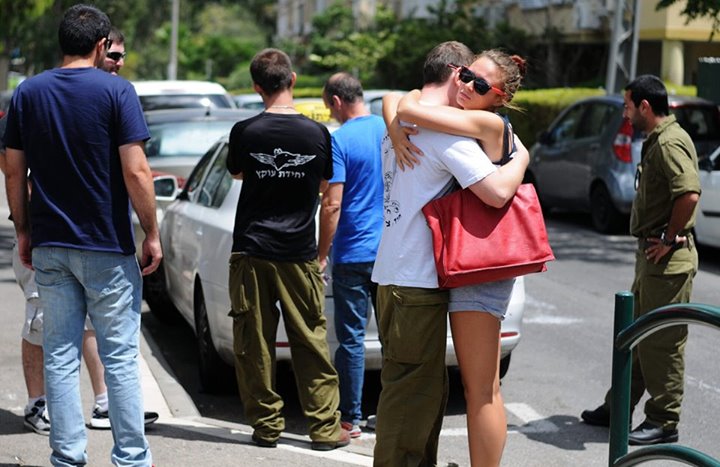
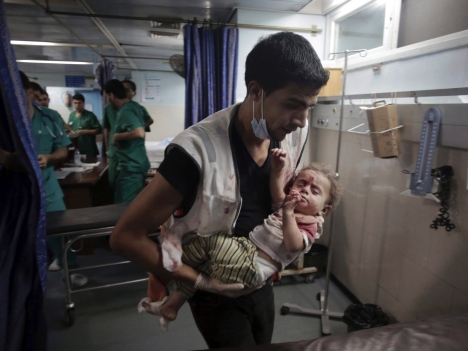
It’s not over not because nothing has changed. More than 1600 Palestinians have been killed, along with 66 Israelis, and thousands of homes and other buildings in Gaza have been destroyed. The death and destruction has been colossal and dreadful.
It’s not over because we didn’t talk. It’s not over because the underlying issues that led to the violence have not been addressed. It’s not over because there is still an occupation; there is still a siege on Gaza; there are still Israeli settlements throughout the Occupied Palestinian Territories; there is still one law for Israelis and another for Palestinians in Area C; there is still a separation barrier running through Palestinian land; there are still checkpoints restricting Palestinian movement; there are still Palestinian refugees. It’s not over because Hamas and Islamic Jihad use murderous military violence rather than nonviolent means to bring the Palestinians an independent state. It’s not over for all the reasons that a peace agreement between Israel and the Palestinian Authority has not been reached yet.
At the root of all those reasons is the refusal to talk. To really talk. To speak and to listen. To hear what is painful and to say what you fear to say. To talk not only to those with whom one feels comfortable, but with those whom you don’t trust and don’t like. To talk to your enemies. There are many reasons why Israel’s government and its citizens distrust Hamas and also the Palestinian Authority, and why talking with them will be difficult, painful, infuriating. And vice versa.
It’s not over in part because the Israeli government has decided that as a matter of policy it will not talk. It will not talk, except by the most indirect means to Hamas at all, and it will not talk in good faith – really talk – to the Palestinian Authority. It will not talk about peace agreements other than as a way to keep talking but not talk at all. And it won’t talk to a Palestinian reconciliation government that includes Hamas. It won’t talk to Hamas other than through the coercive, violent language of Operation Brother’s Keeper and Operation Protective Edge. Hamas talks back with rockets and tunnel attacks. Helluva way to talk.
 In the midst of the horrific, terrible violence there has been a quiet voice, a voice that talks, that really talks, because it also listens, because it talks for the sake of talking. Not empty talking, but talking for the sake of reconciliation, for the sake of practicing peace long before the politicians get around to talking earnestly about peace. The voice, and the ear, is the Parents Circle Families Forum whose slogan is “It won’t stop until we talk.” During this war, the group of bereaved Israeli and Palestinian families has made efforts, such as this video on social media, to keep talking, to turn people away from the violence that breeds bereavement, and to turn them towards the talk that also listens in their “Peace Tent.” The tent has operated daily throughout the war, in Tel Aviv’s Cinematheque square, offering a space in their words, “to provide an alternative to the propaganda and hatred running rampant in Israel …. [and] share their stories, their choice for reconciliation.” It’s not over yet, because not enough people are listening.
 Picturing Peace