Tag Archives: Nakba

It’s 1933. Some of us will survive.

It’s 1933. Some of us will survive. In the German elections in March 1933 the democratic system of the Weimar Republic created a parliamentary majority for the Nazi Party’s coalition headed by Hitler. In the 2024 US elections the democratic system has selected a president with, at least, fascist tendencies and given his political party a majority in the Senate and quite likely also the House of Representatives.

This piece is neither a prediction of what Trump will do in power nor an analysis of how he won the elections. It is an attempt to turn the deep pit of dread, fear and foreboding in my stomach into the hope contained in the acknowledgement that however bad it will be – and it will be bad – some of us will survive.
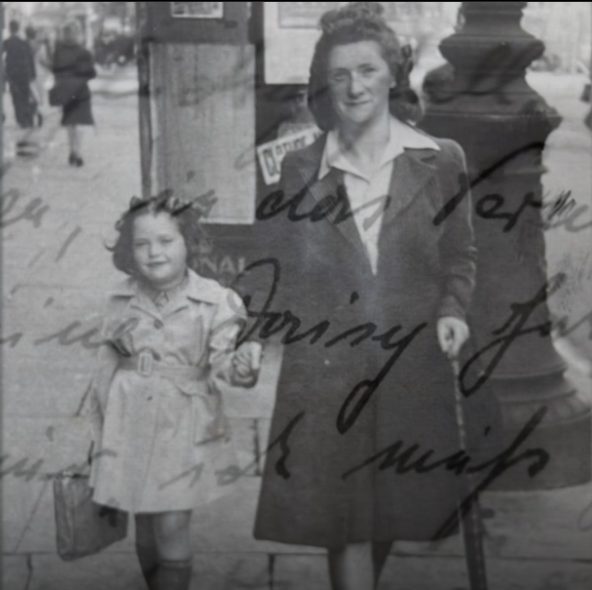
Ursula and Daisy after the wat. Still from BBC A House through Time Series 5, Episode 4.

By chance, my partner and I had just finished watching Series 5: Two Cities at War of the BBC history series A House through Time presented by David Olusoga. Following the stories of the residents of two apartment buildings in London and Berlin from the 1920s to the end of the Second World War, we watch German tanks rolling first into Poland and then France, the bombing Blitz of London and then the Allies’ bombing of Berlin. Of the Jewish families in Berlin, one – parents with a two year-old daughter – escapes only as far as Belgium. The records show the parents being transported to Auschwitz, where the father perished but the mother survived the Death March from there to Ravensbrück. Having witnessed the brutalities of war and being reminded that the fate of the Jewish families is interwoven with the Holocaust, the viewer is left willing for a happy ending for them in the archives. And there is one – a record of mother Ursula and daughter Daisy (who had been placed in hiding by her mother) living together in Brussels, a photo of them after the war and another of them at Daisy’s daughter’s wedding. That is all I needed for the last episode to be bearable – that Ursula and Daisy survived, that they went on to thrive.

Today’s democratically chosen tyrant may be not end up being as responsible for as much human suffering as Hitler. But as Moira Donegan wrote the morning after his election, “For those of us aware of what Trump is capable of, this morning has plunged us into a cold kind of anticipatory grief.” Mass deportations, vast cuts to welfare and health services and “the persecution of dissidents and violent suppression of Trump’s political enemies.”

Trump’s election makes individual and collective survival for millions of Palestinians, especially those in Gaza, an even more acute issue than it has been for decades and since the murderous attacks by Hamas on October 7th 2023. Israel’s vengeful response has already killed as many Palestinians as the German Blitz on Britain, more than 43,000. Its current phase in the north of Gaza that began on October 5th 2024 threatens the lives of some 400,000 people who remain in the area, unwilling or unable to be driven out to the south. A combination of military fire power, from bombs to sniper bullets, starvation, wrecking buildings, and destruction of the last vestiges of a health system, are, writes Idan Landau, “an embodiment of the spirit of ethnic cleansing and resettlement from day one,” paving the way for new Israeli settlements. The pre-US election period was already providing the government and military with a window of opportunity to pursue this particularly vicious operation, but “If Trump wins, the Israeli leadership can breathe a sigh of relief. He will not stop any Israeli plan, however brutal.” Indeed, Netanyahu was quick to congratulate Trump who is an ally of the settler movement, at ease with annexation of Occupied Territories. Thus far US exhortation to Israel to minimise civilian casualties and allow humanitarian relief has had no teeth. Trump will not even encourage such restraint, nor (as did Biden) will he remind the Israeli government of its own duty to protect its citizens held hostage in Gaza for 401 days (as I write this).
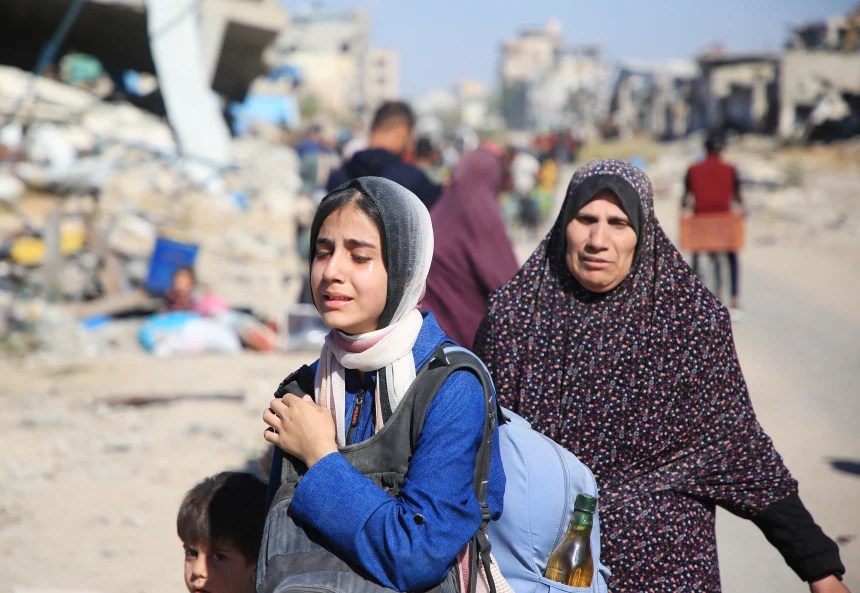
A Palestinian girl cries as the Israeli army forcibly moves civilians from the outskirts of the Jabalia refugee camp in northern Gaza on Tuesday.Mahmoud Sleem / Anadolu via Getty Images

Yet however awful the outcome of the latest Israeli onslaught on Gaza, just as some Palestinians survived the 1948 Nakba and remained tsumud, steadfast on their land, some will survive. Palestinians have survived in Gaza since the blockade began after Hamas took over in 2007 and survived the series of Israeli armed assaults since then, as told in a profound anthology I am currently reading, Daybreak in Gaza: Stories of Palestinian Lives and Culture. Some will survive and then thrive this time as before. And even if the Israeli government abandons the hostages in Gaza to their horrible fate, some were released last November and have survived, and the grieving families of those who perish will survive.

The biggest threat to survival that Trump’s election poses is to the natural environment that sustains humankind. According to The Guardian:

Trump’s agendaanalysts have found, risks adding several billion tonnes of extra heat-trapping gases to the atmosphere, further imperiling goals to stave off disastrous global heating that governments are already failing to meet

As I’m active in Extinction Rebellion I might be expected to believe that the climate and ecological crisis is an existential threat to whole human species. But I believe that global heating and nature loss will destroy human civilisation, leaving a few of us to survive in lives that are for many generations nasty, poor, brutish and short. But some of will survive well enough to build new societies in which some of us can thrive.
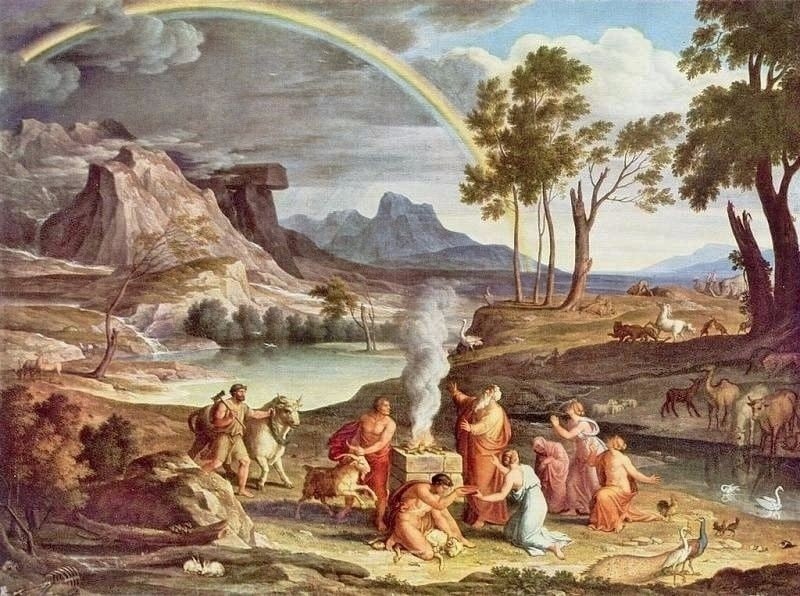
Artist Joseph Anton Koch (1768–1839)

That narrative arc, from impending doom, to catastrophe, through to survival and thriving, which Ursula and Daisy lived through, is grounds for hope. The catastrophe is not averted, many are lost, but something rises from the ashes. Survival cannot bring back all that was lost in the catastrophe, but it is a partial redemption, like the dove that returns with an olive branch to Noah’s ark after the flood. God promises there were never be another flood and commands Noah’s family – all that is left of humanity – to be fruitful and multiply, signifying the covenant with a rainbow. A passage by Rebecca Solnit has been circulated a lot in the days since Trumpism triumphed at the polls, in which she writes :

The fact that we cannot save everything does not mean we cannot save anything and everything we can save is worth saving… A lot of us are going to come under direct attack, and a lot of us are going to resist by building solidarity and sanctuary… People kept the faith in the dictatorships of South America in the 1970s and 1980s, in the East Bloc countries and the USSR… There is no alternative to persevering, and that does not require you to feel good.

We are not passive spectators in the narrative arc from catastrophe to survival. Noah had to be righteous and build an ark. Ursula’s mother had to find solidarity with the good souls who risked their lives by giving sanctuary to Daisy. Hope is a verb, not a passive state of waiting for better times. As Kamala Harris put it in her concession speech:

Don’t ever give up… do not despair. This is not a time to throw up our hands. This is a time to roll up our sleeves. This is a time to organize, to mobilize and to stay engaged for the sake of freedom and justice and the future that we all know we can build together.

Joe Biden offered similar active hope in his address to the nation:

Setbacks are unavoidable, but giving up is unforgivable… A defeat does not mean we are defeated. We lost this battle… We’re going to be OK, but we need to stay engaged. We need to keep going. And above all: we need to keep the faith.

Perhaps those are the clichéd remarks of politicians, but in these dark days I am receptive to those clichés. Even if today I cannot see the rainbow after the flood, survival after catastrophe, I know the narrative arc was fulfilled before and will be again. Trumpism is not forever. Some of us will survive.
The Mark of Cain: Genocide in Gaza

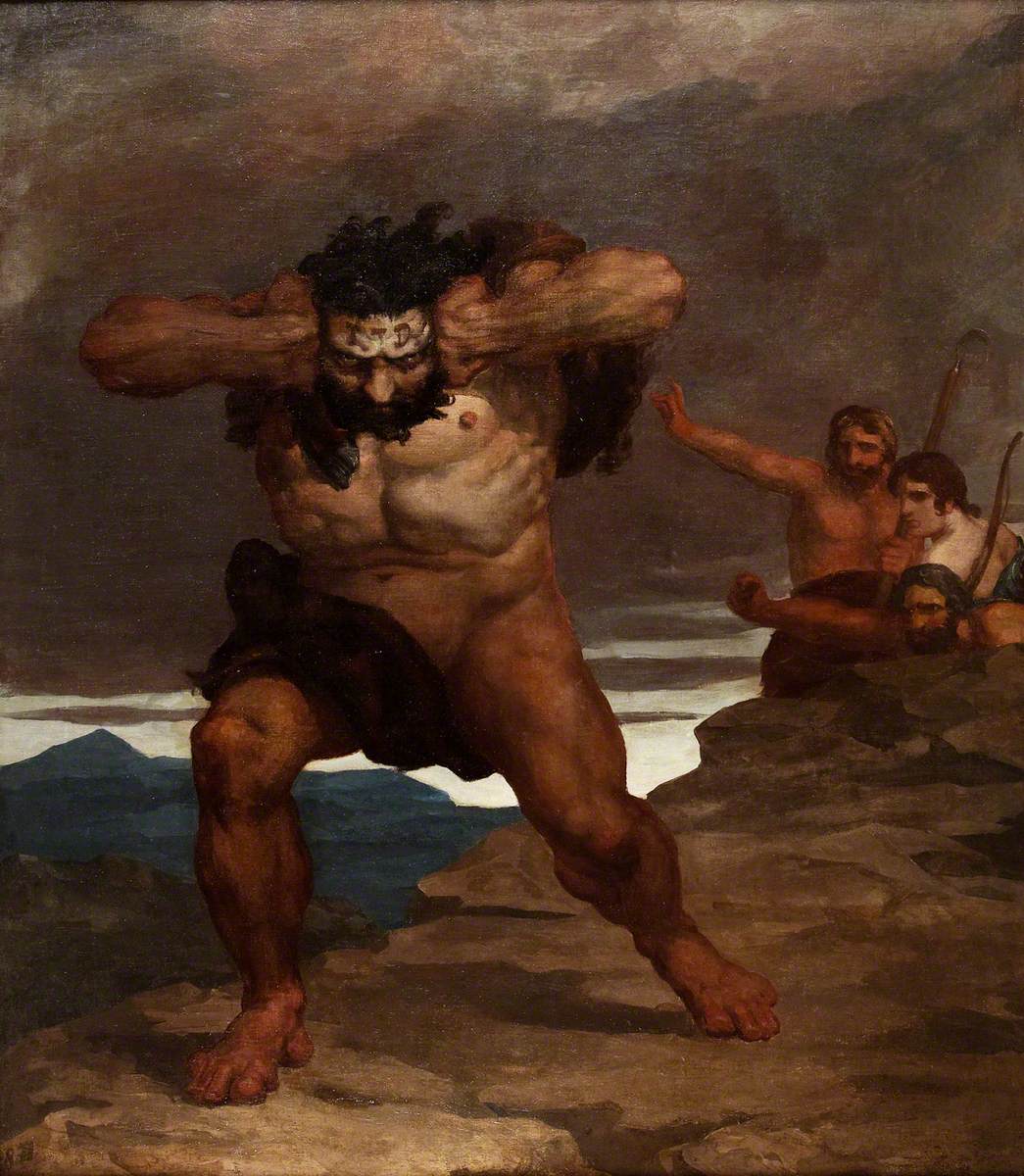
Cain was the first perpetrator of a violent crime, the crime of murder, of fratricide. According to the Biblical story, God asks Cain where Abel is after Cain had killed him, to which Cain responds “Am I my brother’s keeper?” My father loved to repeat that phrase so I grew up with a sense that we siblings were supposed to take of each other, a sense which developed into a broader feeling of social responsibility, of care for others. For his crime Cain was cursed with failure of all his farming endeavours and to be “a fugitive and a vagabond.” When Cain protested that he would be slain in his wanderings, God put a mark on him, a warning sign that others should not punish him further, at the risk of sevenfold vengeance. Although the mark is not given to Cain as the punishment, as the mark of shame for taking a life made in the image of God, it is nonetheless a life-long sign of guilt.

David Scott (1806-1849); Cain Degraded (Remorse); Photo credit: Royal Scottish Academy of Art & Architecture

The accusation brought by South Africa that Israel is committing genocide of Palestinians feels like an unbearable mark of shame and guilt. How can it be the the Jewish state is accused of genocide, less than a century since genocide was committed against the Jewish people? Surely, we are the victims of genocide, not the perpetrators? How can this be any more than a scandalous libel, a blood libel as Israeli government spokesman Eylon Levy said? It’s especially galling so soon after the horrendous attack by Hamas on October 7th that reminded us so starkly of our vulnerability, that looks itself like an act of genocide. Are we to be denied the right to defend ourselves just because our enemy uses its population as human shields and fights from within the civilian infrastructure? “There can hardly be a charge more false and more malevolent than the allegation against Israel of genocide, ” said Israeli Foreign Ministry legal adviser Tal Becker in response to the South African case on January 12th. This is the line of defence against the genocide accusation taken by Israel at the International Court of Justice. We are the victims, not the perpetrators. And some us still bear those other marks, those numbers inscribed on our flesh by the other murderers, before we had a state with which to defend ourselves, when at the whim of persecuting states we could be turned into fugitive vagabonds at a moment’s notice.

I leave to the judges of the court and international law experts to determine the validity of this defence. In part, Jewish and Israeli outrage at and revulsion from the accusation of genocide is prompted by the definition of genocide in the UN’s Convention on the Prevention and Punishment of the Crime of Genocide. There it is stated that

genocide means any of the following acts committed with intent to destroy, in whole or in part, a national, ethnical, racial or religious group, as such:
(a) Killing members of the group;
(b) Causing serious bodily or mental harm to members of the group;
(c) Deliberately inflicting on the group conditions of life calculated to bring about its physical destruction in whole or in part;
(d) Imposing measures intended to prevent births within the group;
(e) Forcibly transferring children of the group to another group.

Genocide does not then mean another Holocaust, extermination camps and gas chambers. It does not mean the destruction of Palestinians in whole, only in part. Killing 1% of the population Gaza, most of them women and children, the displacement of 85% of the population, the destruction of a third of the buildings and the creation of circumstances meaning one in four households is at risk of starvation means Israel does have a case to answer. It also means that Hamas is also open to accusations of genocide, but as it is not a state that has ratified the Genocide Convention, it cannot be brought before the International Court of Justice. Instead, those horrendous crimes are under the jurisdiction of the International Criminal Court as well as Israeli courts.

One of Israel’s key legal difficulties at the Hague is of its own making, the multitude of statements by politicians, official spokespersons, military officers, news anchors, commentators and journalists that appear to advocate or condone genocide. Legal experts say that the hardest part of a genocide case to make is usually the demonstration of intent to commit genocide, but in this instance there has been a lot of unguarded talk. I will come back to Biblical stories to focus on one statement picked out by the South African team, by Prime Minister Netanyahu on October 28th: “you must remember what Amalek has done to you, says our Holy Bible. And we do remember”. The Amalekites were one of the tribes whom the Israelites fought after their Exodus from Egypt, during their sojourn in the desert, before conquering Canaan. In the first telling, in the Book of Exodus 17:8-16, no reason is given for why their remembrance must be blotted out, but Deuteronomy 25:17-19 tells us that “they smote the hindmost of thee, all that were feeble in thy rear, when thou wast faint and weary; and … [Amalek] feared not God.” The Amalekites reappear in the First Book of Samuel 15, when Samuel tells King Saul that God reminds him of what the Amalekites did to Israel and orders him to “go and smite Amaleq, and utterly destroy all that they have, and spare them not; but slay both man and woman, infant and suckling, ox and sheep, camel and ass.” This last passage is quoted in the South African case, seemingly as proof that Netanyahu intended the Israeli troops about to enter Gaza to act similarly.

Joshua fighting Amalek, By Philip De Vere – Phillip Medhurst Collection of Bible illustrations. housed at Belgrave Hall Leicester, made possible by the Kevin Victor Freestone Bequest.

In his rebuttal of the accusation that the accumulation of similar utterances to Netanyahu’s amount to incitement to genocide, Malcolm Shaw argued that the South African team had misunderstood the place of Amalek in Judaism but that there was no time for a theological debate. He is certainly right that within Judaism the literal meaning should not be taken as a commandment, and even if it were, neither the Palestinians or Hamas are literally ancient Amalekites. Shaw goes on to claim that the quotations brought by South Africa “are clearly rhetorical, made in the immediate aftermath of a [traumatic] event.” Again he is right, but not in the way he intended the word “rhetorical,” in the everyday sense of an empty statement, but in the sense of rhetoric as persuasive statements uttered to move their audiences. In their spoken presentation, the South African team referred to the normalization of genocide discourse in Israel, indicating an accumulative pattern of speech and writing across politics and media. They showed a clip of dancing Israeli soldiers, singing that they understood their commandment to “wipe out the seed of Amalek” and their operational slogan that there are “no uninvolved” in Gaza, meaning no innocent civilians. Netanyahu’s rhetoric was clearly understood by the soldiers, as well as the synecdoche whereby today’s Palestinians stand in for the Biblical Amalekites. Whether the soldiers in the clip acted on that understanding, we do not know. But in the context of the rise of the Jewish-supremacist, messianic far-right in Israel and its inclusion in the current government, the meaning of Netanyahu’s statement, along others calling explicitly for a second Nakba, is chillingly dangerous and irresponsible, at least murderous if not genocidal in intent, as my colleague Joshua Shanes noted at the time.

The governing discourse in Israel today is, if not genocidal than at least politicidal, a discourse in which there is no truth to Palestinian collective existence, Palestinian peoplehood and connection to the land. In their eulogy for their brother Hayim who was murdered by Hamas (which of course has its own murderous discourse) on October 7th, his sibling Noy said:

My brother was always active for peace … He spoke truth in the face of – as Foucault said – the power that forces discourse up on us, the power that forces us to say certain things, and not say other things. Hayim spoke truth to power – even at the price of being the one who is different, the one who is strange

The power of Israeli discourse was evident last week when 85 members of Israel’s parliament, the Knesset, from most of the opposition as well as coalition parties, signed up to an impeachment process for one of their number, Ofer Cassif, a representative of Hadash, the Democratic Front for Peace and Equality. He had signed a petition in favour of South Africa’s submission to the ICJ, although from some of the reactions he might as well have joined the petition to the court itself. He is very strange to them, very different, abnormal, and what he says does not make sense to them. He speaks a truth that does not have a place in their consensus. He wrote on X (formerly Twitter) that

My constitutional duty is to Israeli society and all its residents, not to a government whose members and its coalition are calling for ethnic cleansing and even actual genocide. They are the ones who harm the country and the people, they are the ones who led to South Africa’s petition to The Hague.

It will pain me deeply if, after its long deliberations, the International Court of Justice finds that Israel, the Jewish state, committed genocide. It would be a mark of Cain that the state would bear forever. The atrocities of October 7th pained and shocked me deeply, as does the fate of the hostages, now in their 100th day of captivity. But it also pains me that the State of Israel is inflicting so much harm on Palestinians in what it claims is self-defence but seems like a prolonged act of vengeance without achievable and defined goals. At this time of intense polarization, the social media mobs and the gatekeepers of discourse insist that Palestinians can be only either victims or perpetrators, that Israelis can be only victims or perpetrators. But what if we are both victims and perpetrators? If we can speak in a discourse that allows for that possibility, can we then not also be our brothers’ keepers?