Tag Archives: Netanyahu

Who “only understands force”? On the limits of force in politics

The sudden, rapid and unanticipated collapse of Assad’s Ba’athist regime in Syria a few days ago is an historic episode that demonstrates the limitations of force in politics. A brutal regime that had crushed dissent for decades by using military and police violence, torture, incarceration and mass executions of opponents imploded in a matter of days. Yes, it did so in the face of an armed offensive by Hayat Tahrir al-Sham in the north of the country whose success soon prompted other armed rebels against the dictatorship to join in, notably the Southern Operations Room which seized control of Damascus. There were some battles on the roads to Aleppo, Hama, Homs and Damascus, but the key development was the melting away of the military might available to the regime. Soldiers stripped off their uniforms, abandoned their weapons and blended into the civilian population. The regime’s main ally, the Iranian government, evacuated its personnel because the Syrian government forces had no will to fight. The story here is that the seemingly formidable power of the regime vanished.

It is not surprising that some compared the regime’s collapse to the fall of the Berlin Wall in 1989, when German civilians demolished some of that symbol of the Soviet regime. These episodes in which regimes that rely on force and violent repression dissolve seem miraculous. Yet they are apprehensible according to theories of power that grasp that political power and obedience ultimately come from below, from the consent of those who are ruled. In Gene Sharpe’s approach to these theories, which were part of the playbook for the democratic movements of the Arab Spring, the emphasis is on non-violence as the appropriate strategy to bring down repressive regimes.

That was not quite the case in Syria, but the essence of the theory still pertains. Repressive regimes such as Assad’s dictatorship work only so long as the people believe the regime is to be feared and so long as the government’s agents believe that the people are afraid of them. Without the mantel of fear, statues of Assad, like the idols in Abraham’s father Terah’s shop, are just lumps of stone and metal. When the compact of fear fails for significant numbers of people, the repressive emperor has no clothes. The soldiers’ uniforms no longer signify that they command fear from the population, so they take them off and flee, afraid themselves that what they have done to others will be done to them. And hence the latest episode in the long struggle against Assad’s regime was relatively bloodless.

A truck pulls the head from the toppled statue of late Syrian president Hafez al-Assad through the streets of the captured Syrian city of Hama © MUHAMMAD HAJ KADOUR / AFP

Other autocratic regimes in the Arab world would do well to heed the warning about the limitations of violent repression and follow the example of those who have taken some steps towards democratic reform. But there is another regime in the region that relies on force and violent power, one which has never even sought to make itself legitimate in the eyes of its subjects. The Israeli occupation of Palestinians in the West Bank and Gaza has at best offered some crumbs of its own economic prosperity to non-citizen Palestinians under its rule in return for acquiescence. It has never given them any grounds to consent to Israeli rule, to appropriation of land and resources, restrictions on movement, denial of rights, other than fear of the consequences of resistance, whether armed or non-violent.

The apartheid character of the Occupation becomes daily more evident, more nakedly an assertion of alleged Jewish rights and disregard for Palestinian rights. The Occupation regime becomes ever more dependent on bare force. Ironically, it is Israelis who tell each other that “they” (Palestinians, Arabs, Muslims) only understand force, while subjecting Palestinians to rule that will last only as long as occupied and occupier believe that brute force can sustain Occupation. “We will always live by sword,” repeats Netanyahu and as his words are echoed and enacted, it becomes a self-fulfilling prophecy. As Palestinian historian Rashid Khalidi put it in a recent interview with Ha’aretz, when asked if Israel had a real opportunity to break out of the cycle of bloodletting: “It’s been the Iron Wall since Jabotinsky. Force and more force. You’ve been trying to impose a reality that has sent shock waves throughout the Middle East since the 1920s.”

The Israeli government’s response to the toppling of Assad’s regime has been a massive unleashing of military violence to destroy as much as possible of Syria’s military capacity. Israel has also occupied the demilitarized buffer zone between Israeli and Syrian positions established by the 1974 armistice agreement between the two countries. Other governments are opening channels of communication with the new rulers in Damascus, but the Israeli government assumes that Hayat Tahrir al-Sham and its partners will use military force against Israel if they have the means or let them fall into the hands of others who will, such as Hezbollah. We don’t have the luxury of others to get to know these people, an Israeli spokesperson tells Channel 4 news, so first we bomb them. He might as well add: we only understand force.

There is no guarantee of if or when force will cease to work as the compact between occupier and occupied. So far in this phase of violence since October 7th 2023, only a few Israelis such as Soul Behar have refused to put on their uniforms. Most are too afraid that what they have done to others will be done to them, a fear which has also been brought from other places where terrible things were done to their ancestors. Palestinians under Occupation have already shown that they are no longer afraid of the force wielded by the occupiers, notably at the start of the First Intifada when most of the resistance to Occupation was non-violent or unarmed. But what if more Israelis begin to see themselves as Palestinians see them, as inflicting force as violent, merciless and devastating as the Assads’ assaults on their own people? And what if more Palestinians who have survived the violence and are subject to Occupation can see that competing with Israeli violence is not a winning strategy? Assad’s regime has fallen because of the limits of force in politics. The Occupation will end for the same reason.
It’s 1933. Some of us will survive.

It’s 1933. Some of us will survive. In the German elections in March 1933 the democratic system of the Weimar Republic created a parliamentary majority for the Nazi Party’s coalition headed by Hitler. In the 2024 US elections the democratic system has selected a president with, at least, fascist tendencies and given his political party a majority in the Senate and quite likely also the House of Representatives.

This piece is neither a prediction of what Trump will do in power nor an analysis of how he won the elections. It is an attempt to turn the deep pit of dread, fear and foreboding in my stomach into the hope contained in the acknowledgement that however bad it will be – and it will be bad – some of us will survive.

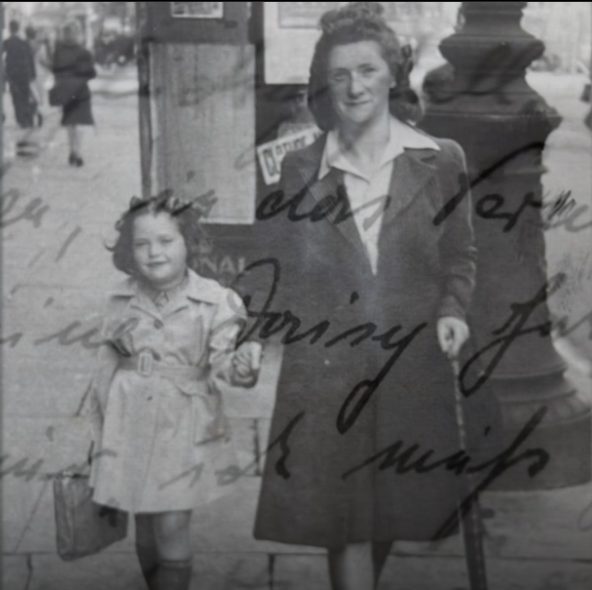
Ursula and Daisy after the wat. Still from BBC A House through Time Series 5, Episode 4.

By chance, my partner and I had just finished watching Series 5: Two Cities at War of the BBC history series A House through Time presented by David Olusoga. Following the stories of the residents of two apartment buildings in London and Berlin from the 1920s to the end of the Second World War, we watch German tanks rolling first into Poland and then France, the bombing Blitz of London and then the Allies’ bombing of Berlin. Of the Jewish families in Berlin, one – parents with a two year-old daughter – escapes only as far as Belgium. The records show the parents being transported to Auschwitz, where the father perished but the mother survived the Death March from there to Ravensbrück. Having witnessed the brutalities of war and being reminded that the fate of the Jewish families is interwoven with the Holocaust, the viewer is left willing for a happy ending for them in the archives. And there is one – a record of mother Ursula and daughter Daisy (who had been placed in hiding by her mother) living together in Brussels, a photo of them after the war and another of them at Daisy’s daughter’s wedding. That is all I needed for the last episode to be bearable – that Ursula and Daisy survived, that they went on to thrive.

Today’s democratically chosen tyrant may be not end up being as responsible for as much human suffering as Hitler. But as Moira Donegan wrote the morning after his election, “For those of us aware of what Trump is capable of, this morning has plunged us into a cold kind of anticipatory grief.” Mass deportations, vast cuts to welfare and health services and “the persecution of dissidents and violent suppression of Trump’s political enemies.”

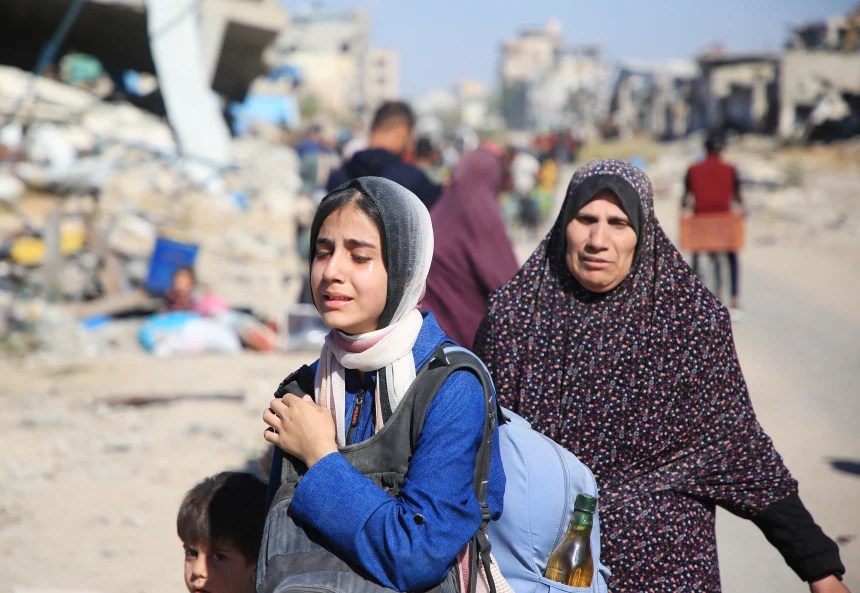
Trump’s election makes individual and collective survival for millions of Palestinians, especially those in Gaza, an even more acute issue than it has been for decades and since the murderous attacks by Hamas on October 7th 2023. Israel’s vengeful response has already killed as many Palestinians as the German Blitz on Britain, more than 43,000. Its current phase in the north of Gaza that began on October 5th 2024 threatens the lives of some 400,000 people who remain in the area, unwilling or unable to be driven out to the south. A combination of military fire power, from bombs to sniper bullets, starvation, wrecking buildings, and destruction of the last vestiges of a health system, are, writes Idan Landau, “an embodiment of the spirit of ethnic cleansing and resettlement from day one,” paving the way for new Israeli settlements. The pre-US election period was already providing the government and military with a window of opportunity to pursue this particularly vicious operation, but “If Trump wins, the Israeli leadership can breathe a sigh of relief. He will not stop any Israeli plan, however brutal.” Indeed, Netanyahu was quick to congratulate Trump who is an ally of the settler movement, at ease with annexation of Occupied Territories. Thus far US exhortation to Israel to minimise civilian casualties and allow humanitarian relief has had no teeth. Trump will not even encourage such restraint, nor (as did Biden) will he remind the Israeli government of its own duty to protect its citizens held hostage in Gaza for 401 days (as I write this).

A Palestinian girl cries as the Israeli army forcibly moves civilians from the outskirts of the Jabalia refugee camp in northern Gaza on Tuesday.Mahmoud Sleem / Anadolu via Getty Images

Yet however awful the outcome of the latest Israeli onslaught on Gaza, just as some Palestinians survived the 1948 Nakba and remained tsumud, steadfast on their land, some will survive. Palestinians have survived in Gaza since the blockade began after Hamas took over in 2007 and survived the series of Israeli armed assaults since then, as told in a profound anthology I am currently reading, Daybreak in Gaza: Stories of Palestinian Lives and Culture. Some will survive and then thrive this time as before. And even if the Israeli government abandons the hostages in Gaza to their horrible fate, some were released last November and have survived, and the grieving families of those who perish will survive.

The biggest threat to survival that Trump’s election poses is to the natural environment that sustains humankind. According to The Guardian:

Trump’s agendaanalysts have found, risks adding several billion tonnes of extra heat-trapping gases to the atmosphere, further imperiling goals to stave off disastrous global heating that governments are already failing to meet

As I’m active in Extinction Rebellion I might be expected to believe that the climate and ecological crisis is an existential threat to whole human species. But I believe that global heating and nature loss will destroy human civilisation, leaving a few of us to survive in lives that are for many generations nasty, poor, brutish and short. But some of will survive well enough to build new societies in which some of us can thrive.

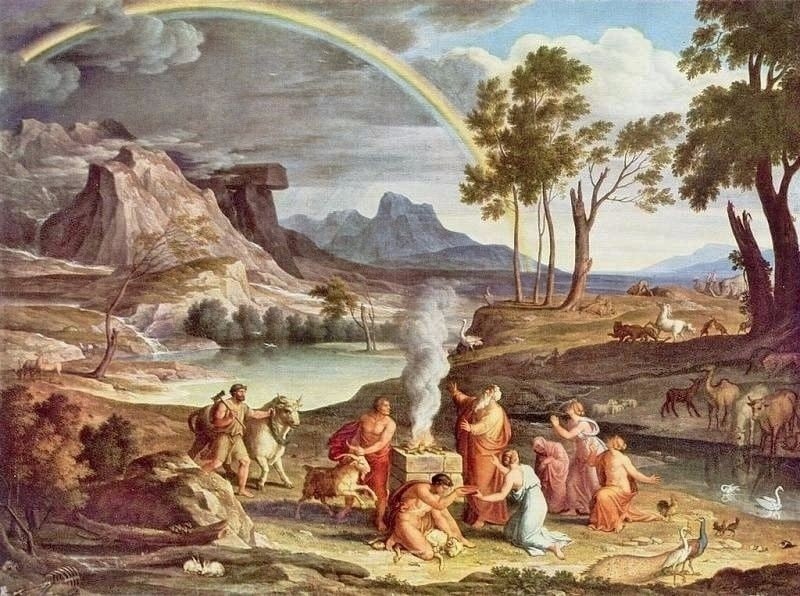
Artist Joseph Anton Koch (1768–1839)

That narrative arc, from impending doom, to catastrophe, through to survival and thriving, which Ursula and Daisy lived through, is grounds for hope. The catastrophe is not averted, many are lost, but something rises from the ashes. Survival cannot bring back all that was lost in the catastrophe, but it is a partial redemption, like the dove that returns with an olive branch to Noah’s ark after the flood. God promises there were never be another flood and commands Noah’s family – all that is left of humanity – to be fruitful and multiply, signifying the covenant with a rainbow. A passage by Rebecca Solnit has been circulated a lot in the days since Trumpism triumphed at the polls, in which she writes :

The fact that we cannot save everything does not mean we cannot save anything and everything we can save is worth saving… A lot of us are going to come under direct attack, and a lot of us are going to resist by building solidarity and sanctuary… People kept the faith in the dictatorships of South America in the 1970s and 1980s, in the East Bloc countries and the USSR… There is no alternative to persevering, and that does not require you to feel good.

We are not passive spectators in the narrative arc from catastrophe to survival. Noah had to be righteous and build an ark. Ursula’s mother had to find solidarity with the good souls who risked their lives by giving sanctuary to Daisy. Hope is a verb, not a passive state of waiting for better times. As Kamala Harris put it in her concession speech:

Don’t ever give up… do not despair. This is not a time to throw up our hands. This is a time to roll up our sleeves. This is a time to organize, to mobilize and to stay engaged for the sake of freedom and justice and the future that we all know we can build together.

Joe Biden offered similar active hope in his address to the nation:

Setbacks are unavoidable, but giving up is unforgivable… A defeat does not mean we are defeated. We lost this battle… We’re going to be OK, but we need to stay engaged. We need to keep going. And above all: we need to keep the faith.

Perhaps those are the clichéd remarks of politicians, but in these dark days I am receptive to those clichés. Even if today I cannot see the rainbow after the flood, survival after catastrophe, I know the narrative arc was fulfilled before and will be again. Trumpism is not forever. Some of us will survive.