Tonight (March 17 2015) it’s probably too early to say for certain what the next Israeli government will look like, but according to the exit polls and the first actual results of the election today, it’s almost certain that Netanyahu will form the next government. And in his victory speech, he promised that it would be a nationalist government. It is certainly too early to explain his and his Likud party’s surprising recovery in the few days preceding the election from their low standing in recent opinion polls. Likud activists were calling Netanyahu a “magician” at their victory celebrations. What sort of magician he is and what sort of national(ist) government he will head can be surmised from a couple of Netanyahu’s moves in his almost single-handed reversal of fortune.
First there is Netanyahu’s declaration that “there will be no Palestinian state on his watch.” That there will not be a Palestinian state and hence not a “two state solution” under his rule should come as no surprise to anyone. But this undiplomatic declaration probably helped Netanyahu bring some of his base support back home. Of course it also depletes any remaining international credit he still had for his 2009 speech at Bar Ilan University for those who were taken in by his sleight of mouth in which he appeared to support the principle of a two state solution. But after this election trick Netanyahu will have lost the fig leaf that protected him from European Union moves towards sanctions of some of Israel’s occupation activities. And of course the Palestinian Authority really has nothing to lose in intensifying its diplomatic campaign against the occupation and for recognition of Palestine as a state. But tomorrow is tomorrow, and Netanyahu may have more dark magic up his sleeve.
If it look like a racist and talks like a racist …
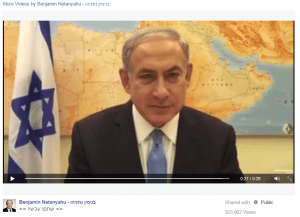
Second (yesterday) was Netanyahu’s overt racism, when he used his Facebook page to rouse his base to come and vote because the Arabs were being mobilized to come out and vote, being bused to the polls by “the Left”. He might as well have been warning white supremacists that the n***ers were being brought to vote by the lily-livered liberals who wanted to hand them God’s own country. Racist incitement is indeed dark magic.
If peace, in the senses of independence for the Palestinian people and civil equality for Palestinian citizens of Israel is already vanishing in the rear-view mirror, where is there a glimpse of peace over the horizon? Well, if you were watching Israeli TV tonight, you wouldn’t know because the third biggest list “the Joint List” didn’t feature in any of the election coverage. The Joint List is an unlikely alliance of Arab-Jewish socialists, Palestinians who claim rights as a national minority in Israel and Islamists, forced together by a recent law that would have prevented them from passing the electoral threshold. But under the superb leadership of Ayman Odeh, who campaigned on behalf of all of Israel’s downtrodden and against Netanyahu’s government’s racism by invoking Martin Luther King, it has the possibility not only to secure effective representation for the 20% of Israel’s citizens who are Palestinian Arabs, but also to constitute another start to a movement of democracy, justice and peace. It’s not here, but when I wake up tomorrow morning, I hope to still believe that in spite of Netanyahu’s dark magic, it is somewhere over the horizon.
This blog is an opinion piece I wrote during the time of the Gaza 2014 war, which has been published in a special supplement (which I edited) of the journal Theory & Event about the war. The whole collection is available free on online, and includes essays by smart, insightful and sometimes sad essays by Adel Manna, Amir Nizar Zuabi, Lev Grinberg, Ofer Cassif, Muhammad Ali Khailid, Louise Bethlehem, and Trude Strand.
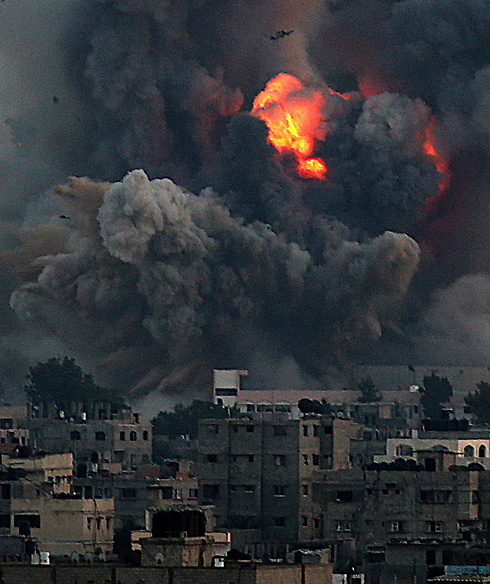
IAF strike on Gaza (Photo: EPA)
On July 7th I flew back to the US after a month-long trip to the UK and then Israel. On the same day, the Israeli assault on Gaza began, called in Hebrew “Operation Steadfast Cliff” (tzuk eitan). In my summer schedule, I had set aside time after my return to Bloomington to work on a paper titled “Peace: An Emergent Norm of War and Conflict,” for the American Political Science Association (APSA) conference. I intended to consider Walter Benjamin’s essay “Critique of Violence” among other texts.1 But I had not taken into account that during the summer I would be trying to write against the background of a war that I felt immediately, a war that interrupted my daily schedule as I constantly listened for and looked at updates.
As I tried to write I was facing the “steadfast cliff” of the Israeli war on Gaza. The utter pointlessness of the deaths, injuries and damage weighed heavily on me. I didn’t want to be in Bloomington. As an Israeli citizen I felt a duty that outweighed my professional duties, a civil duty to participate in the activities of the Israeli opponents of the war, my Israelis, who are increasingly subject to intimidation by ultra-nationalist phalanxes on the streets and on social media.2
It was impossible to separate my work from my anxiety, anger and frustration. I had to submit to the interruption in order to think critically about the normal abnormality of what Benjamin refers to as a “state of emergency.” By contrast, a “real state of emergency” 3 would interrupt not only our professional normality but also the regular flow of history – in this case, the repetition of warfare. What, then, with Benjamin’s help, did I think about peace while rockets, bombs and shells fell on Gaza and Israel and the anti-war demonstrations went on? How could protests constitute an “effective critique” of military violence?4
Through Benjamin’s eyes, the predominant, juridical ways of critiquing the violence of this war are not an effective critique of military violence because they partake in the same means that justify it. In his critique of the legal critique of violence, he argues that all law rests on a “common basic dogma,” that “just ends can be attained by justified means, justified means used for just ends.”5 In the legal framework of the self defense of nation states, or peoples, Israel condemns the military violence of the other as aggression, as a means to unjust ends contrary to the sanctity of human life. At the same time Israel justifies its own force as self defense, as a means to a just end – national and individual survival. Legal norms do not rule out extensive use of military violence as a means of self defense, while the spiral of condemnation and justification speaks to a diabolical logic of “we are good, our enemy is evil.”6
Significantly, Benjamin considers military violence to be paradigmatic of all violence, including the “lawmaking”7 violence of the state, whose ultimate end is in preserving itself. Law cannot provide an effective critique of violence because law itself has a “violent origin.”8 The origin of law is war, in the “peace ceremony” that sanctions “every victory” by “recognizing the new conditions as a new ‘law’.”9 The peace that follows victory establishes the “frontiers” in which the law operates and establishes the “power” of the law.10 Israel historically has been the victor that has used military violence to determine the frontiers in which the state’s civil and military law apply. It has determined who has a right to live within these frontiers, as well as granting partial rights to some of the vanquished, denying them entirely to others.
The “mythical violence” that constitutes law is, Benjamin says, the violent anger of the gods, which humans experience as fate. Indeed, fate, anger and retribution are the terms in which military violence is felt, not the reasonable language of international law. Many Jewish Israelis experience rockets falling like bolts of lightning cast down by the gods, as terror, as the manifestation of the anger and hatred of an enemy who has no rational motive, only a will annihilate them. For their part, Gazans experience unrelenting violence from the skies and on the ground as the anger and rage of their implacable Zionist enemy who denies them national and often personal existence. Military violence is their recurring fate.
As an alternative to the fate of mythical military violence, Benjamin asks whether violence is ever justified as a means, irrespective of its ends. His controversial, affirmative, answer is that there is pure, immediate divine violence that halts mythical violence” and initiates “a new historical epoch”.11 Benjamin’s conception of the pure means of nonviolence comes down to pure language that is neither intersubjective nor communicative. It is not a means to an end, nor a medium, but an immediacy that “corresponds … to the messianic end of the history.”12 The pure language of nonviolent means is the same as divine violence.
But Benjamin also takes us in a different direction – towards the nonviolent resolution of conflict, towards peace. On the face of it, he has a conventional understanding of the nonviolent means of conflict resolution, referring to the values of courtesy, sympathy, and trust in resolving disputes, along with conferences and diplomacy. 13 Yet, it seems to me, that along with Benjamin’s notion of divine violence is a notion of divine peace that also does the Messianic work of interrupting the cycle of mythical violence.
Must we then wait, perhaps forever, for the coming of the messiah for this violence to stop, or can there be peace now? Perhaps, but perhaps the interruptions of mythical and military violence are performed and witnessed on an everyday level even as the violence continues. As an example, I turn to the activities of the Parents Circle Families Forum Bereaved Families a joint Israeli-Palestinian organization of about 600 families. For them reconciliation between nations is a prerequisite for conventional, negotiated peace. 14 During the Israeli war on Gaza the Bereaved Families have interrupted the military, mythical violence in two ways.
In a video that they disseminated through social media, they interrupt the repetition through which mourning for the fallen is sanctified by further military violence which leads to more bereavement.15 At a time of war when the impulse is for each nation to unite, to become one camp, the video repeatedly tells us in Hebrew and Arabic that they don’t want us “here,” with them, in a circle of bereavement.16 The solemn faces against the grey background speak a pure language, the sharing of language as a sharing of existence.
Parents Circle Families Forum – Peace Square, July 2014
The group’s second interruption of military violence is the “Peace Square” next to Tel Aviv’s Cinémathèque, in which they counter the media propaganda and hatred running rampant in Israel by sharing their stories, and their choice for reconciliation, providing a space for dialogue.17 The talk under their canopy will lead to no peace treaty, but it is a sharing of language and a persistent presence. 18 Their slogan is “it won’t stop until we talk” and though “it” hasn’t stopped, their talk interrupts momentarily the flow of violence.
Of course, I do not mean that in actuality the violence stops. The messiah is not here, and history continues. The language of divine peace is a language we don’t yet understand, but through it passes the “weak Messianic power” that each generation has.19 One of the Bereaved Families’ projects is a dialogue on Facebook in which posts are translated from Hebrew and Arabic, and vice versa. The site is called “Crack in the Wall,”20 and it indicates how “every second of time … [can be] the strait gate through which the Messiah might enter.”21 Through these small cracks in the wall, the Bereaved Families interrupt mythical violence, making room for a different history that might burst through at any time. Peace.
Notes
1. Walter Benjamin, “Critique of Violence,” in Reflections: Essays, Aphorisms, Autobiographical Writings, ed. Peter Demetz (Schocken Books, New York, 1978): 277–300.
3. Walter Benjamin, “Theses on the Philosophy of History.” In Illuminations: Essays and Reflections, ed. Hannah Arendt, (Schocken: New York, 1968), 257.
12. Carlo Salzani, “Purity (Benjamin with Kant),” History of European Ideas 36 (2010), 444.
13. Benjamin, “Critique of Violence,” 289.
14. Its mission is to prevent further bereavement through dialogue, tolerance, peace and reconciliation. http://www.theparentscircle.org/Content.aspx? ID=2#.U4Ss7PldWSo. Accessed May 24, 2014.
15. See Jon Simons, “Mourning the fallen: working through bereavement,” Picturing Peace blog, July 26 2014.


 Picturing Peace