Author Archives: Jon Simons

World War Zion: or Trumpeldor’s Return

Zombies rush the wall in World War Z. Paramount Pictures

Zombies rush the wall in World War Z. Paramount Pictures

(spoiler alert)

By now word is out that the new Hollywood summer blockbuster zombie movie, World War Z, includes a controversial section about Israel/Palestine. In the rapidly paced plot, driven at the speed of an action movie, the world is overrun by a viral pandemic of fast-moving zombies. Gerry Lane, the hero of the film, an American former UN investigator (remobilized for the emergency), played by co-producer Brad Pitt, learns from a former CIA operative in a US military jail in South Korea that Israel knew of the outbreak and had time to quarantine itself behind a wall. Lane flies to Jerusalem, where Mossad agent Jurgen Warmbrunn dispels the hint of a global Zionist conspiracy by explaining that they had intercepted Indian military communications about fighting the zombies, then implemented their survival plan based on prior experience of persecution and attack. As Lane is shown around Jerusalem, the film shows scenes (filmed in Malta) of a huge wall on the edge of Jerusalem that clearly resembles the existing notorious separation wall that encloses and cuts off most of the Palestinian West Bank. As in reality, the film portrays an elaborate military checkpoint through which healthy people of any background may pass into the safe zone, apparently allowing Palestinian Arabs as well as Israeli Jews to enter. But the joyful survivors celebrate together noisily, attracting the zombies outside, who pile on top of each other to climb over the wall, bringing the safe haven of Zion to an end. Lane narrowly escapes by plane, taking with him one of the Israeli military escorts, a woman who calls herself by her rank segen (lieutenant) and whose left arm Lane amputated hastily after she was bitten by a zombie, thereby saving her. Segen becomes Lane’s lieutenant for the rest of the film, a heroine who assists him in discovering and obtaining the medical means to camouflage the survivors from the zombies, namely, injecting the healthy with terminal but curable pathogens.

Al-Jazeera reported that some viewers have interpreted the film (both critically and favourably) to be ‘pro-Israeli’ because it justifies the separation wall as a means to keep out an implacable enemy bent on the annihilation of the Israeli population. Others noted the irony of Palestinians as well as Jewish Israelis being admitted through the checkpoint in the film, while others pointed out that the wall failed to keep out the threat. In a piece published in the Washington Post, Jake Coyle noted the ambiguity of the film’s message about the wall, wondering if it might be a symbol of peace, a haven for Jews and Muslims, which unfortunately is not secure enough. In light of the film’s sympathetic treatment of Israel’s brief, militarized survival as the world’s last civilized state, Jordan Hoffman approvingly takes it to be ‘the greatest piece of cinematic propaganda for Israel since Otto Preminger’s Exodus’, even while noting that it is the ‘joyous cherished vision of unity and peace’ – Israel’s admission of Palestinian as well as Jewish survivors who celebrate together – that leads to its downfall. Jesse Benjamin notes the same point in her critical reading according to which the audience is treated to a ‘not at all veiled justification of Israel’s current and widely condemned Apartheid Wall’ along with the usual (for Hollywood) racial and gender hierarchies.

The ‘message’ of the film regarding Israel goes deeper than whether the wall failed because it was not mighty, high or exclusive enough, or because the survivors were too noisy in their celebration, or because the wall is a failed strategy for security. The real wall itself is often credited by the Israeli government with preventing terrorist attacks, especially suicide bombers. ‘Zuicide’ bombers appear akin to zombies in that they are implacable, irrational, inhuman, and are already dead, or committed to death. Yet, the wall is neither complete yet, nor hermetically sealed, and the Palestinian Authority’s security force’s sustained cooperation with their Israeli counterparts, along with changes in Palestinian attitudes towards such violence, probably explains as much about the reduction in suicide bombings as does the wall itself. Nor is it one wall that encloses Israel, but a series of walls, fences, barriers and checkpoints built around Palestinians in the West Bank, in addition to being a target of protest and resistance itself.

Less significant than the portrayal of the wall in the film is its very character as an action drama infused with the terror of human annihilation by the mouths of the insatiable zombies. If, as I did, viewers suspend all disbelief, mortal fear is rarely more than 30 seconds away. Such existential anxiety in the film has been carried over from the books by Max Brooks on which it is loosely based, who explains in an interview that his books are not horror that conjures up fear but instead a vehicle for ‘a baseline level of just anxiety about the world I live in’ (emphasis added). The child of anxious and protective parents, Brooks enables his readers to ‘metabolize’ their fears about the world – HIV/AIDS, post 9/11 instability, natural disasters – into science fiction. The zombies are not real, but the grounds for fear are.

In the case of Israel and Zionism, such existential fear for survival is rarely far from the surface. For many, probably most, Jewish Israelis, fear of collective annihilation by a ferocious, implacable enemy underlies their felt need for security embodied in armed force and high walls. Zionism’s first military hero was Joseph Trumpeldor, a decorated former officer in the Russian army, who lost his left arm in battle (like Segen in the film), emigrated to Palestine in 1911, and died as the legendary defender of the Tel Hai settlement in 1920. Given Trumpeldor’s fate, I was relieved that Segen survived the movie, but by now Trumpeldor is very much a faded legend in Israel, as much a target of satire as a heroic figure, as Yael Zerubavel explains in her book Recovered Roots: Collective Memory and the Making of Israeli National Tradition. Segen, self-identified only by military rank, is always serious. With her shorn head, she appears in the scene in which she and Lane survive a plane crash wrapped in a blanket, looking every inch like a death camp survivor. The connection between near annihilation in the Holocaust and survival through military might is blatant. In the face of such inhuman hostility, much Israeli policy operates under the conviction that ‘the whole world is against us’, and ‘there is no partner for peace’. In World War Zion, Israel faces the zombies alone, and there can be no peace with zombies, or zuicide bombers.
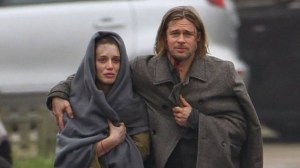
Segen (Danielle Kertesz) with Brad Pitt in "World War Z" (photo credit: Courtesy)

Segen (Danielle Kertesz) with Brad Pitt in “World War Z” (photo credit: Courtesy)

The fear is real, but the zombies are not. The Palestinians are not zombies, but people who want what Israelis have: civil rights, independence, and so on. Not all Israeli Jews see the Palestinians and other Arabs (and Muslims) as zombies, and Israeli perceptions and policies change over time. But the upper hand is with those who see zombies everywhere, build walls to keep them at bay, and disregard the value of their lives. The lives of the Palestinians do not count. Their lives are not, as the American Jewish philosopher Judith Butler puts it in another context, grievable when Palestinians are framed in Israeli discourse as zombies.

The ‘zombies’ that many Jewish Israelis fear came from elsewhere, from another time and place. Like the fears that Brooks channels into science fiction, these Israeli Jews displace their just fears of former persecutors in Europe and other places onto Palestinians and Arabs in general. It is a fear that I carry too, a fear that also allowed me to feel, for a while, in the movie that if only Israel survived, that would be good enough. But in order to avoid the injustice of treating Palestinians as zombies, as ungrievable lives, I and other Jewish Israelis need to understand – and feel- that we are not the only ones who are afraid, whose lives are lived in the shadow of existential anxiety, whose lives are, as Butler says, precarious. Out of concern for own precariousness, we have imposed it on the Palestinians. We have sought to be exclusive and pure in our precariousness, yet in the film it is not purity that immunizes human beings against the zombie threat (by camouflaging them), but self-contagion with pathogens. So long as we seek to be utterly secure at the cost of the insecurity and precariousness of Palestinian existence, we will not be secure, nor will we be at peace. Acknowledging the shared human condition of precariousness, and the unjust imposition of it on those we frame as zombies, is a precondition for a future peace.

Too Late for Two States? A Stale Debate Makes News

Palestinian street scene (Israel Channel 2 news, screenshot)

Palestinian street scene (Israel Channel 2 news, screenshot)

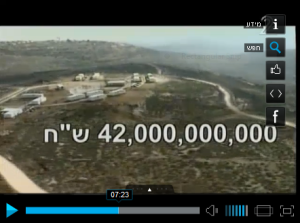
Estimated cost of removing settlements (Israel Channel 2 news, screenshot)

Estimated cost of removing settlements (Israel Channel 2 news, screenshot)

I’m not a fan of Israel’s Channel 2 news, but I watch it online precisely for the reasons that I dislike it. Its broadcasts exemplify wonderfully Israel’s ‘extreme centre’, the mainstream, consensual  prejudices, defensiveness and self-righteousness of Israel’s ‘white tribe’, its Jewish, Ashkenazi, middle class. It is (not coincidentally) the channel on which Yesh Atid leader Yair Lapid used to host a talk show, and then the ‘Friday Studio’ news magazine programme. That honour is now held by Danny Kushmaro, who this week (31 May 2013) filed his own extended report: ‘Two States: Have We Missed the Opportunity?’ As one of his interviewees, academic and former politician Meron Benvenisti, pointed out, the significance of the report is that it raises the question of whether a two-state solution to the Palestinian-Israeli conflict is possible, and explains to the viewers that this is a stale (literally ‘mouldy’) debate.

It is indeed a stale debate for Benvenisti, who made the case as long ago as 1984 in his West Bank Data Project report that the Israeli settlement project in the Palestinian Occupied Territories is irreversible and that there could be no divided sovereignty between the Jordan River and the Mediterranean. However, for Kushmaro this is newsworthy. He framed his recorded report from the studio by presenting  as obstacles to the two state solution the presence of 350,000 Israeli settlers in the West Bank, excluding East Jerusalem, along with the lack of political leadership on both sides,.

Ostensibly, the point of the report is to contrast the official Israeli government policy of ‘two states for two peoples’ with its impossibility. The first point is established through a series of clips of footage in which Ehud Barak, Ariel Sharon, Ehud Olmert, Benjamin Netanyahu, Yair Lapid and Shimon Peres all state their support for the two state policy. Netanyahu does so thrice, once in English for good measure. The case that the opportunity for two states has passed (or that it never existed) is made in three interviews, the first being with Meron Benvenisti, whose skepticism about it predates its adoption by the mainstream Israeli peace camp, especially Peace Now, during the first intifada. Retired politician Yossi Sarid represents the mainstream left, telling us from his living room that ‘the State of the Land of Israel’ has defeated the ‘State of Israel’, that ‘we’ have all been defeated as the settlers are leading us to the ‘end of the Zionist dream’. While he still hopes for another ending, he fears that as far as two states go, ‘the train has already left the station’. For the politically illiterate, he adds that Netanyahu’s declared acceptance of a demilitarized Palestinian state alongside Israel was a ‘statement of political charlatanry’. Former Defence Minister Moshe Arens concurs in his interview that the settlers have won, but he has consistently opposed Palestinian statehood. Additional support for the case is made by Palestinian pollster Khalil Shikaki, whose point in a brief interview is that while most Palestinian still support a two state solution, they no longer believe it is a practical possibility, and by leading Fatah official Abu Ala, who in a short clip says that if the two state approach has failed, there will be one state.

Deputy Foreign Minister Ze’ev Elkin, himself a settler, makes a hapless case for the official government line, undermining it by pointing out that it is only a theoretical issue, a matter for Israelis to discuss among themselves, given the condition of the ‘Palestinian side’. Justice Minister Tzipi Livni sounds more convincing when she insists on her commitment to the two state solution as the only way to sustain Israel as a Jewish and democratic state, despite the difficulties and complexities. Yet, she seems to have been interviewed in the lobby of the studio, as if to indicate that her formulaic statements belong in the never-never land of no progress on peace talks, alluded to in Elkin’s interview, so long as there is ‘no partner for peace’. The issue is, she says, to get into the negotiation room, but she is not in a room herself. The most forceful arguments for the two state approach came for the studio pundits, especially Amnon Abromovich and Udi Segal, commenting after the report. The former claimed the naysayers had formed a link between extreme left and right, which is just what someone from the extreme center would say. The latter managed to make it sound as if he was arguing with him, while insisting that there is no alternative to the two state solution, that former rightists such as Olmert and Netanyahu had come to accept it, that when push comes to shove Israel will make the decision and withdraw, that it is unthinkable that a Palestinian from Nablus would become a citizen of Israel, and that those settlers living outside the settlement blocs (which contain about 75% of the settlers on about 4% of the West Bank) who do not wish to leave can stay. Whatever point Danny Kushmaro had tried to make in his report, they were having none of it. After all, how could they be considered experts if they changed their minds after 13 minutes of footage?

There is certainly much missing in the report, such as a graphic telling us what are the cost of Israeli government support for the settlements, and the additional costs of occupation, including building and maintaining the separation wall. The most significant omission is the range of debate within Israel (as well as Palestine) about alternatives to the two state solution. For example, in the summer of 2012 there was a whole issue of the political science journal Public Sphere, published by Tel Aviv University, dedicated to the question of a single state as a utopia or emerging reality. Kushmaro’s report pitted Benvenisti against the Israeli left, but there is a vibrant if small left which since the collapse of the Oslo process has been discussing with some intensity the question of what sort of political entity should replace Israel and its military occupation: a bi-national state, a federal or confederal arrangement, a unitary state of civil equality, or even no state at all. That is not a stale debate, but one worthy of its own Friday evening extended coverage.

Visually, however, the report seemed to be making another case too. Although the number of 350,000 Israeli settlers is repeated in a graph several minutes into the report, the camera favours the physical existence of the settlements as evidence of the irreversibility of the settlement project. Settlements are shown as the backdrop to Meron Benvenisti’s interview, from a viewpoint where he could show how in the area between East Jerusalem and Ma’aleh Adumim known as E1, wherever one can see trees there is an Israeli settlement. Ze’ev Elkin also points out his own settlement and neighbouring ones during his interview from a similar vantage point, as the camera sweepingly takes possession of the land. When the figure of 42 milliard shekels (over $11 milliard) is cited as the cost of evacuating 70,000 settlers, it is displayed on screen against a background of settlements seen from afar and above. When it is suggested at the end of the report that perhaps a new solution to the conflict is needed, we see settlement building activity, to which we return, complete with heavy machinery and then a shot of a multi-storied set of dwellings built on a hillside, at the very end of the report, which concludes that with each passing day the two state solution becomes less possible. Oddly, the report only shows settlers in footage of them being removed by Israeli authorities from the Gaza settlements. Once, we see such scenes during the interview with Moshe Arens who refers to the ‘uprooting’ of those settlements as a national trauma, while patriotic music plays in the background. We see similar scenes, as well as the forced evacuation of a small hill-top settlement, when the report emphasises how difficult it would be to remove tens of thousands of settlers. Settlements appear in the report to be concrete manifestations of possession of the land, scoped from other points of visual mastery of the landscape, not places where people live.

By contrast, on the occasions when we are shown Palestinian areas of the West Bank, we see streets full of cars and people, first when we are told that the Palestinians would not accept the removal of only 70,000 settlers, but at least 150,000, and then as the backdrop to a couple of vox pop pieces in which two Palestinian men from Ramallah state that 19 years of negotiations have brought no progress and that they would prefer rights and equality under Israel (backing up Shikaki’s assessment). The other typical shot of the Palestinian areas is of graffiti-covered walls (not only the separation wall). Twice we see Arafat’s iconic face, once when the commentary says how many more settlers the Palestinians want to go (as if Arafat is the cause of such ‘intransigence’). His other appearance comes at the point in Kushmaro’s voice-over when he says that the Palestinian Authority is on the point of financial collapse. Along with Arafat’s portrait, we see shots of Palestinian flags and maps on the walls. So, it seems that the Palestinians live in crowded streets, hemmed in by walls decorated by nationalist sentiment. Empty Israeli settlements shot from afar; busy Palestinian streets filmed up close. Somehow, the camera (the shots, the editing, the soundtrack) cannot help but reiterate that whatever the political solution may be, what we see before us is alien settlement and an occupied people.