Author Archives: Jon Simons

The Naïvety of Security

Smoke and fire fill the the skyline over Damascus early Sunday after an Israeli airstrike targeting a shipment of Iranian-made missiles believed to be on their way to Lebanon's Hezbollah group. (AP Photo/Ugarit News)

Smoke and fire fill the the skyline over Damascus early Sunday after an Israeli airstrike targeting a shipment of Iranian-made missiles believed to be on their way to Lebanon’s Hezbollah group. (AP Photo/Ugarit News)

At this point at which attention is focused on the Israeli air strikes on targets in Syria, the usual protests against occupation seem irrelevant. What does it matter if some Palestinian farmers have been denied access to this or that field by the army or settlers, when Israel’s security is at stake? What does it matter if this or that building has been demolished by Israeli occupation forces in this or that Area C West Bank village when the murderous chaos in Syria threatens to flow over into Israel? What does it matter that this or that house in the East Jerusalem area of Sheikh Jarrah has been taken over by right-wing Jewish settlers  when the real question is whether Hezbollah will possess Fateh-110 missiles , Israel’s sworn arch-enemy? Why make a headline report about an incident (on the same day as the air strike) near Ramallah, where 12 Palestinians were injured in clashes with settlers and soldiers who burst into Ras Karkar village? Doesn’t it seem hopelessly naïve for Israeli peace activists to be demonstrating about some uprooted olive groves and the route of the Separation Barrier in the West Bank when, as they really should have understood from kindergarten, Israel is a small country surrounded by enemies, and without the Israeli Defence Forces, would have been wiped off the map years ago?


And so, we sensible Israelis should put in the proper context the growing tension in the West Bank and Gaza that was evident last week, including the murder of Israeli settler Evyatar Burovsky (the first Israeli fatality on the West bank since September 2011), the subsequent rioting of settlers under the noses (and sometimes protection) of the Israeli security forces, the arrests of terrified Palestinian children in Hebron for alleged stone-throwing by Israeli troops (who threw a Swedish observer into the mix of arrests for good measure). Mairav Zonszein wrote on the +972 blog in relation to those and other events that “violence is a cruel reminder of a reality that is neither calm nor stable,” and in light of the Israeli strikes on Syria we should (if we are sensible) misunderstand her message to mean that of course “the situation” (as Israelis refer to our complicated reality) is not ever really calm, other than the calm brought to us by our security forces, the Rock of Israel. Another disturbance in the calm last week was the first Israeli targeted killing of an alleged Global Jihad militant, Haitham Ziad Ibrahim Sahali, in Gaza, since last November’s “Pillar of Cloud,” on the grounds that he was involved in the recent rocket attack on Eilat. So, you see, it’s really the same pattern that always repeats itself: they attack us and we are forced to defend ourselves. It can hardly be surprising that there was only a lukewarm Israeli response to the Arab League’s hint at softening the terms of its 2002 peace plan in a meeting with US Secretary of State John Kerry, on April 30th 2013. Only naïve peaceniks (and opposition politicians hoping for  a headline) concern themselves with such hypothetical matters, when Israeli common sense focuses on the serious threats that come from outside. Maybe tomorrow there will be time for peace; now (a long now) it’s time for war.


At a time like this, a sensible Israeli should watch Channel 2 news, taking a cue from the ever serious looking anchor Yonit Levi to take utterly seriously the very important and wise things that the authoritative men at her side, the security commentators Ehud Ya’ari and Ronnie Daniel are telling us. They know, after all, what the guardians of our security cannot tell us in detail just yet, about how they are defending us. We should pay close attention, so that we understand why it is very unlikely that either the Syrian regime or its Hezbollah ally will retaliate, why it is important to prevent these particular arms from falling into the hands of Hezbollah (on top of all the other rockets they have), how carefully calculated each Israeli military strike is, what’s going on with the Turks, the Russians, the Americans, and which precise message the air strikes send and to whom (because simply texting wouldn’t possibly communicate effectively). We should be reassured that the Home Front Command has issued no special instructions and Prime Minister Netanyahu has set off for China as planned, though local government officials in the north of the country are making sure that they are ready just in case. The question we can ask ourselves (so long as we remain sensible and think first and foremost about security), as Amos Harel puts it in Ha’aretz, is whether the Syrians will respond, in which case, the government might have some explaining to do. Perhaps, despite the clarifications on Channel 2 and other Israeli media, someone in Syria or Lebanon has misunderstood the message (but surely they too hang on every word of Israeli TV news?). And if the situation does heat up, Ya’ari and Daniel will be reinforced in the studio by other authoritative and serious men in suits or leather jackets whose security expertise will protect us from confusion and questioning.


Certainly, because we’re sensible and put security before and above all other issues, we shouldn’t ask the kind of questions that Larry Derfner suggests in his +972 blog, in which he points out that nobody in Israel is asking too many questions or protesting because no missiles have stated falling on Israel from either Lebanon or Syria. Nobody asks too closely which ‘game’ the weapons that Israeli attacks targeted would change, so Derfner tells us (though he lacks the proper qualifications of the security experts):

The game of Israeli military superiority, of the Israeli “qualitative edge.” The rules of this game are that Israel continually flies spy planes over Lebanon, bombs Syria now, and may bomb Iran’s nuclear facilities later, secure in its belief that the targets can’t do much in return.

The key question we shouldn’t ask is why is Israel provoking a war? As we know, we sensible Israelis, that question doesn’t make sense, because we don’t provoke wars, they (Syrians, Hezbollah, Global Jihadists) do. Only the naïve peaceniks who protest the trivial side-effects of the occupation we have to sustain because they don’t want peace would take seriously the sort of polemic expressed by Secretary-General of Palestinian National Initiative, Dr. Mustafa Barghouti. In response to the violence at Ras Karkar he stated that the ongoing and escalating attacks carried out by the settlers are “a repetition of what Zionist gangs did in Palestine, and the massacres they committed in 1947 and 1948”. It’s as if, according to some twisted logic, we sensible Israelis who know that security matters above all else have some responsibility for our lack of security, as if reliance on armed force to secure ourselves, in the fields and villages of Palestine in 1948 or the skies above Damascus in 2013, has not brought us security, but continued insecurity. To be so naïve as to ask questions about the false security of superior armed might would be suggest that the naïve are those who believe in the fantasy of security without peace.
Troublers of Israel point to the Trouble with Israel

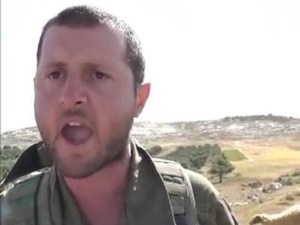
"I'll give you one in the head," threatens the soldier who lost his composure (Screen shot).

“I’ll give you one in the head,” threatens the soldier who lost his composure (Screen shot).

Umm Al Amad 27.4.2013, IOF no need to add a word!

Almost every week, photographs and video of weekly activity by Ta’ayush in the southern West Bank circulate on social media. Ta’ayush is an Israeli-Palestinian grassroots partnership to end the occupation through non-violent direct action, currently focused on Israeli activists from Jerusalem working with Palestinian farmers in the especially troubled South Hebron Hills area. The videos and pictures generally circulate among fellow activists and supporters, rarely making the mainstream news in Israel. Typically, they show some sort of confrontation between on one side activists and farmers trying to access and work on their land, by ploughing a field or shepherding a flock, and on the other side Israeli soldiers, police, and settlers who prevent them from doing so, sometimes violently. More than 300 videos documenting such routine acts of denial of access to land, often accompanied by arrests and violence, are located on a Ta’ayush activist’s YouTube Channel, guybo111, which has attracted more than 400,000 views. The videos document the routine of Israeli Occupation, the creeping annexation of Area C of the West Bank, including small acts of dispossession and coercion. As routine, the videos and events they show in raw footage, accompanied by minimal textual explanation, are rarely considered newsworthy. Sometimes someone bleeds, but it doesn’t lead in mainstream Israeli media.


This week, however, a video of one such event was picked up, by both the Y-net service of Israel’s mainstream newspaper, Yediot Aharonot, and the on-line news service of Walla!, a main Israeli web portal. Whereas the activist video carried (in English) the heading: “Umm Al Amad 27.4.2013, IOF no need to add a word!” the Y-net (in Hebrew) article is titled “’Arab lover’: Soldier documented yelling at Leftist Activists,” and in English, “Watch: IDF soldier lashes out at activists.” The headline of the article on Walla! is: “Soldier threatened: ‘I’ll give you one in the head, you’re worse than the Arabs’.” For activist circulation, the video needs no explanation or translation, the location being given by its Arabic name rather than the nearby illegal outpost settlement, Otniel, and the Israeli army labelled as Israeli Occupation Forces. The text that accompanies the video on the +972 blog, which opposes the occupation is committed to human rights and freedom of information provide more explanation

:

Israeli Ta’ayush activists who were accompanying Palestinian shepherds in the southern West Bank village Umm al Amad on Saturday were confronted by a soldier who lost his cool, to say the least.

According to Guy, the Israeli activist who filmed the video below, this is private Palestinian land (the Otniel settlement is nearby) that the IDF and settlers routinely try and keep the Palestinian residents out of. In the video below, the soldier can be seen first approaching the Palestinian shepherd, screaming in his face in Arabic: “You better watch it!” Then Guy tells the soldier not to scream at him and to leave him alone, to which the soldier turns to Guy, screaming: “Get out of here you Israel haters, I’ll kick the crap out of you. You are worse than the Arabs.”

He then turned to one of the female Israeli activists and said: “Shut up, Israel hater who goes to bed with Arabs.”

On Y-net news, only Otniel is mentioned, the soldier is identified as a reservist, and in addition to the testimony of the activist, an army spokesperson is quoted saying:

“Leftwing activists gathered near Otniel. While security forces were trying to disperse them, a reserve unit and an activist confronted each other. Following the release of the video, the IDF will question the reservist about the incident and the proper measures will be taken. In general, this incident does not reflect the behavior expected of security forces and the issue will be clarified.”

The longer Walla! report mentions that other soldiers tried to calm the reservist who had lost control of himself, and also provides some background, explaining briefly about Ta’ayush, as well referring to a more serious violent incident a year ago in which Lieutenant Colonel Shalom Eisner struck an activist with his rifle butt  (after which he was removed from his position). The report also quotes an unnamed senior officer in the West Bank who considers the Israeli activists to be provocateurs who stir up trouble.


So there was a minor incident, remarkable neither for harm done to Israeli “leftist” activists or Palestinian farmers, which raises the question of why this week’s incident became newsworthy. Perhaps it is news because something of the mask fell away from the occupation. Wrapping itself in a mantle of quasi-legality, bureaucratic procedures, and policing tactics, the occupation likes to present itself as calm, business as usual. It doesn’t like to appear as its racist, sexist self, according to which all Israelis who act in solidarity with the civil and political rights of Palestinians are traitors, and thus “worse” than Arabs (who are seen to be inherently bad), especially Israeli women, whose “disloyalty” upsets the ethno-sexist assumption that Jewish women should belong to Jewish men. In this light, the Ta’ayush  activists are provocateurs, provoking the occupation forces to show that it has no legitimacy in claims to provide “security,” and that the very premise of Jewish ownership of all the land is racist.

More than that, the Biblical Hebrew phrase used by the offending soldier “ochrei yisrael does not simply mean “enemy of Israel” but “troubler of Israel”. While it is a curse often flung at Israeli leftists, its Biblical provenance should be, well, troubling to the cursers. One such “troubler of Israel” is Achan, the Israelite stoned and burned (along with his family) for looting precious and idolatrous objects from Jericho during Joshua’s invasion of Canaan, for which the Israelites were punished by God with defeat in their first assault on Ai (Joshua 7). Those who hurl the insult of “troubler of Israel” at leftists are perhaps comfortable with the reminder that the Promised Land had to be seized violently by the Israelites under the leadership of the ethnic cleanser Joshua. Yet the troubling implication is that the current conquerors of the Promised Land are themselves guilty of looting idolatrous objects, in this case the land itself, in whose service they are prepared to commit all sorts of immoral acts, and all kinds of modern idolatries.

The prophet Elijah is also called a “troubler of Israel” by King Ahab, although Elijah then turns around the accusation, labelling Ahab’s idolatry as the trouble brought on Israel (1 Kings 18). Merely calling Ta’ayush leftists “troublers” does not make them the idolaters, the sinners, since the charge can be reversed. This is the trouble that Ta’ayush cause, walking in the ways of righteousness by lending support to the oppressed, and by doing so, provoking the ire of the idolaters of the land.