Category Archives: Anti-occupation

Troublers of Israel point to the Trouble with Israel

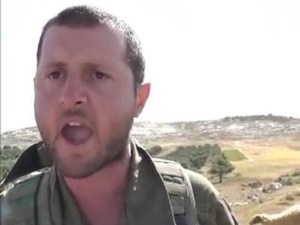
"I'll give you one in the head," threatens the soldier who lost his composure (Screen shot).

“I’ll give you one in the head,” threatens the soldier who lost his composure (Screen shot).

Umm Al Amad 27.4.2013, IOF no need to add a word!

Almost every week, photographs and video of weekly activity by Ta’ayush in the southern West Bank circulate on social media. Ta’ayush is an Israeli-Palestinian grassroots partnership to end the occupation through non-violent direct action, currently focused on Israeli activists from Jerusalem working with Palestinian farmers in the especially troubled South Hebron Hills area. The videos and pictures generally circulate among fellow activists and supporters, rarely making the mainstream news in Israel. Typically, they show some sort of confrontation between on one side activists and farmers trying to access and work on their land, by ploughing a field or shepherding a flock, and on the other side Israeli soldiers, police, and settlers who prevent them from doing so, sometimes violently. More than 300 videos documenting such routine acts of denial of access to land, often accompanied by arrests and violence, are located on a Ta’ayush activist’s YouTube Channel, guybo111, which has attracted more than 400,000 views. The videos document the routine of Israeli Occupation, the creeping annexation of Area C of the West Bank, including small acts of dispossession and coercion. As routine, the videos and events they show in raw footage, accompanied by minimal textual explanation, are rarely considered newsworthy. Sometimes someone bleeds, but it doesn’t lead in mainstream Israeli media.


This week, however, a video of one such event was picked up, by both the Y-net service of Israel’s mainstream newspaper, Yediot Aharonot, and the on-line news service of Walla!, a main Israeli web portal. Whereas the activist video carried (in English) the heading: “Umm Al Amad 27.4.2013, IOF no need to add a word!” the Y-net (in Hebrew) article is titled “’Arab lover’: Soldier documented yelling at Leftist Activists,” and in English, “Watch: IDF soldier lashes out at activists.” The headline of the article on Walla! is: “Soldier threatened: ‘I’ll give you one in the head, you’re worse than the Arabs’.” For activist circulation, the video needs no explanation or translation, the location being given by its Arabic name rather than the nearby illegal outpost settlement, Otniel, and the Israeli army labelled as Israeli Occupation Forces. The text that accompanies the video on the +972 blog, which opposes the occupation is committed to human rights and freedom of information provide more explanation

:

Israeli Ta’ayush activists who were accompanying Palestinian shepherds in the southern West Bank village Umm al Amad on Saturday were confronted by a soldier who lost his cool, to say the least.

According to Guy, the Israeli activist who filmed the video below, this is private Palestinian land (the Otniel settlement is nearby) that the IDF and settlers routinely try and keep the Palestinian residents out of. In the video below, the soldier can be seen first approaching the Palestinian shepherd, screaming in his face in Arabic: “You better watch it!” Then Guy tells the soldier not to scream at him and to leave him alone, to which the soldier turns to Guy, screaming: “Get out of here you Israel haters, I’ll kick the crap out of you. You are worse than the Arabs.”

He then turned to one of the female Israeli activists and said: “Shut up, Israel hater who goes to bed with Arabs.”

On Y-net news, only Otniel is mentioned, the soldier is identified as a reservist, and in addition to the testimony of the activist, an army spokesperson is quoted saying:

“Leftwing activists gathered near Otniel. While security forces were trying to disperse them, a reserve unit and an activist confronted each other. Following the release of the video, the IDF will question the reservist about the incident and the proper measures will be taken. In general, this incident does not reflect the behavior expected of security forces and the issue will be clarified.”

The longer Walla! report mentions that other soldiers tried to calm the reservist who had lost control of himself, and also provides some background, explaining briefly about Ta’ayush, as well referring to a more serious violent incident a year ago in which Lieutenant Colonel Shalom Eisner struck an activist with his rifle butt  (after which he was removed from his position). The report also quotes an unnamed senior officer in the West Bank who considers the Israeli activists to be provocateurs who stir up trouble.


So there was a minor incident, remarkable neither for harm done to Israeli “leftist” activists or Palestinian farmers, which raises the question of why this week’s incident became newsworthy. Perhaps it is news because something of the mask fell away from the occupation. Wrapping itself in a mantle of quasi-legality, bureaucratic procedures, and policing tactics, the occupation likes to present itself as calm, business as usual. It doesn’t like to appear as its racist, sexist self, according to which all Israelis who act in solidarity with the civil and political rights of Palestinians are traitors, and thus “worse” than Arabs (who are seen to be inherently bad), especially Israeli women, whose “disloyalty” upsets the ethno-sexist assumption that Jewish women should belong to Jewish men. In this light, the Ta’ayush  activists are provocateurs, provoking the occupation forces to show that it has no legitimacy in claims to provide “security,” and that the very premise of Jewish ownership of all the land is racist.

More than that, the Biblical Hebrew phrase used by the offending soldier “ochrei yisrael does not simply mean “enemy of Israel” but “troubler of Israel”. While it is a curse often flung at Israeli leftists, its Biblical provenance should be, well, troubling to the cursers. One such “troubler of Israel” is Achan, the Israelite stoned and burned (along with his family) for looting precious and idolatrous objects from Jericho during Joshua’s invasion of Canaan, for which the Israelites were punished by God with defeat in their first assault on Ai (Joshua 7). Those who hurl the insult of “troubler of Israel” at leftists are perhaps comfortable with the reminder that the Promised Land had to be seized violently by the Israelites under the leadership of the ethnic cleanser Joshua. Yet the troubling implication is that the current conquerors of the Promised Land are themselves guilty of looting idolatrous objects, in this case the land itself, in whose service they are prepared to commit all sorts of immoral acts, and all kinds of modern idolatries.

The prophet Elijah is also called a “troubler of Israel” by King Ahab, although Elijah then turns around the accusation, labelling Ahab’s idolatry as the trouble brought on Israel (1 Kings 18). Merely calling Ta’ayush leftists “troublers” does not make them the idolaters, the sinners, since the charge can be reversed. This is the trouble that Ta’ayush cause, walking in the ways of righteousness by lending support to the oppressed, and by doing so, provoking the ire of the idolaters of the land.
Obama’s Peace, Our Occupation

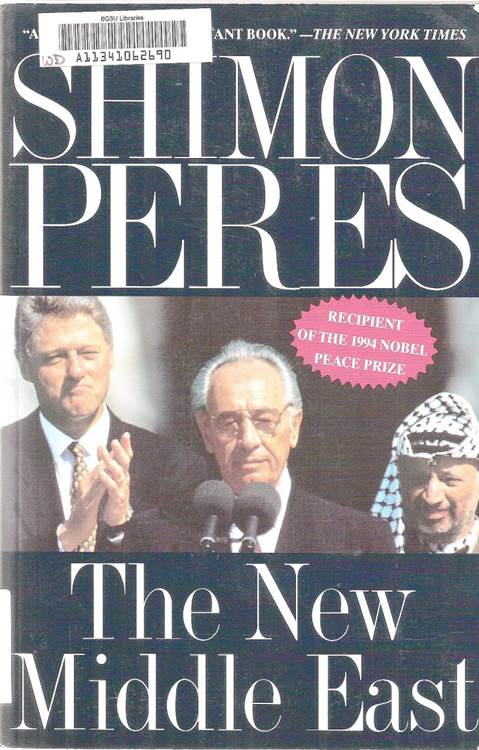
Cover of Shimon Peres' book from 1993

Cover of Shimon Peres’ book from 1993

Watching Obama's speech in Rabin square. From Peace Now facebook page.

Watching Obama’s speech in Rabin square. From Peace Now facebook page.

Despite the low expectations about President Obama’s visit to Israel and Palestine, everyone on the Israeli left seems to want to talk about his speech to Israeli students, which was also his direct address to the Israeli public rather than its politicians. Quick off the mark was Moriel Rothman in his Leftern Wall blog, who found five positive points in the otherwise biased, ‘gloop-filled’ speech, such as Obama’s call for an independent, viable Palestinian state to achieve peace, his condemnation of unpunished settler violence, and especially the phrase: ‘Neither occupation nor expulsion is the answer’. Similarly, Gush Shalom praised the speech for reminding us ‘that peace is possible and necessary, that we do have a partner for peace, … and that Israel must end the occupation’. Peace Now labelled it a ‘historic speech’. Commentators in Ha’aretz were impressed too. Ari Shavit considered the 18 minutes of the speech dedicated to the pursuit of a necessary, just and possible peace to be ‘a soft admonishment’ to Israelis in what was otherwise ‘a royal visit of love’. According to Barak Ravid, the speech was ‘a combination of a warm embrace and a punch in the gut’, both identifying with Jewish Israeli self-perceptions and also trying to ‘shake their paranoia and their fears’. More critical voices on the +972 blog noted that while the speech contained some ‘niceties regarding peace … the Right proved that the occupation has no cost, that the rift with the U.S. doesn’t exist and that denying the Palestinians their freedom is sustainable policy’. Obama called settlements ‘counterproductive’ to peace, but he did not repeat his 2009call for a freeze. And he endorsed the recent Israeli expectation to be recognized as a Jewish State by the Palestinian Authority, even though about twenty percent of Israel’s population isn’t Jewish but Palestinian Arab.

Obama’s visit to Israel was a successful charm offensive, his speech being a key part of that by taking rhetorical responsibility for the state of mind of the Jewish Israeli public. He did this most clearly when he said first in Hebrew and then in English ‘You are not alone’ so long as the USA exists, a point repeated twice when he said that ‘Israel has the unshakable support of the most powerful country in the world’ and that the USA is ‘a country that you can count on as your greatest friend’. Before first making that point, he had rehearsed the Zionist narrative of Jewish exile, persecution, and longing for return to the promised land, of building the land, of resilient defence in the face of external hatred and military threats to the state’s existence and terrorism, of rebuffed offers for peace to the Arab world. No wonder, then, that for the audience in Ramallah Obama’s speech proved that he’s more Jewish than the Jews, according Amira Hass’s report. And perhaps it’s less surprising, given all this reassurance that Jewish Israeli fears are not only understood but also justified, that the applause continued to punctuate Obama’s speech when he called for justice for Palestinians too, for them to be ‘a free people in their own land’ (echoing the words of Hatikva, the Israeli national anthem, in reference to Jewish nationhood).

In advance of Obama’s delivery of the speech, we were told that its writer, Ben Rhodes, would want to convey messages that ‘that Israel can no longer rely on authoritarian leaders in Egypt and elsewhere in the Arab world to help guarantee its security’ and that ‘people can make a difference, even if their leaders are stuck’. Those points were made, but what matters more are the grounds of the American appeal to Jewish Israel (overlooking the non-Jewish fifth of Israel) which is based on complete American identification with Israel. The speech also hopes that the reassurance of this empathetic identification will propel Jewish Israelis to identify with what it takes to be the shared hopes of Palestinians. It offers an image of peace in which both Israelis and Palestinians are said to want the same things: ‘the ability to make their own decisions and to get an education and to get a good job, to worship God in their own way, to get married, to raise a family’. The speech asks the audience to imagine ‘a future in which Jews and Muslims and Christians can all live in peace and greater prosperity in this Holy Land’. In the final section of the speech, Obama focused on Israeli prosperity and innovation, echoing the Israeli PR image of the ‘start-up nation’. He figured Israel as the embodiment of that which people across the Middle East ‘are yearning for — education, entrepreneurship, the ability to start a business without paying a bribe, the ability to connect to the global economy’. In other words, Obama asked Jewish Israelis to identify peace with the sort of prosperity offered by neo-liberal global capitalism, the prosperity that some Israelis do enjoy, but most feel excluded from, as demonstrated by the massive social protests of the summer of 2011. Nonetheless, it is a positive image of peace that speaks to Israeli sensibilities, a continuation of the charm offensive. His host, Israeli President Shimon Peres, had tried to sell a similar image of peace at the time of the Oslo agreements, but his vision of a prosperous new Middle East has long since been tarnished by the absence of peace and the failure of negotiations.

Yet, in another key section of the speech Obama identified peace as justice, first insisting on the centrality of Israeli security to any peace agreement, then calling on Israelis to identify with Palestinians, to ‘put yourself in their shoes. Look at the world through their eyes’. Briefly, Jewish Israelis were invited to see the Israeli military as a ‘foreign army’ in the Palestinian occupied territories, to see themselves as farmers barred from their land and families displaced from their homes. But only briefly, and then peace as justice gave way to peace as prosperity, and the Israeli audience saw itself mirrored again in America’s unconditional love, the favoured child of its Big (M)Other, tied by a relationship that began just ‘eleven minutes after Israeli independence’.

In this speech Obama failed to ‘create the change that you want to see’, if indeed he wanted to picture peace as justice and for Israelis to identify with Palestinians. Instead, he reinforced the prevalent Israeli view that their security takes precedence over justice for Palestinians (in the form of the ending of occupation and independent statehood). The speech reassures Jewish Israelis that they should repeat their hegemonic narrative of victimhood and persecution, according to which the question of justice pertains primarily to righting the wrong of past generations through present force and might. Seeing itself in the mirror of American power, when asked to see the world through Palestinian eyes, this Jewish Israeli narrative can see only that a Palestinian child is being beaten, not that we are beating the Palestinian child.

No justice, no peace.