Category Archives: anti-war

Mourning the fallen: working through bereavement

As I begin to write this blog, there are three hours left of the twelve hour humanitarian truce in the military violence of Operation Protective Edge. It’s Shabbat, so there are no funerals in Israel today, but there have already been more than thirty funerals for fallen soldiers so far and there will be more. This morning the Israeli military announced the deaths of another two personnel, and then another three, bringing the total to fourty. Each death brings to an early end the story of an individual, a son, a brother, a young person with hopes and dreams. Each death brings immeasurable grief to families and friends, indescribable loss, unending mourning. For Hamas, for Gazans, these losses inflicted on “the Zionist enemy” are a cause for celebration, evidence of another “victory,” as they did when they claimed to have captured Oren Shaul. Certainly, that is how the Israeli media and much of the Israeli public perceive Palestinian response to their loss.

Israel wraps the families of its fallen in the solidarity of public mourning. Families do not mourn alone, as the dead are held to be everyone’s sons, everyone’s boys. A grass roots campaign to encourage people to attend the funeral of Max Steinberg, an American who came to Israel to serve in the army without his family, brought 30,000 to act as his surrogate family. The price paid is a collective price, mourned once at the funeral, during the week long shiva, and then again and again on each Memorial Day.

It is in the nature of the trauma brought on by bereavement to return to the loss. The mourning is repeated, as the loss becomes part of the identity, the very being, of the bereaved. Not to mourn, again and again, would mean to betray those who are lost. Not to be haunted by their death would mean to kill them again. If that is how an individual feels, what is it like when a whole nation feels it?

Yet, the repetition of mourning is destructive. Not only is mourning repeated, but so is the situation in which the mourning first occurred. If the memory of the fallen is to be honoured, then it must be given meaning. In the case of nationally felt loss, the meaning is the survival of the nation. The reason why the dead sons fell is so that the rest of the rest of the national family can live on. The dead fell to protect the family from an enemy, an Other, who must remain the enemy and the Other if the death of the sons is to have meaning, to have been for something, to not have been senseless. The situation of loss is one in which more sons will continue to fall to make sense of the deaths of the sons who have already fallen. Because senseless loss is truly unbearable.

To break the repetition of mourning , the return to the situation of loss, the mourning has to be worked through. A way has to be found to live, not without forgetting the lost, not without ceasing to mourn – as if bereavement could ever stop – but to live in a way so that the act of mourning does not make sense through more deaths. I have never had to mourn the loss of a parent, child or sibling in war. I do not know how it feels, and I never want to. Those who have found a way to work through mourning agree with me. They don’t want me to join them in bereavement. As the Parents Circle Family Forum say, repeatedly, in this video: they don’t want me with them, because they do know how that loss feels.

Each of them has worked through mourning to the point where they can also feel the pain of the Other, Israelis and Palestinians. Or maybe only by feeling the pain of the Other have they worked through mourning to live without the need for revenge, to revisit the situation of loss by seeing the enemy as implacable, incapable of mourning, glorifying and sanctifying their dead without feeling pain.  When the Bereaved Families mourn those who have fallen in conflict, they do so together, in a ceremony that takes place on the same day as the Israeli Memorial Day. In dialogue with the mourning of the Other, finding themselves in each other, they seek a reconciliation that will bring not only the bereaved, but those who are yet to be bereaved, out of the situation of loss which brings no security, only more loss. And that is why tonight, as the humanitarian truce has ended been (as I wrote) extended, the bereaved families will be in Rabin Square in a rally organized by Combatants for Peace with many others, Jews and Arabs, calling for an end to the deaths. There will be no end to human mourning and bereavement, but there can be an end to this senseless bereavement.
The Qana Moment: When the Israeli government falls off its Protective Edge

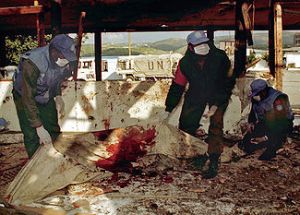
When the Israeli government and military began Operation Protective Edge, they must have known that the moment would come. I’ll call it the Qana moment after the incident on April 18, 1996, during Operation Grapes of Wrath, a round of the war between Israel (with its proxy, the South Lebanon Army) and Lebanon (in the form of Hezbollah). Then, as now with the hostilities between Israel and Gaza, an undercurrent of violence flared up into open warfare, with each side blaming the other for starting it. Then, as now, Israeli authorities accused their opponents of using civilians as human shields.

UNIFIL Peacekeepers (Qana 1996) Remove Artillery Attack Victim Remains

UNIFIL Peacekeepers (Qana 1996) Remove Artillery Attack Victim Remains

Then, as now, Israeli authorities called on civilians to leave the area in which they were going to attack, and hundreds of thousands did flee. Some 800 of them took refuge in a UN compound, nearby from which Hezbollah fighters fired rockets and mortar rounds towards Israeli military positions. In the response, Israeli artillery shells struck the compound, killing 106 and injuring many more. International outrage did not immediately halt the military campaign, although on the same day the UN Security Council passed resolution 1052 calling for an immediate ceasefire, which was not reached until ten days later. A subsequent UN investigation concluded that it was extremely unlikely that the Israeli shells had hit the compound by accident, and in its rejection of the report the Israeli government continued to claim that it had not intended to hit the compound.

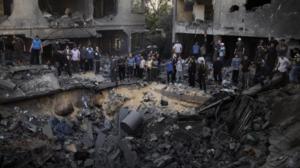
The Qana moment is not an isolated incident in Israel’s asymmetrical wars against non-state foes, when “by accident” a horrific number of civilians are killed by Israeli munitions. In the last round of the Israel-Gaza war in 2012, the moment was the Al-Dalu family killing on 18 November, in which twelve people died in an attack on a home.

Palestinian men gather around a crater caused by an Israeli air strike on the al-Dalu family's home in Gaza City on November 18, 2012. (AFP Photo / Marco Longari)

Palestinian men gather around a crater caused by an Israeli air strike on the al-Dalu family’s home in Gaza City on November 18, 2012. (AFP Photo / Marco Longari)

In Cast Lead, in 2009, it was the shelling on January 6 of the al-Fakhura school in which hundreds of people were sheltering, killing more than 40 of them. The story is always the same. The Israeli authorities say that they were targeting a source of fire or some armed people or installation, and that the civilians were too close to the target, or there was some technical error. As Moriel Rothman-Zecher put it on his Leftern Wall blog, the Israeli authorities’ intention matters less than the consequences of their action. The killing of civilians is not an incidental by-product of this sort of asymmetrical warfare: it is an inevitable element of it, just as the deaths of Israeli soldiers, some by “friendly-fire,” are inevitable when the air war becomes a ground war. When Israeli authorities wage war in this way, it simply means that they intend to hit their targets. That is a military, not a moral, stance.

The Qana moment may already have happened in this bout of hostilities, Protective Edge. It might have been the bombing of the Abu Jameh family home on July 20th, killing 25, apparently without warning. As I write, details are emerging of another deadly strike that is eerily similar to the al-Fakhura incident: an UNWRA school in Beit Hanoun in which people had sought shelter but were apparently trying to evacuate, was hit by shells, killing about 10-15 and injuring many more.

The Qana moments don’t stop the violence (or bring the Western governments that support Israel’s “right to self-defense to withdraw their public support), nor does media attention to them address the whole range of death and destruction. At this point, unlike in the actual Qana moment, the UN Security Council has not resolved that there be an immediate ceasefire, although the UN human rights council has formed a commission to look into possible Israeli war crimes. The Israeli response has been dismissive, with Justice Minister Tzipi Livni saying “get lost” and Prime Minister Netanyahu calling it a travesty, given Hamas’ war crimes. In all probability, when the UN completes its report, the Israeli government will reject it, just as they after Grapes of Wrath, and for the same reasons. And when civilians are killed again in the next operation, and the one after that, and so on, they will repeat the same talking points as civilians die.

The deadly repetition of inevitable civilian casualties might perhaps be slowed if not halted by an Israeli public opinion that is as appalled by them as much as public opinion is elsewhere. But unless Israelis are seeking out alternative news to that provided by their mainstream media, they will see and hear little about the Palestinian casualties. Surely if Israeli authorities were as confident in the “righteousness of our way” as they claim to be, as in the new President Reuven Rivlin’s swearing in speech, then there would be no problem for the Israeli public to be fully aware of each “justified” death, each “justified” injury, each “justified” destruction of homes, and hospitals, and mosques. As a way of bringing the public’s attention to that for which they bear responsibility but do not hear, Israeli human rights groups B’tselem tried to pay for a spot on Israeli public radio in which the names of some of the dead Palestinian are read out. But the Israeli Broadcasting Authority rejected the group’s appeal to place the spot, so instead it can be found on social media, out of sight and mind of most of the Israeli public and its sphere of ethical responsibility.

“Every person has a name” goes the Hebrew song that is used on memorial days for soldiers and the Holocaust. And indeed, everyone does have a name, and the taking of that name cannot be excused by talking points. The cost of the Qana moments is horrendous, but they have the power to remind all of us of our ethical responsibility.