Category Archives: Protest

The Peace of Jerusalem

Sheikh Jarrah vigil, November 30. 2012

Sheikh Jarrah vigil, November 30. 2012

10.5.2013 No to another eviction from Sheikh Jarrah (Guy Butavia)

10.5.2013 No to another eviction from Sheikh Jarrah (Guy Butavia)

If there were peace, there would be no need for peace activists to demonstrate against the desire of some Israeli Jews to live in a particular neighbourhood of Jerusalem. But if there were peace, the Shamasneh family would not be facing eviction from its home in the East Jerusalem area of Sheikh Jarrah to make room for Jewish families. If there were peace, Palestinians could live where they liked in Jerusalem too, including in their former homes in the neighbourhoods of Baka, Talbiyeh, the Katamonim, from which they were driven by Israeli conquest in 1948. According to the structural injustice of Israeli law, specifically the Absentees’ Property Law (1950), former Palestinian owners of homes in West Jerusalem, now refugees, have no rights to their property. Yet, Jewish owners do have rights to their land in East Jerusalem that came under control of the Jordanian Custodian for Enemy Properties after 1948, which used the land to settle Palestinian refugees. Following the 1967 war the land and homes built on it were taken over by the Israeli General Custodian. Although Israeli law does grant protected tenancy to Palestinians who had rental agreements prior to 1968, the Shamasne family have been unable to prove to the satisfaction of the Jerusalem magistrates court that they have such status. Their case comes before the Israeli High Court on May 20th 2013, which explains why there was a demonstration last Friday (May 10th 2013) to raise awareness about the impending eviction.


This is not an isolated incident, but part of an ongoing campaign to ‘Judaize’ East Jerusalem, to erase the Palestinian presence there and to deny its status as a key Palestinian city, if not its capital. The State of Israel annexed Arab East Jerusalem in the wake of the 1967 war, then began a massive programme building twelve suburbs there such as Pisgat Ze’ev, Gilo, and most recently Har Homa, in which about 190,000 Israelis now live. Again, there is nothing in itself wrong with the housing developments in Jerusalem, but as neither the national or local Israeli government enabled or permitted development of the Palestinian areas of Jerusalem, such building must be understood as part of a process to privilege Jewish sovereignty over the city. The building projects are concrete, financial and bureaucratic aspects of the ethnocentric superiority that was evident in last week’s Jerusalem Day parade, an annual event that marks the ‘liberation’ of East Jerusalem through Israeli conquest in 1967. For the right-wing, religious march to proceed, Palestinian and Israeli leftist had to be cleared by police from the Damascus Gate entrance into the Old City of Jerusalem.


Another way that Israeli government obstructs Palestinian development in East Jerusalem is to declare as yet undeveloped areas to be parks that may not be built on, as is the case of the Slopes of Mt. Scopus National Park that hems in the villages of Issawiya and A-Tur. Even more destructive is the building of large roads through Palestinian areas, notably the evisceration of Beit Safafa and Beit Hanina as reported recently by Nir Hasson in Ha’aretz. Yet, the most contentious of the steps to ‘Judaize’ Jerusalem are the small settlement compounds in Palestinian neighbourhods, in which some 2,300 Jews now live, such as the Muslim Quarter of the Old City, Silwan, and since 2008, Sheikh Jarrah.


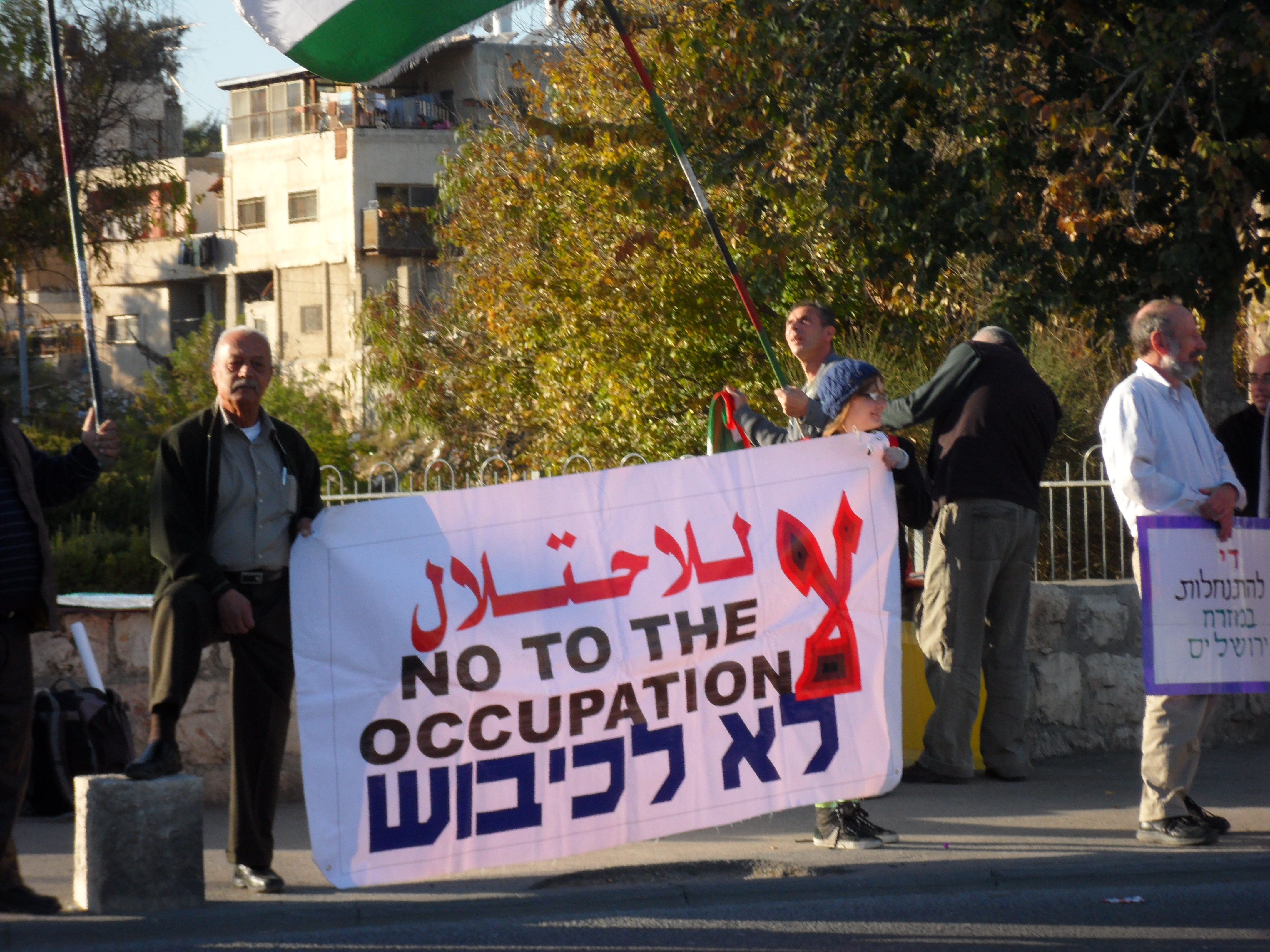
The Israeli peace camp had consistently joined in solidarity with Palestinians to protest these inflammatory settlements, which are maintained only by a massive and intrusive security presence. But the attempt to move into Sheikh Jarrah provoked not merely a few demonstrations but a sustained campaign of determined resistance to threats of evictions, settler violence, and police partisanship, Sheikh Jarrah Solidarity. As this video chronicle shows, the efforts of the police to suppress the legal demonstrations with arrests backfired, encouraging more mainstream participants, such as the Israeli author David Grossman, to join in the growing events. Eventually, the police backed off after being reprimanded by the courts for some of the arrests they made and their infringements of the rights of protestors. The campaign did lose some steam, as some activists burnt out and others shifted their attention to other hotspots in Jerusalem or elsewhere. But the campaign did not die, maintaining a weekly vigil in Sheikh Jarrah, one of which I participated in on November 30th, 2012. That day, two or three score Jewish Israelis and Palestinians stood by the roadside, holding banners with slogans such as ‘No to Occupation’ and ‘End the Settlement in East Jerusalem, along with Palestinian flags, accompanied by a steady drum beat. There were no police present (though some did pass occasionally), and most of the passing traffic was supportive, often honking horns. Ultra-orthodox Jewish men seemed unafraid to walk alone or in pairs to and from the Tomb of Shimon the Righteous that is in the neighbourhood. As an event, it was unremarkable, but the vigil was less a spectacle than a meeting or networking site. Some guys remained in a huddle near a low wall, discussing their upcoming court cases ensuing from earlier incidents in which they had been arrested. Some of the conversation going on was about a local committee being established to represent all of the residents and business owners in the neighbourhood. These were the conversations that create and sustain solidarity.


In other respects, the single event itself was very similar to demonstrations against East Jerusalem settlements I had attended some twenty years previously – the same slogans were held up, and even some of the same faces were there. It is the nurturing of solidarity between Israelis and Palestinians that is different. This ongoing campaign not only says ‘no to occupation’, but also ‘yes’ to ‘partnership between Arabs and Jews, Palestinians and Israelis’, yes to ‘an alternative to the hatred and suspicion, which are imprisoning us all behind walls’. Essential to such solidarity is recognition that Palestinian ‘refugees from 1948 have been expelled from their homes in 2010 and turned into refugees for a second time’, and thus that the just political arrangement that the settlement tries to block must take into account not only what happened in 1967, but also in 1948. And this is not only solidarity of Israelis with Palestinians, but a mutual solidarity, in which the struggle to overcome discriminatory land laws and arbitrary police suppression of demonstrations is a struggle to realize democracy and equality. The peace of Jerusalem is not a matter of which people hold rights to which pieces of it; it is in the fabric of the patient solidarity that stands consistently, weaving relationships of justice and equality between those for whom the Shamasne family matters.
Troublers of Israel point to the Trouble with Israel

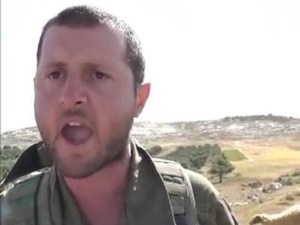
"I'll give you one in the head," threatens the soldier who lost his composure (Screen shot).

“I’ll give you one in the head,” threatens the soldier who lost his composure (Screen shot).

Umm Al Amad 27.4.2013, IOF no need to add a word!

Almost every week, photographs and video of weekly activity by Ta’ayush in the southern West Bank circulate on social media. Ta’ayush is an Israeli-Palestinian grassroots partnership to end the occupation through non-violent direct action, currently focused on Israeli activists from Jerusalem working with Palestinian farmers in the especially troubled South Hebron Hills area. The videos and pictures generally circulate among fellow activists and supporters, rarely making the mainstream news in Israel. Typically, they show some sort of confrontation between on one side activists and farmers trying to access and work on their land, by ploughing a field or shepherding a flock, and on the other side Israeli soldiers, police, and settlers who prevent them from doing so, sometimes violently. More than 300 videos documenting such routine acts of denial of access to land, often accompanied by arrests and violence, are located on a Ta’ayush activist’s YouTube Channel, guybo111, which has attracted more than 400,000 views. The videos document the routine of Israeli Occupation, the creeping annexation of Area C of the West Bank, including small acts of dispossession and coercion. As routine, the videos and events they show in raw footage, accompanied by minimal textual explanation, are rarely considered newsworthy. Sometimes someone bleeds, but it doesn’t lead in mainstream Israeli media.


This week, however, a video of one such event was picked up, by both the Y-net service of Israel’s mainstream newspaper, Yediot Aharonot, and the on-line news service of Walla!, a main Israeli web portal. Whereas the activist video carried (in English) the heading: “Umm Al Amad 27.4.2013, IOF no need to add a word!” the Y-net (in Hebrew) article is titled “’Arab lover’: Soldier documented yelling at Leftist Activists,” and in English, “Watch: IDF soldier lashes out at activists.” The headline of the article on Walla! is: “Soldier threatened: ‘I’ll give you one in the head, you’re worse than the Arabs’.” For activist circulation, the video needs no explanation or translation, the location being given by its Arabic name rather than the nearby illegal outpost settlement, Otniel, and the Israeli army labelled as Israeli Occupation Forces. The text that accompanies the video on the +972 blog, which opposes the occupation is committed to human rights and freedom of information provide more explanation

:

Israeli Ta’ayush activists who were accompanying Palestinian shepherds in the southern West Bank village Umm al Amad on Saturday were confronted by a soldier who lost his cool, to say the least.

According to Guy, the Israeli activist who filmed the video below, this is private Palestinian land (the Otniel settlement is nearby) that the IDF and settlers routinely try and keep the Palestinian residents out of. In the video below, the soldier can be seen first approaching the Palestinian shepherd, screaming in his face in Arabic: “You better watch it!” Then Guy tells the soldier not to scream at him and to leave him alone, to which the soldier turns to Guy, screaming: “Get out of here you Israel haters, I’ll kick the crap out of you. You are worse than the Arabs.”

He then turned to one of the female Israeli activists and said: “Shut up, Israel hater who goes to bed with Arabs.”

On Y-net news, only Otniel is mentioned, the soldier is identified as a reservist, and in addition to the testimony of the activist, an army spokesperson is quoted saying:

“Leftwing activists gathered near Otniel. While security forces were trying to disperse them, a reserve unit and an activist confronted each other. Following the release of the video, the IDF will question the reservist about the incident and the proper measures will be taken. In general, this incident does not reflect the behavior expected of security forces and the issue will be clarified.”

The longer Walla! report mentions that other soldiers tried to calm the reservist who had lost control of himself, and also provides some background, explaining briefly about Ta’ayush, as well referring to a more serious violent incident a year ago in which Lieutenant Colonel Shalom Eisner struck an activist with his rifle butt  (after which he was removed from his position). The report also quotes an unnamed senior officer in the West Bank who considers the Israeli activists to be provocateurs who stir up trouble.


So there was a minor incident, remarkable neither for harm done to Israeli “leftist” activists or Palestinian farmers, which raises the question of why this week’s incident became newsworthy. Perhaps it is news because something of the mask fell away from the occupation. Wrapping itself in a mantle of quasi-legality, bureaucratic procedures, and policing tactics, the occupation likes to present itself as calm, business as usual. It doesn’t like to appear as its racist, sexist self, according to which all Israelis who act in solidarity with the civil and political rights of Palestinians are traitors, and thus “worse” than Arabs (who are seen to be inherently bad), especially Israeli women, whose “disloyalty” upsets the ethno-sexist assumption that Jewish women should belong to Jewish men. In this light, the Ta’ayush  activists are provocateurs, provoking the occupation forces to show that it has no legitimacy in claims to provide “security,” and that the very premise of Jewish ownership of all the land is racist.

More than that, the Biblical Hebrew phrase used by the offending soldier “ochrei yisrael does not simply mean “enemy of Israel” but “troubler of Israel”. While it is a curse often flung at Israeli leftists, its Biblical provenance should be, well, troubling to the cursers. One such “troubler of Israel” is Achan, the Israelite stoned and burned (along with his family) for looting precious and idolatrous objects from Jericho during Joshua’s invasion of Canaan, for which the Israelites were punished by God with defeat in their first assault on Ai (Joshua 7). Those who hurl the insult of “troubler of Israel” at leftists are perhaps comfortable with the reminder that the Promised Land had to be seized violently by the Israelites under the leadership of the ethnic cleanser Joshua. Yet the troubling implication is that the current conquerors of the Promised Land are themselves guilty of looting idolatrous objects, in this case the land itself, in whose service they are prepared to commit all sorts of immoral acts, and all kinds of modern idolatries.

The prophet Elijah is also called a “troubler of Israel” by King Ahab, although Elijah then turns around the accusation, labelling Ahab’s idolatry as the trouble brought on Israel (1 Kings 18). Merely calling Ta’ayush leftists “troublers” does not make them the idolaters, the sinners, since the charge can be reversed. This is the trouble that Ta’ayush cause, walking in the ways of righteousness by lending support to the oppressed, and by doing so, provoking the ire of the idolaters of the land.