Category Archives: Protest

Open Letter to Natan Blanc, an Israeli conscientious objector

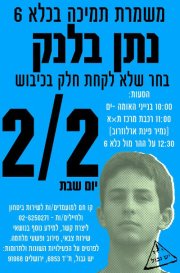
Poster for Yesh Gvul solidarity protest for Natan Blanc

Poster for Yesh Bgvul solidarity protest for Natan Blanc

Natan Blanc

Natan Blanc

Dear Natan,
I am sorry that I cannot be with you in solidarity today on the hill opposite Atlit prison, taking part in the protest against your detention. I am far away in the Unites States, on a wintry, snowy day in Indiana, though rain or shine, I would much rather be spending my day with other activists on the buses organised by the refuser-group, Yesh Gvul, bringing you some moral support as you serve your fifth spell in military jail no. 6. Outside jail, the 20 days of this sentence, in addition to the previous four sentences since November 19, 2012, would slip by quickly. Inside, the time and boredom must weigh heavily on you. It takes a great deal of fortitude to be willing to serve one sentence after another, to persist in your refusal to serve in the Israeli armed forces. We have been privileged to read recently the intimate account by another conscientious objector, Moriel Rothman, of his spell in military jail. From afar, I can only admire your determination and commend the sacrifice you are willing to make for the sake of justice and peace.

I don’t know how much it helps you as you serve your sentence to imagine the people in Israel and beyond who want to give you their strength in support of your ethical stance. But in any case, let me say a little about myself. Some 18 years ago, as a (by then not so new) immigrant, I was inducted into the Israeli armed forces but refused to get on a bus taking us for basic training in the Occupied Territories. I, however, was lucky enough not to have to test my mettle for more than an hour, when an officer prompted me to come up with a personal problem so that I could stay at Tel Hashomer (the induction base) for another week. The same officer then released me until another induction date a few months later, and by the time that day came around I had found my first academic position in the UK and left Israel. It was hard enough to stand my ground for an hour in the car park in the face of various threats and cajolements: I don’t know what it feels like to persist and endure for more than 70 days.

Unlike myself, who grew up in Britain, for most of my teens in the warm environment of a Zionist youth movement, Habonim-Dror, you have had to find your way through the intensive socialization of the Israeli education system on the value and benefits of military service. More than that, you must have to contend with a huge amount of peer pressure, to toe the line, to do your duty to “defend” your country, to prove yourself as a man, to turn yourself into a “full” Israeli citizen, to take on your share of the burden that so many voices today clamor to share equally. In your refusal declaration, you show how clearly you see the blindness, denial, and even outright hypocrisy in all these statements about duty, defense and nationalism. As you say:

It is clear that the Netanyahu Government … is not interested in finding a solution to the existing situation, but rather in preserving it. From their point of view, there is nothing wrong with our initiating a “Cast Lead 2″ operation every three or four years … and we will prepare the ground for a new generation full of hatred on both sides. As … citizens and human beings, [we] have a moral duty to refuse to participate in this cynical game.

Somehow in your 19 year old wisdom you have already learned to see through the ingrained militarism of Israeli culture and society. You already practise the principles of New Profile, the feminist anti-militarism organisation that opposes the occupation, advocates the right of conscientious objection to military service, and supports you and other refusers practically. In their charter, they write that:

we refuse to go on raising our children to see enlistment as a supreme and overriding value. We want a fundamentally changed education system, for a truly democratic civic education, teaching the practice of peace and conflict resolution, rather than training children to enlist and accept warfare.

So, you do not see military service as a value, but instead have taken on another burden, another duty, an ethical duty to refuse to participate in the ongoing oppression and violence of the occupation.
But I do not share equally with you the burden of that duty. Nor when I was 19 could I see as clearly as you do now. No doubt at some point you will be – have been – called a coward. But you are braver than your conformist accusers. You will be told that you are naïve, a lover of your enemies. Yet, you are wiser than your detractors, the purveyors of hate. You will be told that you are a shirker, yet you have taken on a greater burden than any of those cogs in the machines of war and occupation. Thank you for your service.

Partnering in justice

If I were a cinematographer, I’d show you the scene this way. First you see small groups of Palestinian men and children sitting on rocks on a sunny hillside, mostly in everyday, modern clothes, many smoking as they chat. The camera passes over a few Israelis and a Westerner sitting among them, apparently basking in the sun. To one side, women, more of whom are in traditional dress, are preparing tea over an open fire. You might think it’s a village picnic with a few guests, but then the soundtrack begins to pick up a few agitated voices among the conversations, especially an older man wearing a keffiya and holding a staff who is gesticulating vigorously. The camera follows his gestures, panning across a partially ploughed field and a stationary tractor, pausing to show some temporary buildings on a hillside, and then tracking back to the edge of the field where a loosely ranked collection of Israeli soldiers, border police and civil police watch the seated Palestinians and Israelis. This is no picnic.


Army, border police and civilian police blocking the field at Umm el-Arayes

Army, border police and civilian police blocking the field at Umm el-Arayes

The outpost settlement on the hill, unauthorized even by Israeli authorities, is Mitzpe Yair, located in the especially troubled South Hebron Hills area, where many Palestinians face eviction and the destruction of property to make way for military firing zone 918. The villagers have come from Umm el-Arayes to plough a field owned by their families that the settlers have worked on, thereby turning it into “disputed land” in the eyes of the “Civil” Administration that still governs some 60% of the West Bank, Area C, under the 1993 Oslo agreements. Local Palestinians have been subject to violence and intimidation from the settlers of Mitzpe Yair before, including shepherds from Umm el-Arayes. Activists from the Israeli-Palestinian group Ta’ayush, a grassroots partnership to end the occupation through non-violent direct action, have already been to this spot, have come from Jerusalem early on a Shabbat morning, as they do each week, joining with the Palestinians to try and shield them from physical attack or at least document the violence and obstruction. This time, on December 1st 2012, it’s not the settlers who are the problem, but the whole panoply of occupation forces.


Before the camera started rolling for the scene above, tens of Palestinians and the five Ta’ayush activists allocated to this site (while another ten or so were doing similar work in small groups elsewhere in the area) spread across the field, making ourselves busy by removing stones and burning thorns as the tractor started to plough. Little had been achieved before a contingent of soldiers who had been observing nearby rushed across the rocks and earth, some bringing the tractor to a halt while others ordered everyone else to stop work. By side of the stalled tractor an argument broke out between the commanding officer (who declared the field a “closed military area”), Palestinians (including the tractor driver and the owner of the land), and the Israeli activists. The script of the exchange was already known to the players: “It’s our land and we have the right to plough it;” “you have no legal authority to declare a closed military zone because of a land dispute;” “you’re closing the land to those who own it, but not to the settlers;” and from the military side; “this is only temporary until the dispute is settled in a few days;” (a claim that had been repeated many times already) and “we can detain whom we want.” Both the military and the activists filmed the event and each other up close. Soldiers and activists showed each other documents, though only the former had the weapons with which to authorize their words.

Under the lens of occupation

Under the lens of occupation


Arguing over access to the field

Arguing over access to the field

For a while, there was a brief truce as the officer agreed to wait until the representative of the Civil Administration arrived, but the tractor engine had to remain silent. The uniformed official turned up, along with a contingent of border police and a few civilian police, bringing their own cameras. The arguments were rehearsed again, this time in Arabic as well as Hebrew, the closure document was produced and photographed, but now the closure order was to be enforced under threat of arrest.


Slowly, the field emptied as a ragged line of military police moved towards an edge of the field, accompanied by rather than pushing or moving the remonstrating Palestinians. The order was not defied, but it was not obeyed with any urgency.

Leaving the field

Leaving the field

When everyone had gathered by the side of the field, the border police commander remained unhappy, initiating yet another slow, reluctant movement some twenty meters up onto the hillside. There we sat, as a kind of protest, holding the occupation forces on the spot, exercising a minor power to irritate, to disturb a routine, to exact a small cost, to remind them that there was an issue they had promised to address even under the terms of the unjust laws of occupation. Every day a little Naqba, every day a little resistance. We sat under the watch of the boots on the ground and those in vehicles on both sides of the field, their cameras still recording. We were a fleck in the eye of the occupation as it observed us through its lenses; the fleck in the eye of an enormous bureaucratic-military system of cold and cynical rules and regulations that is blind to the difference between its laws and justice. Yet, we could see from our shared hillside a partnership between Israelis and Palestinians that is just, and a justice that is peace.