
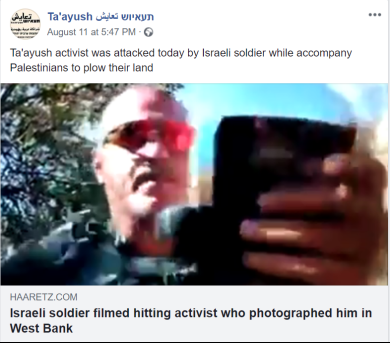
 “Whose provocation?” asks the Ta’ayush activist who has recorded on video an Israeli soldier striking one of her fellow activists. Rightly, she says the provocation came from the soldiers who had come only to see what was happening, not even to serve a “closed military area” order, not even to make the Palestinian farmer stop ploughing the field next to the olive grove, not even to tell the other Palestinians, Italian volunteers and Israeli activists to get lost. So, in that sense, the blows dealt by the soldier to another activist filming him were unprovoked. He seems to have worked himself up into aggression by his own monologue about the “traitors” who were accompanying Palestinians from the town of Bani Naim to work on their land under the noses of the settlers of Pnei Hever. The local relations of occupation between the two places have been rehearsed many times before but of course the settlement has an army on its side in this uneven conflict. On this occasion, and following reports of the incident in Ha’aretz and other news outlets, even the Israeli army deemed that the soldier, Alon Segev, had used excessive force and discharged him from reserve duty. His blows were unprovoked.
Yet, in another – and good – sense, Ta’ayush were being provocative. I was with the Ta’ayush activists in the South Hebron Hills that day, August 10th 2018, but I was elsewhere, accompanying a shepherd, when this incident occurred. When after a short hike I joined the group near Pnei Hever the activist who had been hit was just being driven off to an emergency room as he was feeling unwell. Then I found this provocative scene. While the guy on the tractor got on with his ploughing, Israelis, internationals and Palestinians sheltered from the hot sun under a tree. Hot, sweet tea and coffee were served, some snacks were passed around. Various conversations murmured on in different languages, in a blend of Hebrew and Arabic about the spring connected to a cave whose water used to feed the fields we were in but is now within the fence of the settlement, about politics and peace, about Catalan and linguistics, about how the Israeli matriculation exam in Arabic doesn’t enable students to speak Arabic. By the time the ploughing was done and the picnic was packed up, I had given my address to two of the Palestinians, one who is already studying a PhD in the UK and the other who is about to come to study.

Picnic at Bani Naim, 10 August 2018
So why is this picnic provocative? Because the co-resistance to Occupation by Israeli Jews, non-citizen Palestinians and internationals defies the accepted logic of separation between “Jews” and “Palestinians” that underlies the conflict. This relaxed togetherness and well-practiced partnership resist all the opposing practices of dispossession, estrangement, demonization and denial that fuel enmity and convince Israeli Jews that “there is no partner for peace” and they must always “live by the sword.” The picnic provokes further because it shows that peace is not made by living behind secure borders and in isolation from each other, but by confronting injustice together.
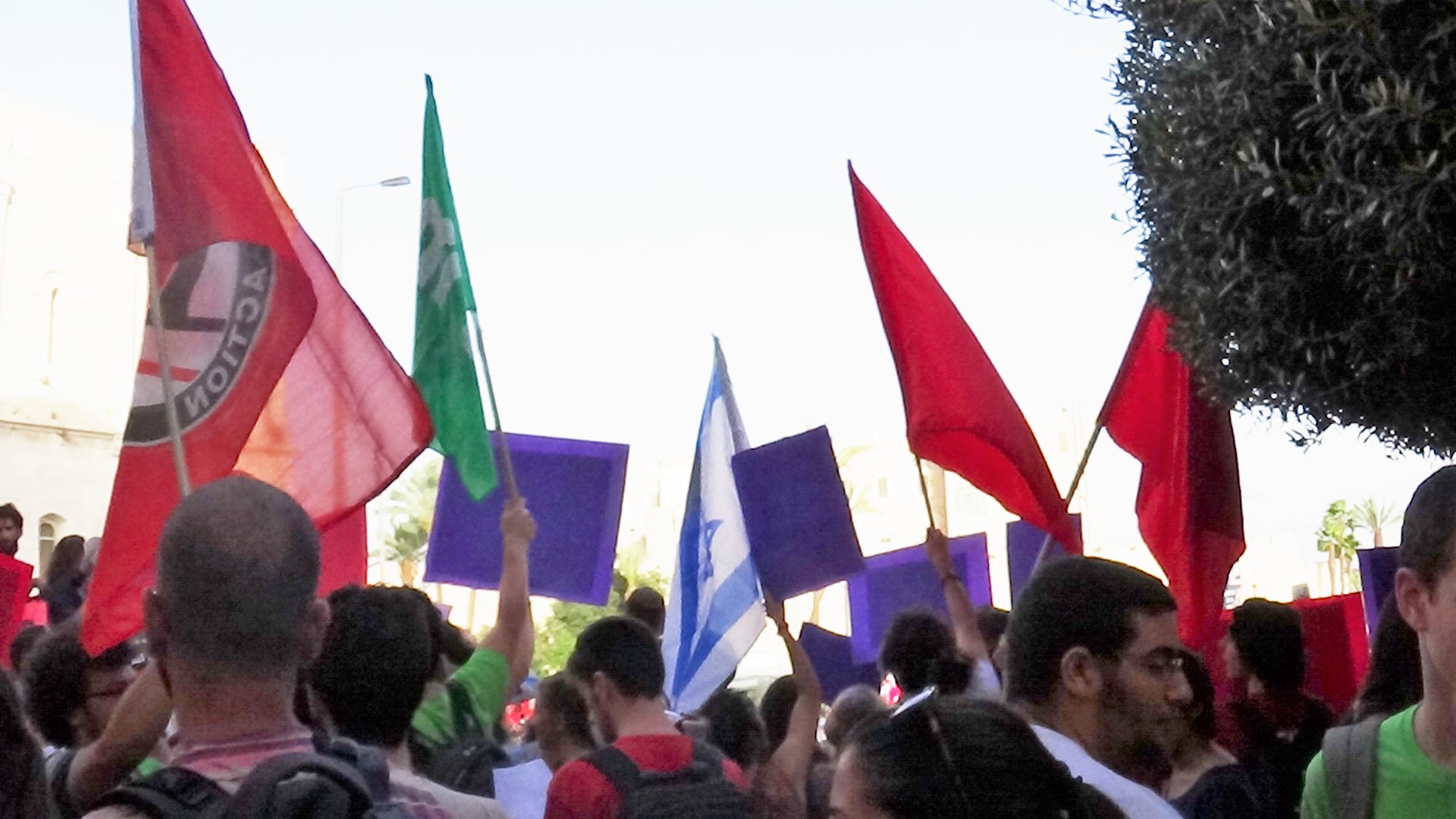
That evening I participated in another provocation, a demonstration in Tel Aviv by Jewish and Palestinian citizens of Israel against the new Nationality Law that enshrines already-existing inequality by asserting the rights of the Jews in Israel above all others. The law is itself a provocation against democracy, but much of the Israeli press chose to focus on the “provocation” of the display of Palestinian flags by some of the demonstrators (against the wishes of the organizers). A provocation to show that there is a Palestinian as well as a Jewish nationality in this land between the river and the sea. A provocation to gather and march together in the sultry humidity of a summer night, to protest the racism of ethno-religious superiority in a territory in which two peoples dwell. I preferred the hum of conversations under the tree to the long speeches at the demonstration, but in their own way each was a provocation to resist oppression and struggle for just peace.

“Jews and Arabs together”. Anti-Nationality Law demonstration. Tel Aviv, 10 August 2018

 nationalists who also want to claim the flag for themselves. Peace Now has its own flag for Independence Day, which replaces the Star of David at the center with the word “shalom.”

 Picturing Peace