Tag Archives: +972 blog

When Peace Became a Dirty Word: John Kerry and the Peddling of Pseudo-Peace

U.S. Secretary of State John Kerry is greeted by Israeli Prime Minister Benjamin Netanyahu prior to their meeting in Jerusalem on May 23, 2013. [State Department Photo/ Public Domain]

U.S. Secretary of State John Kerry is greeted by Israeli Prime Minister Benjamin Netanyahu prior to their meeting in Jerusalem on May 23, 2013. [State Department Photo/ Public Domain]

Peace is generally thought to be a good thing, conjuring up positive, pastoral images of lions lying down with lambs, swords being beaten into ploughshares, and each person sitting unafraid under their vine and fig tree. Yet, this near-universal and enduring admiration of peace has been perverted in Israel/Palestine, not because of any honest, outspoken preference for war but because ‘peace’ has been contaminated by pseudo-peace. A key trigger for my project on Israeli peace images was a report in Ha’aretz on June 10th 2004 that some 40 Israeli and Palestinian media and public relations professionals would be meeting in Jordan ‘to try and find a way to promote the brand name of peace,’ and ‘to create a ‘local and international campaign to promote the image of peace’. The campaign was initiated by the director of the Peres Center for Peace, Ron Pundak, who was one of the negotiators of the 1993 Oslo Accords between Israel and the PLO. He acknowledged that the ‘image of the peace brand …. has been worn down over the past few years,’ but hoped that the public relations experts could achieve what the diplomats had been unable to do, namely ‘to define certain concepts, such as coexistence, in a way that will be acceptable to both sides’. As it happens, the peace branding campaign never got off the ground, because the Israelis and Palestinians participating in it could not agree on a concept of peace to promote. But what had tarnished the image of peace, and how has it been corroded even further since 2004?

The most obvious answer is that by 2004 the Oslo process had lost all credibility, in the wake of the failed Camp David talks between Israeli Prime Minister Barak and Palestinian President Arafat in 2000 and the violence of the Second Intifada. That answer suggests that the image of peace has been eroded because the promise of peace has not been fulfilled, and raised expectations have been dashed. Yet, equally significant in the context of 2004 was the international Quartet’s April 2003 road map for peace, which offered nothing that had not already been proposed under Oslo (It did, however, cover the withdrawal of Israeli armed forces from the positions they reoccupied inside the Palestinian areas during Operation Defensive Shield in 2002). Ironically, it is pursuit of the pseudo peace of the ‘peace process’ that has tarnished the image of peace among the very people in Israel (and Palestine) that do the most to build peace.

When I visited Israel in the summer of 2009, an academic colleague who has been active in anti-occupation groups and refused reserve military duty in the Palestinian Occupied Territories put it this way – that only a charlatan still speaks about peace. Retroactively, he considered the organization he co-founded, The Twenty First Year, and other groups to the ‘left’ of Peace Now during the first intifada such as End the Occupation, to have been directed against the occupation rather than for peace. Yet, one of our common protest chants at the time was ‘Peace – Yes! Occupation – No’, while the most concrete notion of peace we had in mind was of two states for two peoples, a proposal that was then radical if not unthinkable in Israeli political culture. It seemed clear to us in 1988 that ending the occupation and bringing peace implied each other. However, in June 2009, the charlatan-in-chief, Prime Minister Netanyahu, publicly and cynically endorsed the ‘two state solution’, while his government did as much as it could to ensure that such peace could not be achieved (such as expanding settlements).

It is not surprising, then, that currently Israeli and Palestinian peace-builders often do not identify as peace activists. In her book Struggling for a Just Peace: Israeli and Palestinian Activism in the Second Intifada, Maia Carter Hallward noted an accentuation of this trend between 2004-5 and 2008 among activists in Ta’ayush, Machsom Watch, Rabbis for Human Rights, and other groups (151, 158). For the mainstream Jewish Israeli public disillusion with ‘peace’ deepened because Israeli’s unilateral disengagement from Gaza in 2005 was taken to be a step towards peace taken by Israel to which Hamas responded with Qassam rockets. So much, then, for the formula of ‘territories in return for peace’. But for the activist peace camp, following the Israeli withdrawal Gaza was still under occupation, now out of reach for nearly all Israelis and West Bank Palestinians, and in effect under siege. Hallward considers it crucial as a researcher to focus on ‘peace work rather than peace words’ (54), noting how the latter has become so discredited that is has become a dirty word among activists (164).   

Last week saw the end of yet another international effort to ‘revive the peace process’ that further eroded the image of peace. Unable to bring the Palestinian Authority and Israeli government any closer than they had been before, US Secretary of State John Kerry ended a spell of intensive diplomatic toing and froing with an announcement that the two sides needed to think about their positions and a plan to boost the Palestinian private economy (meaning the West Bank economy), so as to reduce the PA’s dependency on the foreign aid that actually supports the status quo. Under such circumstances, I can only agree with Noam Sheizaf of the +972 blog that:

what this moment calls for, more than anything else, is some honesty. Kerry would have done his own cause justice if he simply stated that there is no peace process, nor has there been one in recent times, and that the current trends on the ground are likely to continue in the foreseeable future.

The peace process is a pseudo peace, a ‘peace’ in which there can be endless negotiations  while at the same time occupation continues, settlements expand, a permit system and checkpoints obstruct Palestinian movement, the separation wall is completed, Palestinians can be imprisoned without trial, and the Palestinian economy is subordinated to the Israeli one. There is ‘peace’ and there is just peace, and the peace that Kerry has been peddling is the snake oil of the charlatan.
Troublers of Israel point to the Trouble with Israel

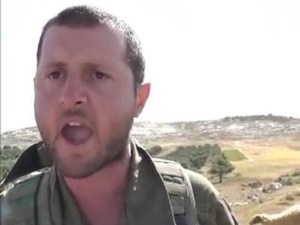
"I'll give you one in the head," threatens the soldier who lost his composure (Screen shot).

“I’ll give you one in the head,” threatens the soldier who lost his composure (Screen shot).

Umm Al Amad 27.4.2013, IOF no need to add a word!

Almost every week, photographs and video of weekly activity by Ta’ayush in the southern West Bank circulate on social media. Ta’ayush is an Israeli-Palestinian grassroots partnership to end the occupation through non-violent direct action, currently focused on Israeli activists from Jerusalem working with Palestinian farmers in the especially troubled South Hebron Hills area. The videos and pictures generally circulate among fellow activists and supporters, rarely making the mainstream news in Israel. Typically, they show some sort of confrontation between on one side activists and farmers trying to access and work on their land, by ploughing a field or shepherding a flock, and on the other side Israeli soldiers, police, and settlers who prevent them from doing so, sometimes violently. More than 300 videos documenting such routine acts of denial of access to land, often accompanied by arrests and violence, are located on a Ta’ayush activist’s YouTube Channel, guybo111, which has attracted more than 400,000 views. The videos document the routine of Israeli Occupation, the creeping annexation of Area C of the West Bank, including small acts of dispossession and coercion. As routine, the videos and events they show in raw footage, accompanied by minimal textual explanation, are rarely considered newsworthy. Sometimes someone bleeds, but it doesn’t lead in mainstream Israeli media.


This week, however, a video of one such event was picked up, by both the Y-net service of Israel’s mainstream newspaper, Yediot Aharonot, and the on-line news service of Walla!, a main Israeli web portal. Whereas the activist video carried (in English) the heading: “Umm Al Amad 27.4.2013, IOF no need to add a word!” the Y-net (in Hebrew) article is titled “’Arab lover’: Soldier documented yelling at Leftist Activists,” and in English, “Watch: IDF soldier lashes out at activists.” The headline of the article on Walla! is: “Soldier threatened: ‘I’ll give you one in the head, you’re worse than the Arabs’.” For activist circulation, the video needs no explanation or translation, the location being given by its Arabic name rather than the nearby illegal outpost settlement, Otniel, and the Israeli army labelled as Israeli Occupation Forces. The text that accompanies the video on the +972 blog, which opposes the occupation is committed to human rights and freedom of information provide more explanation

:

Israeli Ta’ayush activists who were accompanying Palestinian shepherds in the southern West Bank village Umm al Amad on Saturday were confronted by a soldier who lost his cool, to say the least.

According to Guy, the Israeli activist who filmed the video below, this is private Palestinian land (the Otniel settlement is nearby) that the IDF and settlers routinely try and keep the Palestinian residents out of. In the video below, the soldier can be seen first approaching the Palestinian shepherd, screaming in his face in Arabic: “You better watch it!” Then Guy tells the soldier not to scream at him and to leave him alone, to which the soldier turns to Guy, screaming: “Get out of here you Israel haters, I’ll kick the crap out of you. You are worse than the Arabs.”

He then turned to one of the female Israeli activists and said: “Shut up, Israel hater who goes to bed with Arabs.”

On Y-net news, only Otniel is mentioned, the soldier is identified as a reservist, and in addition to the testimony of the activist, an army spokesperson is quoted saying:

“Leftwing activists gathered near Otniel. While security forces were trying to disperse them, a reserve unit and an activist confronted each other. Following the release of the video, the IDF will question the reservist about the incident and the proper measures will be taken. In general, this incident does not reflect the behavior expected of security forces and the issue will be clarified.”

The longer Walla! report mentions that other soldiers tried to calm the reservist who had lost control of himself, and also provides some background, explaining briefly about Ta’ayush, as well referring to a more serious violent incident a year ago in which Lieutenant Colonel Shalom Eisner struck an activist with his rifle butt  (after which he was removed from his position). The report also quotes an unnamed senior officer in the West Bank who considers the Israeli activists to be provocateurs who stir up trouble.


So there was a minor incident, remarkable neither for harm done to Israeli “leftist” activists or Palestinian farmers, which raises the question of why this week’s incident became newsworthy. Perhaps it is news because something of the mask fell away from the occupation. Wrapping itself in a mantle of quasi-legality, bureaucratic procedures, and policing tactics, the occupation likes to present itself as calm, business as usual. It doesn’t like to appear as its racist, sexist self, according to which all Israelis who act in solidarity with the civil and political rights of Palestinians are traitors, and thus “worse” than Arabs (who are seen to be inherently bad), especially Israeli women, whose “disloyalty” upsets the ethno-sexist assumption that Jewish women should belong to Jewish men. In this light, the Ta’ayush  activists are provocateurs, provoking the occupation forces to show that it has no legitimacy in claims to provide “security,” and that the very premise of Jewish ownership of all the land is racist.

More than that, the Biblical Hebrew phrase used by the offending soldier “ochrei yisrael does not simply mean “enemy of Israel” but “troubler of Israel”. While it is a curse often flung at Israeli leftists, its Biblical provenance should be, well, troubling to the cursers. One such “troubler of Israel” is Achan, the Israelite stoned and burned (along with his family) for looting precious and idolatrous objects from Jericho during Joshua’s invasion of Canaan, for which the Israelites were punished by God with defeat in their first assault on Ai (Joshua 7). Those who hurl the insult of “troubler of Israel” at leftists are perhaps comfortable with the reminder that the Promised Land had to be seized violently by the Israelites under the leadership of the ethnic cleanser Joshua. Yet the troubling implication is that the current conquerors of the Promised Land are themselves guilty of looting idolatrous objects, in this case the land itself, in whose service they are prepared to commit all sorts of immoral acts, and all kinds of modern idolatries.

The prophet Elijah is also called a “troubler of Israel” by King Ahab, although Elijah then turns around the accusation, labelling Ahab’s idolatry as the trouble brought on Israel (1 Kings 18). Merely calling Ta’ayush leftists “troublers” does not make them the idolaters, the sinners, since the charge can be reversed. This is the trouble that Ta’ayush cause, walking in the ways of righteousness by lending support to the oppressed, and by doing so, provoking the ire of the idolaters of the land.