Tag Archives: combatants for peace

Mourning the fallen: working through bereavement

As I begin to write this blog, there are three hours left of the twelve hour humanitarian truce in the military violence of Operation Protective Edge. It’s Shabbat, so there are no funerals in Israel today, but there have already been more than thirty funerals for fallen soldiers so far and there will be more. This morning the Israeli military announced the deaths of another two personnel, and then another three, bringing the total to fourty. Each death brings to an early end the story of an individual, a son, a brother, a young person with hopes and dreams. Each death brings immeasurable grief to families and friends, indescribable loss, unending mourning. For Hamas, for Gazans, these losses inflicted on “the Zionist enemy” are a cause for celebration, evidence of another “victory,” as they did when they claimed to have captured Oren Shaul. Certainly, that is how the Israeli media and much of the Israeli public perceive Palestinian response to their loss.

Israel wraps the families of its fallen in the solidarity of public mourning. Families do not mourn alone, as the dead are held to be everyone’s sons, everyone’s boys. A grass roots campaign to encourage people to attend the funeral of Max Steinberg, an American who came to Israel to serve in the army without his family, brought 30,000 to act as his surrogate family. The price paid is a collective price, mourned once at the funeral, during the week long shiva, and then again and again on each Memorial Day.

It is in the nature of the trauma brought on by bereavement to return to the loss. The mourning is repeated, as the loss becomes part of the identity, the very being, of the bereaved. Not to mourn, again and again, would mean to betray those who are lost. Not to be haunted by their death would mean to kill them again. If that is how an individual feels, what is it like when a whole nation feels it?

Yet, the repetition of mourning is destructive. Not only is mourning repeated, but so is the situation in which the mourning first occurred. If the memory of the fallen is to be honoured, then it must be given meaning. In the case of nationally felt loss, the meaning is the survival of the nation. The reason why the dead sons fell is so that the rest of the rest of the national family can live on. The dead fell to protect the family from an enemy, an Other, who must remain the enemy and the Other if the death of the sons is to have meaning, to have been for something, to not have been senseless. The situation of loss is one in which more sons will continue to fall to make sense of the deaths of the sons who have already fallen. Because senseless loss is truly unbearable.

To break the repetition of mourning , the return to the situation of loss, the mourning has to be worked through. A way has to be found to live, not without forgetting the lost, not without ceasing to mourn – as if bereavement could ever stop – but to live in a way so that the act of mourning does not make sense through more deaths. I have never had to mourn the loss of a parent, child or sibling in war. I do not know how it feels, and I never want to. Those who have found a way to work through mourning agree with me. They don’t want me to join them in bereavement. As the Parents Circle Family Forum say, repeatedly, in this video: they don’t want me with them, because they do know how that loss feels.

Each of them has worked through mourning to the point where they can also feel the pain of the Other, Israelis and Palestinians. Or maybe only by feeling the pain of the Other have they worked through mourning to live without the need for revenge, to revisit the situation of loss by seeing the enemy as implacable, incapable of mourning, glorifying and sanctifying their dead without feeling pain.  When the Bereaved Families mourn those who have fallen in conflict, they do so together, in a ceremony that takes place on the same day as the Israeli Memorial Day. In dialogue with the mourning of the Other, finding themselves in each other, they seek a reconciliation that will bring not only the bereaved, but those who are yet to be bereaved, out of the situation of loss which brings no security, only more loss. And that is why tonight, as the humanitarian truce has ended been (as I wrote) extended, the bereaved families will be in Rabin Square in a rally organized by Combatants for Peace with many others, Jews and Arabs, calling for an end to the deaths. There will be no end to human mourning and bereavement, but there can be an end to this senseless bereavement.
The Silliness of ‘Security’ and Puppets for Peace

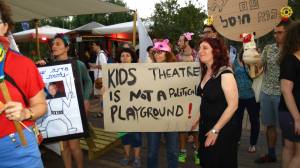
Theatrical protest against closure of El Hakawati theatre. Photo: Guy Butavia.

Theatrical protest against closure of El Hakawati theatre. Photo: Guy Butavia.

For most Jewish Israelis, ‘peace’ means ‘security’. According to this mainstream ‘securitatist’ orientation (as Israeli sociologist Baruch Kimmerling put it in his 2001 book The Invention and Decline of Israeliness: State, Society, and the Military) ‘peace’ means that Israel will be secure when both the state and its citizens will not be subject to attack by their enemies. Any image or notion of peace connotes security, as peace entails the end of hostilities. The Israeli sense of ‘peace-as-security’ also refers to security guarantees and arrangements, in the form of territorial boundaries that provide strategic depth or advantage (such as the Jordan River), or the demilitarization of the proposed Palestinian state.

Yet, the very meaning and purpose of peace is undermined and obstructed by ‘peace-as-security’ as pursued in Israeli policy. Israeli political scientist Galia Golan argued this point in her paper, ‘Transformations of Conflict: Breakthroughs and Failures in Israeli Peace Efforts’, which she presented to the 29th Annual Association for Israel Studies Conference, June 24-26, 2013, at UCLA. In light of an underlying assumption that the other side, ‘the Arabs’ will never make peace with Israel because they do not accept Israel’s legitimacy, Israeli leaders have aimed not for peace but for ‘security’ in the sense of the optimal conditions for fighting the next war. ‘Peace-as-security’ is not peace at all, but an obstacle and alternative to peace. Successive Israeli governments distrust all but the most dramatic of Arab moves to peace, such as President Sadat’s visit to Israel in 1977. When there are peace negotiations, or, (as at present under US secretary of state John Kerry’s guidance) negotiations about negotiations, Israeli diplomats stick to the self-defeating ‘security first’ formula. As a result, Israelis get neither peace nor long-term security.

Prioritization of ‘security’ also turns into a doctrine whereby every political position of Israeli governments in the context of the conflict with Palestinians is framed in terms of ‘security’. The separation barrier is the most obvious current example of security as a doctrine. For Israel governments, the Israeli Supreme Court, and most of the Jewish Israeli public, the barrier is the ‘security fence’ which prevents terror attacks on Israeli citizens. For Palestinians, and Israeli peace activists such as Combatants for Peace (who offer educational tours of areas around the barrier), it is both a means to dispossess Palestinians of the land on which the wall is built and part of a whole network of walls, fences, gates, checkpoints and travel permits that separates them from each other, their land, and vital economic and civil services. In this and similar cases, Israeli ‘security’ concerns appear cynical, undermining the governments’ case that Israeli anxieties about security are genuine, rather than veiled efforts to perpetuate occupation.

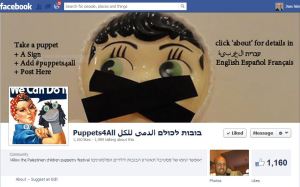
Puppets4All Facebook page

Puppets4All Facebook page

Sometimes, however, it’s not a question of cynicism but outright silliness. Two weeks ago, on June 22nd, the 19th annual Palestinian children’s theatre festival was due to open in the El Hakawati theatre in East Jerusalem. But (as reported by Amira Hass in Ha’aretz), the director of the theatre, Mohammed Halayka, was summoned for questioning by what he said was the Shin Bet security service. Then the Israeli Public Security Minister Yitzhak Aharonovitch issued an order closing the theatre for eight days beginning on the scheduled first day of the festival, on the grounds that the event would be held ‘under the auspices of or sponsored by the Palestinian Authority’, which would contravene an Israeli law passed as part of the Oslo peace process. The law is designed to rebut Palestinian claims to East Jerusalem, which Israel annexed unilaterally following the 1967 war. It’s a matter of sovereignty, not security.

Riki blich , actress -Israel Pupprts4all# — with Riki blich.

Riki blich , actress -Israel
Pupprts4all# — with Riki blich.

Aharonovitch’s move also exposes the silliness of the security doctrine. There have been several Israeli as well as Palestinian protests against the theatre closure, including a petition signed by many Israeli actors, playwrights and directors (as reported by Haggai Matar on the +972 blog). On Thursday, June 27th, a theatrical protest was held, a carnival of colour, masks, music, movement, and a wonderful spoken word poetry performance by Moriel Rothman. Perhaps the best response, however, has come in the form of a Facebook page ‘Puppets4All’, on which many Israeli and other performers have posted pictures of themselves and a puppet or two with a sign reading ‘I too am a security threat’. All of which leaves Minister Aharonovitch looking not only like a version of scrooge (children’s theatre? – bah humbug!) but also like a ‘total muppet’. If Israel’s security doctrine sees danger in these puppets, then that only proves that the danger is in the eye of the beholder. It’s well passed time for Israel’s leaders – and publics – to see that actual peace is the best – the only – security.