Tag Archives: Gaza

Bombs Over Be’er Sheva

This piece was written by Rema Kheriya Irshed, a Palestinian Israeli psychotherapist and group facilitator trainer, with Ariel Katz, who studied Middle Eastern Studies at Cornell University and now works as a play therapist. This article was published by the Common Ground News Service (CGNews) in May 2012, and refers to a previous round of military escalation between Israel and Hamas.

Be’er Sheva, Israel – Over a four-day period this March, sirens periodically sounded to warn residents of Be’er Sheva, one of Israel’s largest cities near Gaza, to take shelter from missile attacks.

On the first day when the siren sounded, my son was not home. Panicking, I called his cell phone. There was no answer. I began to pray to Allah and meditate to calm myself and overcome an overwhelming fear for my son’s safety. I went into our reinforced safe room but couldn’t bring myself to close the door without my son inside.

Moments later, he burst into the house, followed by two Jewish friends. I rushed the boys into the safe room and shut the iron door behind them, speaking to my son in Arabic, our native language. I told the boys, in Hebrew, to call home and reassure their mothers that they were safe. I covered
our dog with a blanket. It was enough that the Jewish boys were frightened. At least I could make sure they didn’t get bitten.

When one of the boys refused to call home, my identity as a mother faded into the background so that our national identities could be addressed. One of the boys, Yossi, had never met me before. There was something in his stillness that reminded me that it could be frightening for him to be with Arabs, even from his own community, during an attack. I considered the idea that he may have chosen not to phone home because he didn’t want his mother to know he was with Palestinians.

My thoughts and sympathies stayed with the Jewish mother who did not know where her son was. I could feel that mother’s anxiety, which had been mine only moments before. I insisted the boy text his mother to say he was safe in a shelter. That way, he would be filtering out the difficult information.

I put myself in this teenage boy’s shoes, sitting in a strange room with a Palestinian family while being bombed by Palestinians. I was overwhelmed with the boy’s fear of being trapped in a room full of the “enemy”. Even though it was unnatural for me to speak Hebrew with my family, to put the boy more at ease, I forced myself to do so.

The next day, the school that my son and his friends attend was closed in anticipation of further missile attacks. Though our family is Muslim, we chose to send our son to a Jewish school close to our house. When I returned from work, my son was not at home. Searching for him, I called the mother of the other Jewish boy I had sheltered, whom I knew better, and was told that the boys had all been taken to a local swimming pool. I offered to go pick the boys up and bring them home, and was given the address of the war veterans’ club where the father of one of the boys was a member. I
froze, finding it offensive that the Jewish mother could be so insensitive. I didn’t want my son at a military establishment, out of solidarity with the innocent Palestinians suffering retaliation across the border in Gaza. Then I asked myself, “What is the dilemma? When the mothers took him to that swimming pool, they were not thinking of us as Arabs. We are people looking after each other’s children.”

Both Yossi and I needed to rationalise away the fear of the other’s space, and what it meant about our identities to inhabit it. This complex zooming in and out of focus from background to foreground, from person to group and back again, is crucial to maintaining real relationships. For Yossi, it was hard to differentiate the people who are threatening him from the people protecting him. For myself, it was as natural to protect Yossi as it was to protect my own son.

I empathise with the fear of both Israeli children and the children of Gaza, and with parents’ desperation to keep one’s family safe on both sides of the border. When one’s identity precludes a clear “us” vs. “them”, what becomes clear is the tragedy of this destructive pattern. Only when we recognise that no one wins from terrifying the other will we understand that triumph in battle is not a solution – and that both sides can be winners if we all choose to let each other live in freedom, and with dignity.
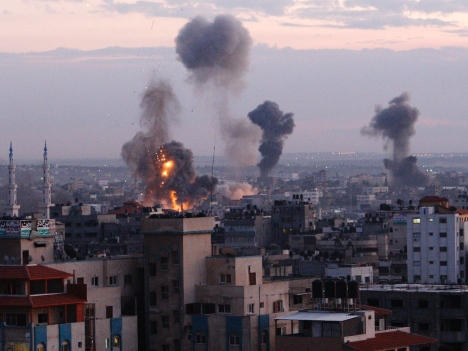
Pillar of Cloud, Pillar of Defense

Gaza, November 14, 2012, AP


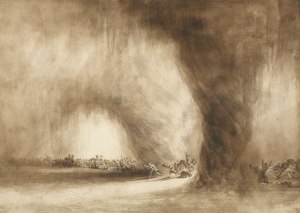
William West, The Israelites Passing through the Wilderness Preceded by the Pillar of Clouds, 1845

When the Israeli government and military launched its latest assault on Gaza yesterday, November 14th 2012, by killing Hamas’ military commander, Ahmed Jabari from the air, it indicated it was ready for a sustained campaign by giving it a codename. Curiously, though, its name in Hebrew, “amud anan” which refers to the biblical term “pillar of cloud”, has been translated to English as “pillar of defense.” The difference in name indicates that the Israeli authorities are hoping to win the battle over the image of this war, unlike “Operation Cast Lead” in the winter of 2008-9. “Cast lead” sounds ominous in English, though it is a phrase taken from a poem by Chaim Nachman Bialik, one of Israel’s national poets, to mark the festival of Chanukah which coincided with the war. So, the image managers of this war are avoiding using what they take to be an internal, Israeli Jewish cultural association that might be “misunderstood” abroad, and might thus contribute to international condemnation of the Israeli military action against Hamas.

Yet, the phrase “pillar of cloud” is hardly an unknown expression in English and in Western culture generally, as illustrated by William West’s painting, just as the Bible is somewhat more widely read around the world than Bialik’s poetry.  Appearing first in the story of the Children of Israel’s exodus from slavery in Egypt, the crossing of the Red Sea in which Pharaoh’s army pursuing them was drowned, and their long journey through Sinai, the “pillar of cloud” symbolizes divine leadership of the Israelites’ progress. “And the LORD went before them by day in a pillar of a cloud, to lead them in the way; and by night in a pillar of fire, to give them light; to go by day and night” (Exodus 13:21).

An Israeli military spokesperson quoted on the Gawker blog states that: “The name is not a direct, word-for-word translation. Like most translations, it is an attempt to convey the spirit of the name, rather than a simple Google Translate.” One wonders whether the spokesperson is unaware that the Bible has been translated into English for centuries, or whether the image managers belatedly realized that the brand name for the war was open to “misunderstanding” once again. Indeed, the Gawker has already interpreted the choice of Hebrew and Biblical name to mean that “Israel Names Its New War After Biblical Story About God Terrorizing Egyptians,” on the grounds that the divine pillar threw the Egyptian army into confusion so the Israelites could escape.

The codename perhaps has been (mis)translated deliberately by the Israeli military to cloud the negative connotations that the “pillar of cloud” has. But the (mis)translation follows a deeply rooted cultural logic in Jewish Israeli, Zionist collective existence. Jewish Voice for Peace also condemns the choice of codename, but on the grounds that “it is unseemly to invoke the protection afforded the Israelites wandering in the desert when Israel is the dominant military power in the region”. The Israelites had no army when they fled Egypt, afraid and unsure of their path. But surely, now that Israel has such a powerful military, as the Israeli broadcast media were quick to boast in their cheerleading of the assassination of Jabari and the allegedly precise strikes on the Fajr missile sites, today’s people of Israel do not feel dependent on divine protection and leadership?

In choosing a codename that figures Israel as in need, still, of divine protection, the military image makers express, from behind a cloud, a deep felt need for a Jewish Israeli public to continue to see itself as defenceless despite its strength. True, the image makers’ have an explicit imperative to present this war as a military operation in which Israel is forced to defend itself against an implacable enemy, Hamas, that both targets Israeli citizens and exposes its own people to the harm of Israeli retaliation. That is certainly part of the motivation behind the mis(translation), part of the propaganda campaign to erase Israeli and global awareness of repeated Israeli initiation of armed attacks on Gaza, part of the legitimation of a regular pattern of “little” wars, each of which is “successful” only in so far as it is repeated, as Hagai Matar has pointed out.

“Cloud” is (mis)translated as “defense” because it does not matter how much military power Israel has, nor how victorious its armed forces, nor how precisely its intelligence and weaponry can target its enemies, it will not be enough to fill the felt need for protection, for defense. All the military manna in heaven could not fill that hole. The pillars of smoke and fire that the Israeli military inflicts on Gaza by day and by night are a substitute, though a poor one, for divine protection and presence. The pillars of smoke and fire are clouds that instead of leading today’s Israel towards a promised land lead us to repeat, compulsively, acts of war that bring not peace but situations such as the unilateral withdrawal from and siege of Gaza that demand never-ending military “defense.”  The pillars of smoke and fire that cloud our hopeless, mournful,  traumatic and traumatizising repetition of violence condemn Israel to wander in a wilderness of war until we can see through the clouds of war that only a pillar of peace will dispel the felt need for divine protection and defense that we seek, vainly and profanely, through the force of arms.