
A dear friend from my first long spell in Israel-Palestine in 1978-79, now a rabbi in the US, wrote on her Facebook page a few days ago that Rabbi Hillel’s famous saying had been in her head for days, but she no longer knows who she is. I’m not quite sure what she meant, but in the past week I’ve understood something more of Hillel’s brilliant encapsulation of ethics. I learned how easy it is to lose yourself in your own pain, individual and collective. I learned how difficult but necessary it is to sustain that productive tension between caring for oneself and for others. I struggled to hold on to my moral compass, sometimes losing sight of myself in the swirls of emotional and moral outrage.
The brutal of atrocity of Hamas’s attack on Israeli civilians shocked me by its scale and suddenness. It provoked profound anger in me that I understood grew from an equally deep fear. I was able to avert a visceral urge for vengeance only by contemplating the unbearable cost that exacting revenge would take from my own flesh and blood, the potential perpetrators of revenge. For the first time in decades, I went to a synagogue service not for a special occasion, just to spend time with other Jews and have a chance to talk about what we’re going through. The community was shrouded in sadness, grief and fear, appalled by the massacres, grieving for the dead, in anguish about the hostages, among whom is a friend of the rabbi’s daughter. They were worried about antisemitism, needy for each others’ company and support. The rabbi did a wonderful job of reminding us that the shabbat eve service is a beautiful spiritual exercise to calm the soul (or psyche) and focus on the simple joys of togetherness, the sweetness of the challah bread and kiddush wine. The beauty of Creation and being alive in it as a community.
During the week I had posted to Facebook that.
“I couldn’t bring myself to join in the protest organised by the Palestinian Solidarity Campaign, even though it has never been more urgent and vital to demonstrate solidarity with Palestinians … For the most part, I can join in the chant of ‘From the river to the sea, Palestine will be free’ as a call to end occupation and apartheid, for Palestinian independence. But I cannot shout it when I think that even one other person also shouting it sees a way to freedom through the brutal massacre of civilians.”
A friend from Extinction Rebellion reassured me that there had been no hint of glorifying Hamas at the Nottingham event (where I live). I had heard from colleagues in Na’amod, the Jewish anti-Occupation movement which I’m active in, that they’d been shocked to hear support for Hamas’ “acts of resistance” from people they assumed to be allies. I was feeling too fragile to face that. In the wake of the mass killings by Hamas I sank into the grief and pain of my community, relatively inured to the pain of others.
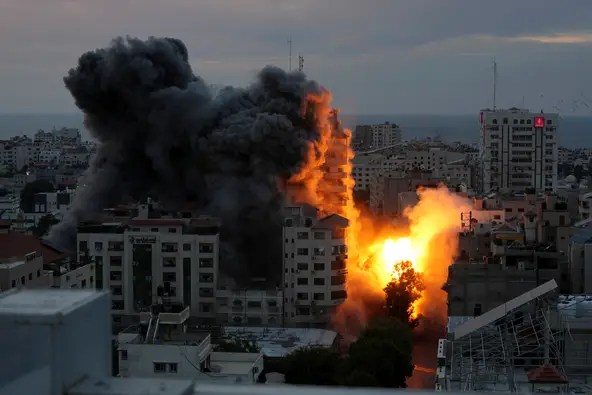
The pain of others, of Palestinians in Gaza and the other Occupied Territories, was all to obvious. Every hour the violence takes on the more familiar pattern of previous Israeli wars on Gaza. 2008-9, 2012 (which I experienced up close), 2014, 2021, but on a bigger scale. In the news cycle, pictures flow of bomb explosions, rocket trails, the rubble of destroyed homes being excavated by hand in the search for survivors and bodies to bury. Some of the pictures, those from al-Ahli Hospital blast, are too horrendous to watch closely. The usual mutual recriminations fly, making no difference to the deaths and injuries suffered. As I write the death toll in Gaza is above 4,000 including 1,756 children and 967 women, surely an atrocity in itself. The intensification of the blockade by Israel as the bombing continues further worsens the already desperate humanitarian conditions.
True, unlike in the past episodes the pictures from the Israeli side are different, a train of funerals, distraught families of hostages, harrowing accounts by survivors of the Hamas attacks. I am still “for myself,” more easily moved by video of an Israeli family in mourning than a Palestinian one. Among the many news articles I read over the week one that most moved me was by Amir Tibon who took part in the meeting between Joe Biden and survivors from the kibbutzim and towns around Gaza, not as a journalist but as a resident. Biden both literally and metaphorically gave the survivors a hug. He had felt their pain and connected to it by sharing the pain of his own bereavement. He was for himself, but also for others, for us, Jews and Israelis. We are not alone when the President of the USA gives us a hug. Of course, he gave Israel much more than that, notably the material means to bombard the same Palestinian civilians for whom he also expressed sympathy, as if one hand did not know what the other is doing.

When we are for ourselves we need others to acknowledge our pain. We need others, like Joe Biden, as well as others in our own community. When we call out “Feel our pain!” we need someone other to hear us. We want them to acknowledge that this Jewish suffering feels to us like all the other Jewish suffering. But the demonstration of sharing one’s pain with others in order to validate and acknowledge their pain works both ways. The very basis of ethics is this relationship with an other. At first, it feels as if acknowledging the pain of others somehow undermines your own pain. But the cost of having your own pain acknowledged is to acknowledge the pain of others.
What and who am I if I am not also moved by a Palestinian woman telling an interviewer that 16 members of her family across three generations were killed when the family home was bombed? Then multiply that family’s loss by about 260. Is that not also an atrocity that cannot be justified by Hamas’ atrocity? Another news report that also moved me last week, but to anger, was about one of those regular acts of brutality to Palestinians in Wadi al-Sik in the West Bank by Israeli soldier-settlers that approached the cruelty of Abu Ghraib. While the incident is overshadowed by the inhumanity of Hamas’ acts, are we that sure we did not also commit atrocities on Palestinians not so long ago, not only at Deir Yassin but also Saliha, Lydda, Abu Shusha, Al-Dawayima, Tantura and elsewhere? Did we ever condemn those massacres at the time of the Nakba the way Palestinians are told by TV interviewers they must condemn what Hamas did? If Hamas terror triggers our trauma of the Holocaust, can we not understand that ordering Palestinians to leave the north of Gaza triggers their trauma of the Nakba? If our pain is acknowledged by others do we not also see how others see us and the pain we have caused them?
What comes to my mind is the famous scene in Avanti Popolo, Rafi Bukai’s 1986 film set at the end of the 1967 war, in which Israeli-Palestinian actor Salim Dau plays an Egyptian soldier, Khaled, who is also an actor. He and another Egyptian soldier are found wandering unarmed and waterless in the Sinai desert by some Israeli soldiers after the cease fire. Dau performs Shylock’s speech from the otherwise antisemitic play by Shakespeare, The Merchant of Venice in English, 51 minutes into the film.
I am a Jew. Hath not a Jew eyes? Hath not a Jew hands, organs,
dimensions, senses, affections, passions; fed with
the same food, hurt with the same weapons, subject
to the same diseases, heal’d by the same means,
warm’d and cool’d by the same winter and summer
as a Christian is? If you prick us, do we not bleed?
If you tickle us, do we not laugh? If you poison us,
do we not die?
The Israelis give them water and reluctantly allow them to tag along. In the subsequent scene the Israeli and Egyptian soldiers march and sing along to the Italian socialist anthem Avanti Popolo which is playing on a transistor radio. The film ends badly for the Israeli soldiers who sneak away from the Egyptians and walk into a minefield and both Egyptians who are shot in the ensuing melee on the banks of the Suez Canal. But there is a moment of shared humanity, mixed up roles as the Palestinian as Jew (playing an Egyptian) beseeches the Israelis to satisfy a basic need, to acknowledge the shared vulnerability of human bodies in a harsh natural and political environment. Shylock’s speech is about seeking revenge for the wrong done to him, just as a Christian would, but Dau stops before that turn. So should we.
Perhaps the hardest bit is not that, acknowledging the pain of others, some of which we are responsible for both then and now, but that we have to take that step now. As Noam Shuster, writing “for those who have the capacity to mourn for two peoples” put it:
“Both peoples are retreating inward right now, and it is extremely difficult for those of us who are trying to hold the pain of everybody grieving. Our mental, emotional, and political space is shrinking all at once.”
I can certainly understand that it is too soon for many to acknowledge the pain of others as the same pain they are feeling. I am far from the place where the grief is being felt directly and have not been bereaved or had anyone I know abducted. So, don’t listen to me, listen to Neta Heiman from Women Wage Peace whose mother Ditza was abducted by Hamas from kibbutz Nir Oz who calls to the Israeli government: “Do not destroy the Gaza strip; that won’t help anyone and will only bring an even more ferocious round of violence the next time.” Listen to Noy Katzman, who at the funeral of their peace-activist brother Hayim, murdered by Hamas, proclaimed: “Do not use our death and our pain to bring the death and pain of other people and other families.” Listen to Ziv Stahl who was visiting her family on kibbutz Kfar Azza on that awful morning who says:
I have no need of revenge, nothing will return those who are gone …all the military might on earth will not provide defense and security. A political solution is the only pragmatic thing that is possible – we are obligated to try, and we must begin this work today.
What is needed now is to acknowledge the immense pain and loss that has been suffered by Palestinians as well as Israelis. What is needed know is to acknowledge that Palestinians bleed as do Jews when pricked by bullets and bombs. What is needed now is a ceasefire, release of the hostages and massive humanitarian aid. Because if not now, when?

 Picturing Peace