It took a sideways glance to jolt me from numb news-following to an adequate appreciation of the dreadfulness I have been watching. For weeks, I have been desperate for the faintest glimmer of hope that an end will come to Israel’s war of annihilation of the Palestinians of Gaza, that there will be a ceasefire, that the bombing, shooting and demolition will stop, that aid will flow in, that hostages and prisoners will be exchanged. Like a junkie, I just needed a report every day that negotiations were continuing between Hamas and the Israeli government via the mediators.
By chance, I watched a documentary by Chiara Sambuchi on the BBC, The Srebrenica Tape, which tells of the genocide through the story of a young mother of mixed Serbian and Bosnian heritage now living in the US. The film follows “Alisa’s road trip to the old home country interwoven with footage from her father Sejfo’s film, allowing a unique interior view from the enclosed and now disappeared town of Srebrenica.” Sejfo was was one of the 8,000 Bosnian Muslims massacred there when Serbian forces overwhelmed the UN “safe zone” in 1995 after encircling it for two years. The documentary has scenes familiar from similar documentaries. Alisa shows her daughter parts of her father’s video, preparing her to learn about his death in a less innocent future. She asks her stony-faced Serbian grandmother, in his whom home Alisa lived during the war, about why they did not talk about the war. She meets up with her half-sister, comparing which features they inherited from their father, regretting the separation between them.
The documentary evoked associations with Holocaust remembrances, fictional and factual, of traumatised survivors numbed into silence, of painful family separations, of unknown burials of the dead, of the bitter-sweet comfort of reunions. It was easy to empathise with Alisa’s story and share in her mourning for her father, because her pain is so easily recognisable as that pain we Jews carry round from place to place, never forgetting, never far from the surface, never quite knowing where to unpack it, wherever we have made our new homes.
Now, however, there is a sharper, more immediate, more difficult pain of recognition and remembrance. Now I – or we, but I can speak only for myself – feel through the sorrowful story of Srebrenica the utter grimness of the genocide perpetrated in Gaza, not by the wicked hands of others, but by our own hands, the hands of Israeli Jews, and are we not, as the Talmud says, all responsible for each other? Responsible not only for each others’ safety, for redeeming our hostages, but also for each others’ heinous actions and inactions? We do not need to wait for Alisa’s father’s video to be smuggled out of Srebrenica or for victorious allies to film liberated camps. Every moment on 24 hours news channels and social media platforms we can see starvation being used as a weapon of this war of annihilation, despite the frantic, denials of Israeli spokespersons and the silence of most Israeli media. Can we not hear in the disgraceful, sinful planning of Israeli politicians and generals for the ever-tighter concentration of Palestinians in Gaza the echoes of the ghettos and concentration camps? Can we not see that the utter depravity of starving a Jewish child in Warsaw is as utterly depraved when it is a child in Gaza?
I quote again Si Heyman’s protest song in 1988, during the first intifada, “Shooting and Crying,” in which she asks, “when did we forget that our children were also killed?” I paraphrase one of the other lines in the song to ask “Whenever did we learn how to starve children to death?” The answer is that we learned all of this when it was done to us. So when will we learn that inflicting it on innocent Palestinians who were not the perpetrators of the Holocaust or of October 7th will not take way the pain of what was perpetrated against us? It creates instead thousands more stories of loss and desolation, thousands more cases of trauma, all of which will be repeated down the generations.
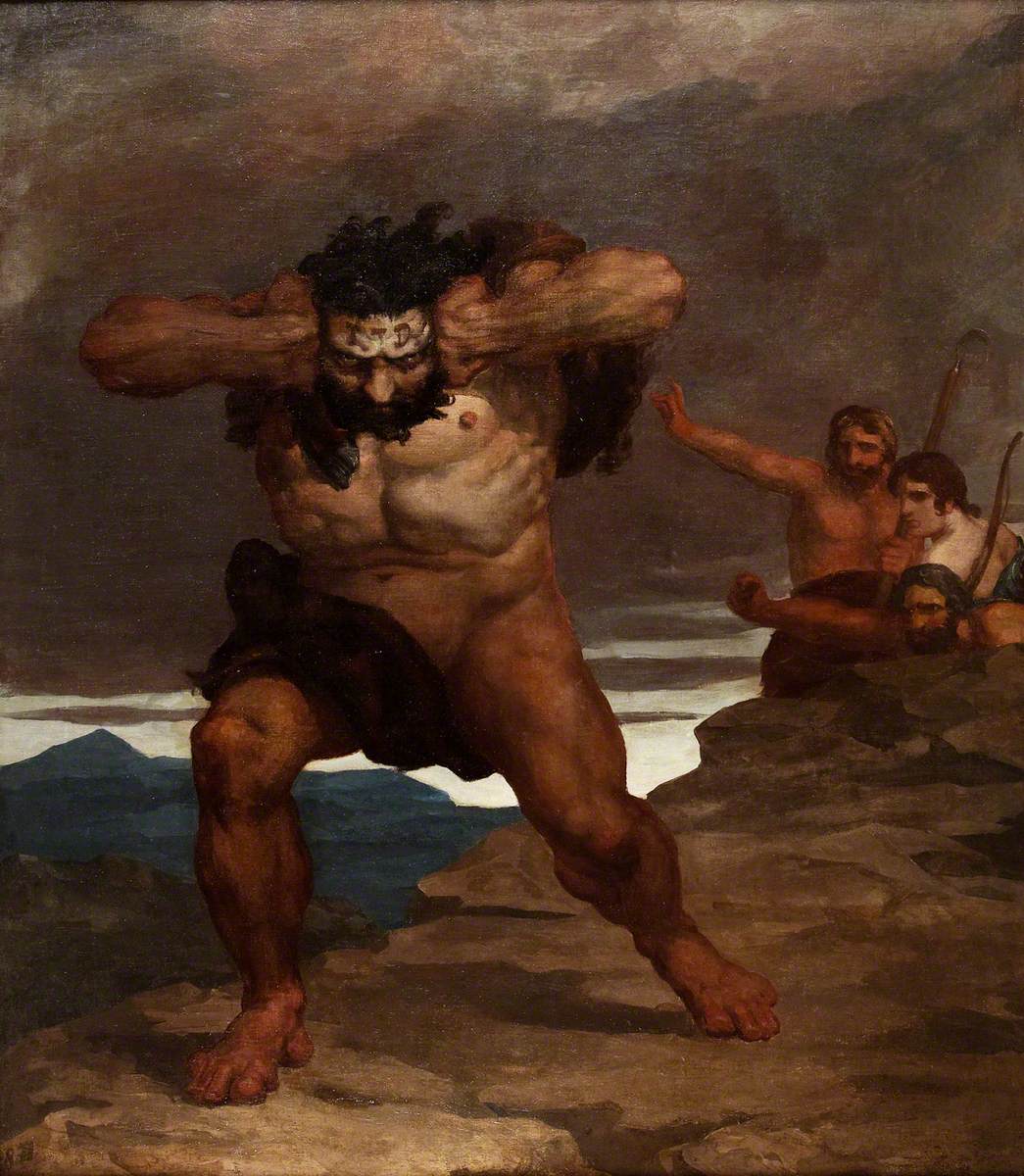
Cain was the first perpetrator of a violent crime, the crime of murder, of fratricide. According to the Biblical story, God asks Cain where Abel is after Cain had killed him, to which Cain responds “Am I my brother’s keeper?” My father loved to repeat that phrase so I grew up with a sense that we siblings were supposed to take of each other, a sense which developed into a broader feeling of social responsibility, of care for others. For his crime Cain was cursed with failure of all his farming endeavours and to be “a fugitive and a vagabond.” When Cain protested that he would be slain in his wanderings, God put a mark on him, a warning sign that others should not punish him further, at the risk of sevenfold vengeance. Although the mark is not given to Cain as the punishment, as the mark of shame for taking a life made in the image of God, it is nonetheless a life-long sign of guilt.
David Scott (1806-1849); Cain Degraded (Remorse); Photo credit: Royal Scottish Academy of Art & Architecture
The accusation brought by South Africa that Israel is committing genocide of Palestinians feels like an unbearable mark of shame and guilt. How can it be the the Jewish state is accused of genocide, less than a century since genocide was committed against the Jewish people? Surely, we are the victims of genocide, not the perpetrators? How can this be any more than a scandalous libel, a blood libel as Israeli government spokesman Eylon Levy said? It’s especially galling so soon after the horrendous attack by Hamas on October 7th that reminded us so starkly of our vulnerability, that looks itself like an act of genocide. Are we to be denied the right to defend ourselves just because our enemy uses its population as human shields and fights from within the civilian infrastructure? “There can hardly be a charge more false and more malevolent than the allegation against Israel of genocide, ” said Israeli Foreign Ministry legal adviser Tal Becker in response to the South African case on January 12th. This is the line of defence against the genocide accusation taken by Israel at the International Court of Justice. We are the victims, not the perpetrators. And some us still bear those other marks, those numbers inscribed on our flesh by the other murderers, before we had a state with which to defend ourselves, when at the whim of persecuting states we could be turned into fugitive vagabonds at a moment’s notice.
I leave to the judges of the court and international law experts to determine the validity of this defence. In part, Jewish and Israeli outrage at and revulsion from the accusation of genocide is prompted by the definition of genocide in the UN’s Convention on the Prevention and Punishment of the Crime of Genocide. There it is stated that
genocide means any of the following acts committed with intent to destroy, in whole or in part, a national, ethnical, racial or religious group, as such: (a) Killing members of the group; (b) Causing serious bodily or mental harm to members of the group; (c) Deliberately inflicting on the group conditions of life calculated to bring about its physical destruction in whole or in part; (d) Imposing measures intended to prevent births within the group; (e) Forcibly transferring children of the group to another group.
One of Israel’s key legal difficulties at the Hague is of its own making, the multitude of statements by politicians, official spokespersons, military officers, news anchors, commentators and journalists that appear to advocate or condone genocide. Legal experts say that the hardest part of a genocide case to make is usually the demonstration of intent to commit genocide, but in this instance there has been a lot of unguarded talk. I will come back to Biblical stories to focus on one statement picked out by the South African team, by Prime Minister Netanyahu on October 28th: “you must remember what Amalek has done to you, says our Holy Bible. And we do remember”. The Amalekites were one of the tribes whom the Israelites fought after their Exodus from Egypt, during their sojourn in the desert, before conquering Canaan. In the first telling, in the Book of Exodus 17:8-16, no reason is given for why their remembrance must be blotted out, but Deuteronomy 25:17-19 tells us that “they smote the hindmost of thee, all that were feeble in thy rear, when thou wast faint and weary; and … [Amalek] feared not God.” The Amalekites reappear in the First Book of Samuel 15, when Samuel tells King Saul that God reminds him of what the Amalekites did to Israel and orders him to “go and smite Amaleq, and utterly destroy all that they have, and spare them not; but slay both man and woman, infant and suckling, ox and sheep, camel and ass.” This last passage is quoted in the South African case, seemingly as proof that Netanyahu intended the Israeli troops about to enter Gaza to act similarly.
Joshua fighting Amalek, By Philip De Vere – Phillip Medhurst Collection of Bible illustrations. housed at Belgrave Hall Leicester, made possible by the Kevin Victor Freestone Bequest.
In his rebuttal of the accusation that the accumulation of similar utterances to Netanyahu’s amount to incitement to genocide, Malcolm Shaw argued that the South African team had misunderstood the place of Amalek in Judaism but that there was no time for a theological debate. He is certainly right that within Judaism the literal meaning should not be taken as a commandment, and even if it were, neither the Palestinians or Hamas are literally ancient Amalekites. Shaw goes on to claim that the quotations brought by South Africa “are clearly rhetorical, made in the immediate aftermath of a [traumatic] event.” Again he is right, but not in the way he intended the word “rhetorical,” in the everyday sense of an empty statement, but in the sense of rhetoric as persuasive statements uttered to move their audiences. In their spoken presentation, the South African team referred to the normalization of genocide discourse in Israel, indicating an accumulative pattern of speech and writing across politics and media. They showed a clip of dancing Israeli soldiers, singing that they understood their commandment to “wipe out the seed of Amalek” and their operational slogan that there are “no uninvolved” in Gaza, meaning no innocent civilians. Netanyahu’s rhetoric was clearly understood by the soldiers, as well as the synecdoche whereby today’s Palestinians stand in for the Biblical Amalekites. Whether the soldiers in the clip acted on that understanding, we do not know. But in the context of the rise of the Jewish-supremacist, messianic far-right in Israel and its inclusion in the current government, the meaning of Netanyahu’s statement, along others calling explicitly for a second Nakba, is chillingly dangerous and irresponsible, at least murderous if not genocidal in intent, as my colleague Joshua Shanes noted at the time.
The governing discourse in Israel today is, if not genocidal than at least politicidal, a discourse in which there is no truth to Palestinian collective existence, Palestinian peoplehood and connection to the land. In their eulogy for their brother Hayim who was murdered by Hamas (which of course has its own murderous discourse) on October 7th, his sibling Noy said:
My brother was always active for peace … He spoke truth in the face of – as Foucault said – the power that forces discourse up on us, the power that forces us to say certain things, and not say other things. Hayim spoke truth to power – even at the price of being the one who is different, the one who is strange
The power of Israeli discourse was evident last week when 85 members of Israel’s parliament, the Knesset, from most of the opposition as well as coalition parties, signed up to an impeachment process for one of their number, Ofer Cassif, a representative of Hadash, the Democratic Front for Peace and Equality. He had signed a petition in favour of South Africa’s submission to the ICJ, although from some of the reactions he might as well have joined the petition to the court itself. He is very strange to them, very different, abnormal, and what he says does not make sense to them. He speaks a truth that does not have a place in their consensus. He wrote on X (formerly Twitter) that
My constitutional duty is to Israeli society and all its residents, not to a government whose members and its coalition are calling for ethnic cleansing and even actual genocide. They are the ones who harm the country and the people, they are the ones who led to South Africa’s petition to The Hague.
It will pain me deeply if, after its long deliberations, the International Court of Justice finds that Israel, the Jewish state, committed genocide. It would be a mark of Cain that the state would bear forever. The atrocities of October 7th pained and shocked me deeply, as does the fate of the hostages, now in their 100th day of captivity. But it also pains me that the State of Israel is inflicting so much harm on Palestinians in what it claims is self-defence but seems like a prolonged act of vengeance without achievable and defined goals. At this time of intense polarization, the social media mobs and the gatekeepers of discourse insist that Palestinians can be only either victims or perpetrators, that Israelis can be only victims or perpetrators. But what if we are both victims and perpetrators? If we can speak in a discourse that allows for that possibility, can we then not also be our brothers’ keepers?


 Picturing Peace