It took a sideways glance to jolt me from numb news-following to an adequate appreciation of the dreadfulness I have been watching. For weeks, I have been desperate for the faintest glimmer of hope that an end will come to Israel’s war of annihilation of the Palestinians of Gaza, that there will be a ceasefire, that the bombing, shooting and demolition will stop, that aid will flow in, that hostages and prisoners will be exchanged. Like a junkie, I just needed a report every day that negotiations were continuing between Hamas and the Israeli government via the mediators.
By chance, I watched a documentary by Chiara Sambuchi on the BBC, The Srebrenica Tape, which tells of the genocide through the story of a young mother of mixed Serbian and Bosnian heritage now living in the US. The film follows “Alisa’s road trip to the old home country interwoven with footage from her father Sejfo’s film, allowing a unique interior view from the enclosed and now disappeared town of Srebrenica.” Sejfo was was one of the 8,000 Bosnian Muslims massacred there when Serbian forces overwhelmed the UN “safe zone” in 1995 after encircling it for two years. The documentary has scenes familiar from similar documentaries. Alisa shows her daughter parts of her father’s video, preparing her to learn about his death in a less innocent future. She asks her stony-faced Serbian grandmother, in his whom home Alisa lived during the war, about why they did not talk about the war. She meets up with her half-sister, comparing which features they inherited from their father, regretting the separation between them.
The documentary evoked associations with Holocaust remembrances, fictional and factual, of traumatised survivors numbed into silence, of painful family separations, of unknown burials of the dead, of the bitter-sweet comfort of reunions. It was easy to empathise with Alisa’s story and share in her mourning for her father, because her pain is so easily recognisable as that pain we Jews carry round from place to place, never forgetting, never far from the surface, never quite knowing where to unpack it, wherever we have made our new homes.
Now, however, there is a sharper, more immediate, more difficult pain of recognition and remembrance. Now I – or we, but I can speak only for myself – feel through the sorrowful story of Srebrenica the utter grimness of the genocide perpetrated in Gaza, not by the wicked hands of others, but by our own hands, the hands of Israeli Jews, and are we not, as the Talmud says, all responsible for each other? Responsible not only for each others’ safety, for redeeming our hostages, but also for each others’ heinous actions and inactions? We do not need to wait for Alisa’s father’s video to be smuggled out of Srebrenica or for victorious allies to film liberated camps. Every moment on 24 hours news channels and social media platforms we can see starvation being used as a weapon of this war of annihilation, despite the frantic, denials of Israeli spokespersons and the silence of most Israeli media. Can we not hear in the disgraceful, sinful planning of Israeli politicians and generals for the ever-tighter concentration of Palestinians in Gaza the echoes of the ghettos and concentration camps? Can we not see that the utter depravity of starving a Jewish child in Warsaw is as utterly depraved when it is a child in Gaza?
I quote again Si Heyman’s protest song in 1988, during the first intifada, “Shooting and Crying,” in which she asks, “when did we forget that our children were also killed?” I paraphrase one of the other lines in the song to ask “Whenever did we learn how to starve children to death?” The answer is that we learned all of this when it was done to us. So when will we learn that inflicting it on innocent Palestinians who were not the perpetrators of the Holocaust or of October 7th will not take way the pain of what was perpetrated against us? It creates instead thousands more stories of loss and desolation, thousands more cases of trauma, all of which will be repeated down the generations.
It’s 1933. Some of us will survive. In the German elections in March 1933 the democratic system of the Weimar Republic created a parliamentary majority for the Nazi Party’s coalition headed by Hitler. In the 2024 US elections the democratic system has selected a president with, at least, fascist tendencies and given his political party a majority in the Senate and quite likely also the House of Representatives.
This piece is neither a prediction of what Trump will do in power nor an analysis of how he won the elections. It is an attempt to turn the deep pit of dread, fear and foreboding in my stomach into the hope contained in the acknowledgement that however bad it will be – and it will be bad – some of us will survive.
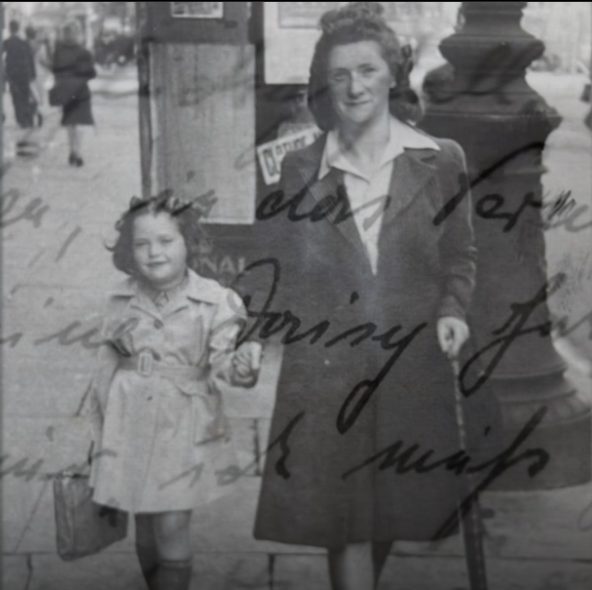
Ursula and Daisy after the wat. Still from BBC A House through Time Series 5, Episode 4.
By chance, my partner and I had just finished watching Series 5: Two Cities at War of the BBC history series A House through Time presented by David Olusoga. Following the stories of the residents of two apartment buildings in London and Berlin from the 1920s to the end of the Second World War, we watch German tanks rolling first into Poland and then France, the bombing Blitz of London and then the Allies’ bombing of Berlin. Of the Jewish families in Berlin, one – parents with a two year-old daughter – escapes only as far as Belgium. The records show the parents being transported to Auschwitz, where the father perished but the mother survived the Death March from there to Ravensbrück. Having witnessed the brutalities of war and being reminded that the fate of the Jewish families is interwoven with the Holocaust, the viewer is left willing for a happy ending for them in the archives. And there is one – a record of mother Ursula and daughter Daisy (who had been placed in hiding by her mother) living together in Brussels, a photo of them after the war and another of them at Daisy’s daughter’s wedding. That is all I needed for the last episode to be bearable – that Ursula and Daisy survived, that they went on to thrive.
Today’s democratically chosen tyrant may be not end up being as responsible for as much human suffering as Hitler. But as Moira Donegan wrote the morning after his election, “For those of us aware of what Trump is capable of, this morning has plunged us into a cold kind of anticipatory grief.” Mass deportations, vast cuts to welfare and health services and “the persecution of dissidents and violent suppression of Trump’s political enemies.”
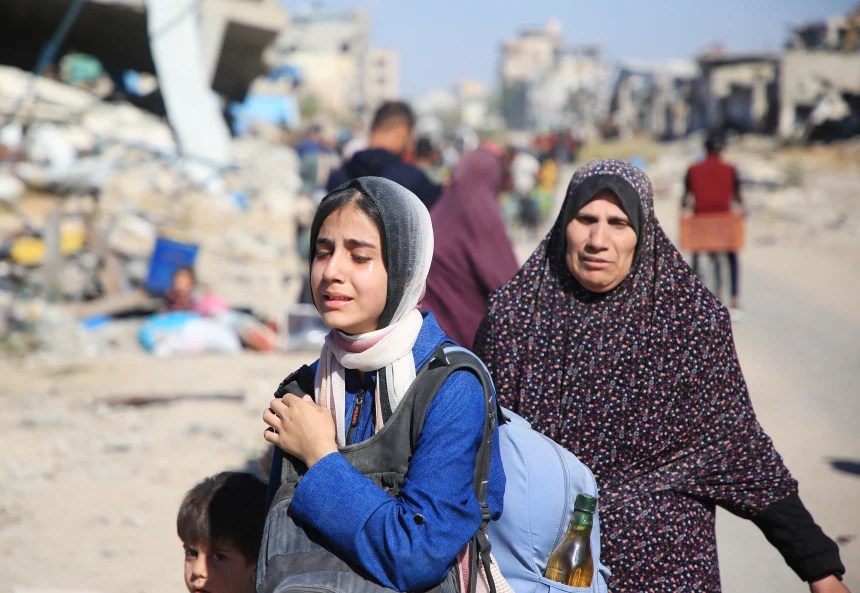
Trump’s election makes individual and collective survival for millions of Palestinians, especially those in Gaza, an even more acute issue than it has been for decades and since the murderous attacks by Hamas on October 7th 2023. Israel’s vengeful response has already killed as many Palestinians as the German Blitz on Britain, more than 43,000. Its current phase in the north of Gaza that began on October 5th 2024 threatens the lives of some 400,000 people who remain in the area, unwilling or unable to be driven out to the south. A combination of military fire power, from bombs to sniper bullets, starvation, wrecking buildings, and destruction of the last vestiges of a health system, are, writes Idan Landau, “an embodiment of the spirit of ethnic cleansing and resettlement from day one,” paving the way for new Israeli settlements. The pre-US election period was already providing the government and military with a window of opportunity to pursue this particularly vicious operation, but “If Trump wins, the Israeli leadership can breathe a sigh of relief. He will not stop any Israeli plan, however brutal.” Indeed, Netanyahu was quick to congratulate Trump who is an ally of the settler movement, at ease with annexation of Occupied Territories. Thus far US exhortation to Israel to minimise civilian casualties and allow humanitarian relief has had no teeth. Trump will not even encourage such restraint, nor (as did Biden) will he remind the Israeli government of its own duty to protect its citizens held hostage in Gaza for 401 days (as I write this).
A Palestinian girl cries as the Israeli army forcibly moves civilians from the outskirts of the Jabalia refugee camp in northern Gaza on Tuesday.Mahmoud Sleem / Anadolu via Getty Images
Yet however awful the outcome of the latest Israeli onslaught on Gaza, just as some Palestinians survived the 1948 Nakba and remained tsumud, steadfast on their land, some will survive. Palestinians have survived in Gaza since the blockade began after Hamas took over in 2007 and survived the series of Israeli armed assaults since then, as told in a profound anthology I am currently reading, Daybreak in Gaza: Stories of Palestinian Lives and Culture. Some will survive and then thrive this time as before. And even if the Israeli government abandons the hostages in Gaza to their horrible fate, some were released last November and have survived, and the grieving families of those who perish will survive.
The biggest threat to survival that Trump’s election poses is to the natural environment that sustains humankind. According to The Guardian:
Trump’s agenda, analystshave found, risks adding several billion tonnes of extra heat-trapping gases to the atmosphere, further imperiling goals to stave off disastrous global heating that governments are already failing to meet.
As I’m active in Extinction Rebellion I might be expected to believe that the climate and ecological crisis is an existential threat to whole human species. But I believe that global heating and nature loss will destroy human civilisation, leaving a few of us to survive in lives that are for many generations nasty, poor, brutish and short. But some of will survive well enough to build new societies in which some of us can thrive.
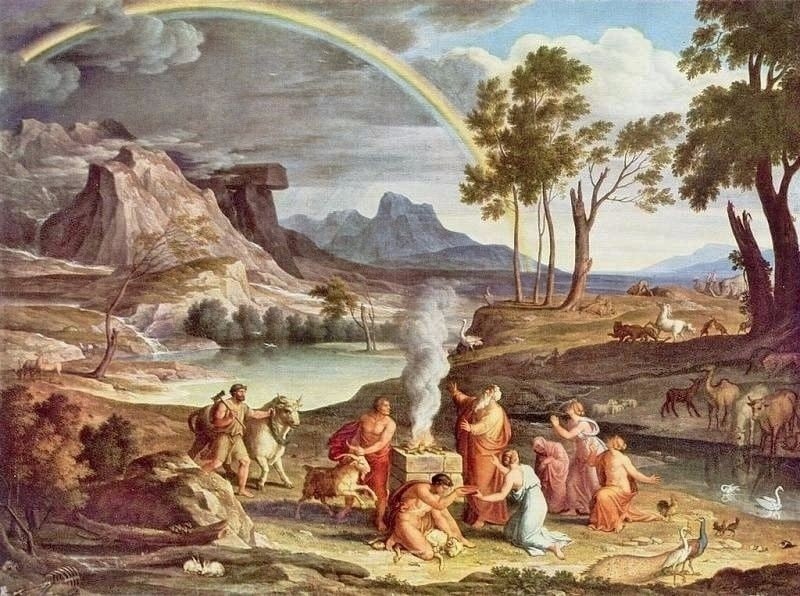
Artist Joseph Anton Koch (1768–1839)
That narrative arc, from impending doom, to catastrophe, through to survival and thriving, which Ursula and Daisy lived through, is grounds for hope. The catastrophe is not averted, many are lost, but something rises from the ashes. Survival cannot bring back all that was lost in the catastrophe, but it is a partial redemption, like the dove that returns with an olive branch to Noah’s ark after the flood. God promises there were never be another flood and commands Noah’s family – all that is left of humanity – to be fruitful and multiply, signifying the covenant with a rainbow. A passage by Rebecca Solnit has been circulated a lot in the days since Trumpism triumphed at the polls, in which she writes :
The fact that we cannot save everything does not mean we cannot save anything and everything we can save is worth saving… A lot of us are going to come under direct attack, and a lot of us are going to resist by building solidarity and sanctuary… People kept the faith in the dictatorships of South America in the 1970s and 1980s, in the East Bloc countries and the USSR… There is no alternative to persevering, and that does not require you to feel good.
We are not passive spectators in the narrative arc from catastrophe to survival. Noah had to be righteous and build an ark. Ursula’s mother had to find solidarity with the good souls who risked their lives by giving sanctuary to Daisy. Hope is a verb, not a passive state of waiting for better times. As Kamala Harris put it in her concession speech:
Don’t ever give up… do not despair. This is not a time to throw up our hands. This is a time to roll up our sleeves. This is a time to organize, to mobilize and to stay engaged for the sake of freedom and justice and the future that we all know we can build together.
Setbacks are unavoidable, but giving up is unforgivable… A defeat does not mean we are defeated. We lost this battle… We’re going to be OK, but we need to stay engaged. We need to keep going. And above all: we need to keep the faith.
Perhaps those are the clichéd remarks of politicians, but in these dark days I am receptive to those clichés. Even if today I cannot see the rainbow after the flood, survival after catastrophe, I know the narrative arc was fulfilled before and will be again. Trumpism is not forever. Some of us will survive.

 Picturing Peace