The big news this weekend about peace between Israel and Palestine is US Secretary of State, John Kerry’s announcement that Israeli and Palestinian leaders have reached an agreement that ‘establishes a basis for resuming direct final status negotiations’. Big news, then, that there might be another breath of life left in the Oslo process, and that if the direct talks actually start, at some point Israel will release some long term Palestinian security prisoners. At present there is much speculation and comment about the character of this agreement, about whether the talks about talks will even get as far as a meeting between Israeli Prime Minister Netanyahu and Palestinian Authority President Mahmoud Abbas, and as to whether the discussions will do more harm than good. Earlier in Kerry’s intensive diplomatic process, I suggested that it promotes only pseudo-peace, turning peace into a dirty word.
Rather than focusing on the ‘big news’, I prefer to pay some attention to events over the week that attracted much less attention. During the recent build up to Kerry’s announcement, there were two small achievements in efforts to build a just peace through non-violent action. Video footage of the detention of five-year old Palestinian boy Wadi’ Maswadeh in Hebron, recorded by fieldworker Manal al-Ja’bari for B’tselem, kicked up enough of a storm on conventional as well as social media for the Israeli army to admit that:
“We made a mistake during the event, both in detaining the boy and detaining his father,” GOC Central Command Maj. Gen. Nitzan Alon told commanders during an operational assessment conducted in the command.
The Israeli army’s acknowledgement of its error, reported in Ha’aretz a week over so after the incident, differs significantly from its initial response to the video:
We regret that B’Tselem has chosen – on a regular basis – to distribute videos of this kind to the media before clarifying the issue with the army first.
The military’s admission of error in this incident also comes after B’Tselem Director Jessica Montell sent a letter to the Legal Adviser to Judea and Samaria, stating:
The footage clearly shows that this was not a mistake made by an individual soldier, but rather conduct that, to our alarm, was considered reasonable by all the military personnel involved, including senior officers.

Border Police statement on Channel 10 news.
A second small achievement last week was also the fruit of video documentation by activists of the excessive use of force by Israeli occupation forces, which was then circulated more broadly. On July 15th there were protests across Israel and Palestine against the Prawer plan, approved by the Israeli Knesset on June 24th 2013. The plan will result in the destruction of 35 ‘unrecognized’ Arab Bedouin villages, the forced displacement of about 40,000 Arab Bedouin citizens of Israel, and the dispossession of their historical lands in the Negev, in the south of Israel. Most of those demonstrations were met with violence by the authorities, including one held at Damascus Gate. In a video recorded by a Ta’ayush activist, military border police run amok in East Jerusalem, knock over food stalls set up during the Ramadan fast, bust into people waiting in a bus queue, and push into a group of medical workers on stand-by. The video was picked up by Israel’s Channel 10 news, which pressed the Border Police for a response. Not quite an admission of fault, their statement notes that the behaviour of some of the soldiers does not match the values expected of the Border Police, promising a further enquiry.
In both cases, the achievement is quite minor. Despite acknowledgement that detaining children below the age of criminal responsibility is illegal, the army continues to do so in Hebron, as this video shows. As for changing the intense restrictions on Palestinians in Hebron that stifle civic life – that is not even on the agenda of the occupation authorities. Moreover, as Gideon Levy reports, Wadi’ Maswadeh has already been traumatised by his experience. It is doubtful that the Border Police’s internal inquiry will change how they respond to demonstrations in East Jerusalem. Perhaps coincidentally, B’tselem spokesperson Sarit Michaeli was shot at close range and injured by a rubber-coated bullet fired by the Border Police while documenting a weekly demonstration at Nebi Saleh, in the West Bank, on Friday July 19th. Nor has there been any backtracking by the Israeli government on the Prawer plan. Instead, on July 16th, the day of the Jewish 9th of Av fast that commemorates the destruction of the temples in Jerusalem, another unrecognized Bedouin village in the Negev, Al-Arakib, was demolished for the 53rd time.
In both cases, activist documentation of the use of force by occupation authorities has not only exposed that violence locally and internationally, but has prompted those authorities to admit that something is amiss. The activists, who practice non-violence and uphold human rights, have taken a small step in decreasing state violence. In doing so, they bring peace closer by a small increment, because they open up a non-violent path out of the conflict between Israelis and Palestinians. They increase the chances for a future peace by practicing and promoting peaceful ways not only of resisting the occupation, but also for the occupation forces to counter that opposition. Non-violent action is an embodiment of the peace that negotiators try to achieve. It is also an education for the occupation forces, a set of small lessons about acknowledging the humanity of the Palestinians and other protestors, about treating five year old boys as children not weapons, and about allowing people on an East Jerusalem street to eat and travel at the end of a fast day.
One would hope that such lessons could be learned and implemented while negotiations about peace negotiations are being held in Jerusalem, Amman, Ramallah and Washington. Just as we expect there to be a ‘cease-fire’ as diplomatic efforts to end the conflict go on, we should expect and demand that all use of force to carry on the occupation – demolitions, expulsions, arrests, travel restrictions – also be suspended. There is no such ‘cease-force’, and hence the small, non-violent steps to peace taken by activists to reduce repression by occupation forces are more concrete steps to peace than those reported in the main headlines.
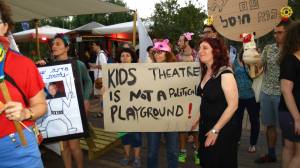


 Picturing Peace