Tag Archives: middle-east

Olive Harvest Coalition, Jayyous October 2012

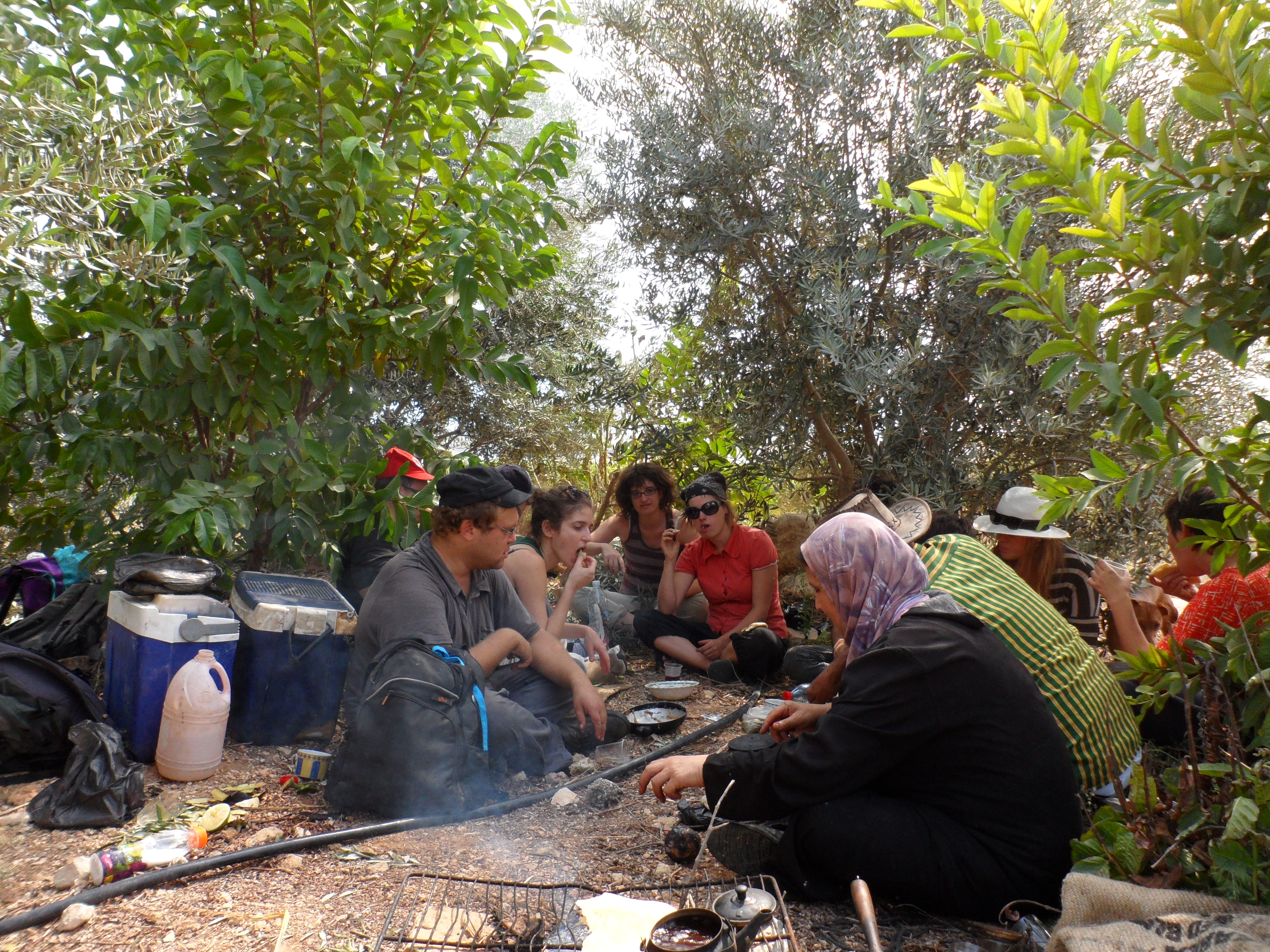
Sometimes what looks like a picture of peace is a symptom of war, or military occupation. What could be more like a picture of peace than a group of Israeli volunteers taking a break in the olive grove of a Palestinian family who have prepared lunch for their guests who have given up their Sabbath to help with the olive harvest? Representations of peace have a limited iconography to draw on: the dove, olive branches, lions lying down with lambs, mothers with children, and pastoral scenes in general. So, surely all the right buttons are being pressed in this picture of Israelis and Palestinians sharing a meal cooked on an open fire under olive trees. Surely this is peace?

No, it isn’t, because the photograph doesn’t tell the story of how this group of Israelis came to the land of the West Bank village of Jayyous on this late summer day. It doesn’t tell the story of how the Israeli separation wall cut off the villagers of Jayyous from most of their land, and how those villages have to obtain permits from the occupation authorities to pass through the two agricultural gates in the wall which are opened and closed by the army. It doesn’t show the map of how that security wall departs from the green line marking the 1949 armistice line between Israel and the West Bank, such that it wraps a noose around the Palestinian town of Qalqilya and zig-zags crazily by Jayyous that lies nearby. Nor does it tell the story of the Eyal checkpoint through which Palestinians from Qalqilya with permits may pass to work in Israel if they are prepared to get there by 4 am, be patient, and subject themselves to the rigorous security checks. That is a story told by Machsomwatch and its members.

Yet, the photograph and the event are both pictures of peace in another way. The Israelis (and some overseas visitors) have found a small, practical way to compensate their Palestinian neighbours for the damage to their lives and livelihoods caused by the separation wall, through an organization called the Olive Harvest Coalition. And the Palestinians of Jayyous have been willing to accept such help from citizens of the state that creates such harsh facts on their ground who had come in place of all those family members and other villagers who do not have permits to cross through the wall. As we spent our day picking olives and taking breaks for food and hot, sweet tea, working under the patient supervision of Ali who had to stretch his Hebrew to direct us, it was hard not to feel peaceful. No doubt there are plenty of Israelis who would think it dangerous for us to put ourselves in the hands of Palestinians, but the only danger was the perilous ride on the overcrowded tractor and trailer. In the midst of all this seemingly intractable conflict between two nations, a dozen or so Israelis could be the guests of Ali, his wife and son for a day, without mutual suspicion, or anxiety, or fear. It was so peaceful that not even we Israelis found anything to argue about. Maybe one day Ali and his neighbours will run a service offering fun days out for Tel Aviv families to experience the olive harvest in Jayyous. But there’s a wall that has come down first.
Museum of Occupation

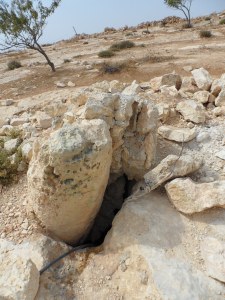
Blocked well in Susiya

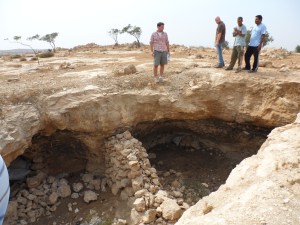
Demolished cave dwelling in Susiya

It’s difficult to picture peace, and so more often than not the Israeli peace movement is working against the current situation – most easily summed up through the expression “occupation” – rather than for the desired outcome of peace activity. The Hebrew term for occupation – kibbush – also means conquest, so it makes sense that “peace” can’t be the “quiet” that follows conquest. At present, such relative quiet is the sort of peace that many Israelis (mis)take for peace, and so various peace groups are busy trying to get the public to see that there is no quiet in the Palestinian occupied territories and that the conquest is still going on there, every day and in their name. One such group is Shovrim Shtika (Breaking the Silence), “an organization of veteran combatants who have served in the Israeli military since the start of the Second Intifada and have taken it upon themselves to expose the Israeli public to the reality of everyday life in the Occupied Territories.” The core of their activity is their testimony, recorded on video and in text, available on their web site, but they “also conduct tours in Hebron and the South Hebron Hills region, with the aim of giving the Israeli public access to the reality which exists minutes from their own homes, yet is rarely portrayed in the media.” And so having read about the current situation in this southern area of the West Bank sometimes on the pages of the liberal Israeli newspaper Ha’aretz and more often on more often the various blogs such as +972 and peace group web-sites, such as Ta’ayush (an Arab-Jewish partnership group), I joined one of the tours to see with my own eyes.

The highlight of the tour was a visit to the Palestinian village of Susiya, whose plight – facing demolition and elimination by the occupation – has been covered elsewhere, including on a campaign blog that is mostly in English. On the day of our visit, the first day of the intermediate, hol hamo’ed period of the week-long Succot festival, the busy part of Susiya was not the village but the archaeological site of the ancient synagogue into which buses and cars full of Israelis were streaming. Symptomatic of the cynical legalism by means of which the Israeli military occupation is conducted, the Palestinian residents of Susiya who had been living on what was discovered (by a military archaeology unit!) to be an historical site had been displaced – as it’s forbidden to live on an archaeological site.  But sure enough, the site soon included a few residencies for the Israeli staff of the site. It was a quiet day for Palestinian Susiya. There were no demonstrations, no military presence, no settlers, just a small group of sympathetic and curious Israelis and a sun insisting on it being late summer rather than early autumn. The conflict seemed a long way away, and one person on the tour said as we left, there seemed to be plenty of room for everyone. Why should Palestinian Susiya have to go even if the Jewish settlements were there to stay?

But as he led us around the village, accompanied by a couple of its residents, our guide Ayal described the place as a “museum of the occupation”. And indeed, juxtaposed to the archaeological site on the other side of the road, were the archaeological remains of the destruction of Palestinian Susiya. The photographs I took are hardly the most dramatic images of recent events at Susiya, many of which can be found at the ActiveStills site, showing clashes between military and settlers on the one side, and residents and activists on the other.  Nor are they the best photographs for showing what daily life is now like in Susiya, of which there are many taken by its women residents, which can be seen on the Susiya Forever blog. What they do show is what is left after the destruction by military bulldozers: a blocked well which now can’t be used for drinking water, but from which a thin pipe leads, providing some water for animals and irrigation; a cave dwelling with its stone roof torn off, being reused as an animal pen. The residents of Palestinian Susiya thus all live in an archaeological site that is a testament not only to the destructive power of the military occupation but also to their determination to remain. Their stubborn attachment to their land – where else can we go, they say, when asked why they don’t give up – obstructs the construction of a false image of peace, of peace after the conquest when the land has been cleared of Palestinians. The picture of peace in this scene is not only in the negation of the ruin wreaked by armed force, but also in the presence of the Palestinians on the land, living among ruins, so that one day they won’t have to.