Tag Archives: October 1973 war

Heaton Park Synagogue

The open day for the new building of Heaton Park Synagogue felt enlightening, literally. Before that, we had used a narrow, single story building with few windows, which must have been very crowded on high holy days. Aged six, I went with my family to marvel at the modern, tall structure. The front, including the doors, was made of glass that extended far above me, flooding the vestibule with light. Inside, the ceiling reached up two high storeys, above the tiered women’s section. Light streamed in through stained glass windows in the wall which housed the Holy Ark, where the scrolls of the Torah were kept. Then, in 1967, there was no fence between the synagogue and Middleton Road, only a low brick wall; no security guards, nothing to stop anyone from walking in. After services, people lingered to chatter in that open space, clearly visible from the street in our best clothes. I loved the slow, leisurely pace the congregants took on the way home, more than a few along the street where my family lived. These were the streets of our community, where we were safe, where we belonged.
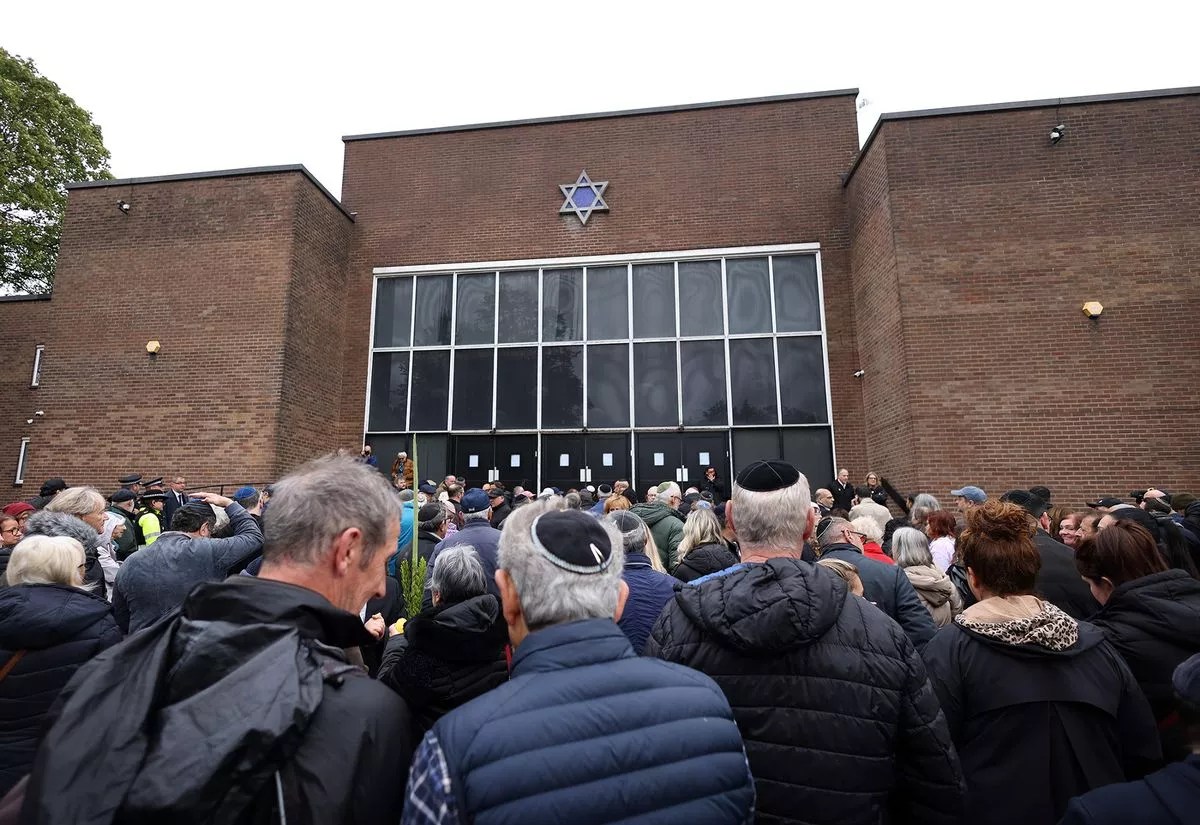
A vigil at Heaton Park synagogue one week after the attack. Crowds (Sean Hansford | Manchester Evening News)

A few years after my Bar Mitzva at the Heaton Park synagogue in April 1974, I stopped attending altogether. My religious phase was over and so my connection to the congregation faded, other than through my parents who emigrated to Israel in 1982. (I followed them two years later but returned to the UK in 1995). But my roots in that congregation and my sense of belonging in that building have never been lost. So when I heard the news of the terror attack on Heaton Park on the morning of Yom Kippur (the Day of Atonement), it was as if the perpetrator, ‘pledged allegiance to Islamic State‘, had smashed the glass front of the synagogue and along with it the warmth of those memories. I did not recognise the names of the victims, Adrian Daulby and Melvin Cravitz, but then a cousin told me that Melvin had lived over the road from them as children and my brother thought he might have gone to King David’s school with him. This was an attack that struck close to home, too close.

But not all of my childhood memories of Heaton Park synagogue are wrapped with warmth. Inevitably, on Yom Kippur my thoughts go back to October 6th 1973, and my feelings touch the tender, pious twelve-year old I was then. I have blogged twice about that day on which Egypt and Syria launched a surprise attack on Israel.

I should remember how tangible my worry was, how the terror of annihilation tasted dry like my fasting mouth, how the anxiety felt like my empty stomach. … Was Israel about to be destroyed? Were the Jews going to be thrown into the sea? Was this somehow God’s judgment? What sin had I or we committed that deserved such punishment?

About the Israeli experience of 1973 I wrote:

My adult, critical understanding cannot undo the horror I felt when I listened to voice recordings of Israeli soldiers in positions on the edge of the Suez Canal as they were being overrun by Egyptian forces. The terror of impending individual annihilation is compounded doubly. First, by a fear that in killing the individuals, the collectivity will also be extinguished and second, by a dread that this surely must not be happening, that now we are strong and able to defend ourselves, if we are attacked, we will vanquish our foes. … the trauma of 1973 lingers, attaching itself to other traumas which cannot be dispelled by critical historical awareness, only by confronting the trauma.

The trauma of October 6th 1973 mingles with the shock of Yom Kippur 2025, which mingles with the trauma of October 7th 2023. So, what to do with the trauma, the fear, the shock, the loss, the deep sense of vulnerability?

For the generation of Israelis who fought the war, their fear gave way not to despondency but to anger at the ineptitude and negligence of the country’s leaders. While for some the Labour establishment remained the focus of their frustration, others came to understand that as citizens they could no longer trust their government to do what is best for Israel. Following President Sadat’s visit to Israel in 1977, a group of the ‘1973 generation’ wrote to then Prime Minister Begin in the famous ‘officers’ letter’ to argue for a path of peace rather than settlements, and the Peace Now movement was born. 

Today more than one generation of Israelis have felt the losses of the failure in 2023 to conceive of and anticipate Hamas’ attack, and more than one generation will feel the consequences of the vengeful, genocidal response of Israel’s civil and military leadership, the damage to Israel’s reputation and the brutalization of its society that led it to perpetrate a second Nakba. And today Israelis do not need to wait several years for the activists who know that they cannot rely on their government. There are all those who, despite their government’s stupidity and stubbornness, campaigned for two years in Israel for a deal to exchange the hostages for Palestinian prisoners, which they knew meant ending the war, some of whom have set up Kumu (Arise), a movement for national renewal. There are those who already knew on or before October 7th that there should be no war, such as the Arab-Jewish Hadash party and the Jewish-Palestinian Standing Together grassroots movement.

But what about we Jews in the UK? What do we do with our trauma? Jonathan Freedland wrote about “Jews wanting to huddle against the cold, to be among those to whom they do not have constantly to justify or explain themselves.” Emma Barnett, also once a young member of the congregation, felt in the immediate aftermath of the attack that she was ” left with myself and to confront how I choose to respond. … I don’t feel much like being virtuous. While Jews have been fearful for a long time as antisemitic attacks and vandalism ramp up around the world, an attack at a UK synagogue represents a threshold being crossed in this country.” Rachel Cunliffe focused on the context since October 7th:

The actions of a country 3,000 miles away of which I am not a citizen have left me feeling unwelcome in the place I was born. Pick a side. The isolating irony is that I can’t. Two years ago, I was blissfully ambivalent about the need for a Jewish state, a haven of last resort for a diaspora persecuted through the centuries. Now that I’ve seen how a significant portion of the country I think of as home really feels about the Jews, it seems more necessary than ever, even as that haven descends into darkness.

I have felt all of those things too, from upset that all the Manchester synagogues had to be evacuated on Yom Kippur 2025, even though it is decades since I have been to a Yom Kippur service; to wondering if I would be allowed in if I rushed round to huddle with Jews at my local synagogue; to feeling like going to settle in one of the kibbutzim overrun by Hamas on October 7 2023. Like Rachel Cunliffe, I have felt pressure to pick a side, which I have resisted through activism with UK Friends of Standing Together which grieves for both Israeli victims of Hamas’ October 7th massacre and Palestinian victims of Israel’s genocidal war on Gaza. Those are comforting feelings, but do they confront the trauma?

Perhaps a better path is indicated by Hadash and Standing Together in Israel, an activist path of solidarity and partnership across national, religious and ethnic boundaries. It will not be straightforward. Many UK Muslims might be repelled by the knowledge that two thirds of UK Jews identify as Zionists, until they hear from us that it does not mean we support Israel’s conduct in Gaza, but the principle of a state of refuge from antisemitism. We Jews will have much to learn too, about the extent and depth of Islamophobia, from which we are not immune. Perhaps, then, rather than huddling alone we could huddle together with one of the traumatized victims of the Islamophobic arson attack on the mosque in Peacehaven who has not left his home since? In Nottingham, I can huddle with volunteers at the Salaam Shalom kitchen, a Muslim-Jewish charity project. And we could huddle with the Manchester Council of Mosques, which declared:

Our thoughts and prayers are with the victims, their families and the Jewish community at this distressing time… Any attempt to divide us through violence or hatred will fail – we remain united in our commitment to peace and mutual respect… It is vital at moments like these that we stand together as one Manchester – united against hatred and committed to peace, justice and respect for all.

Such expressions of solidarity does not in itself tackle the trauma, but it is a step towards active solidarity that can. And yes, that statement describes a Manchester and British community where I would happily walk the streets, feel safe, and belong.

Let’s not seek revenge for our eyes

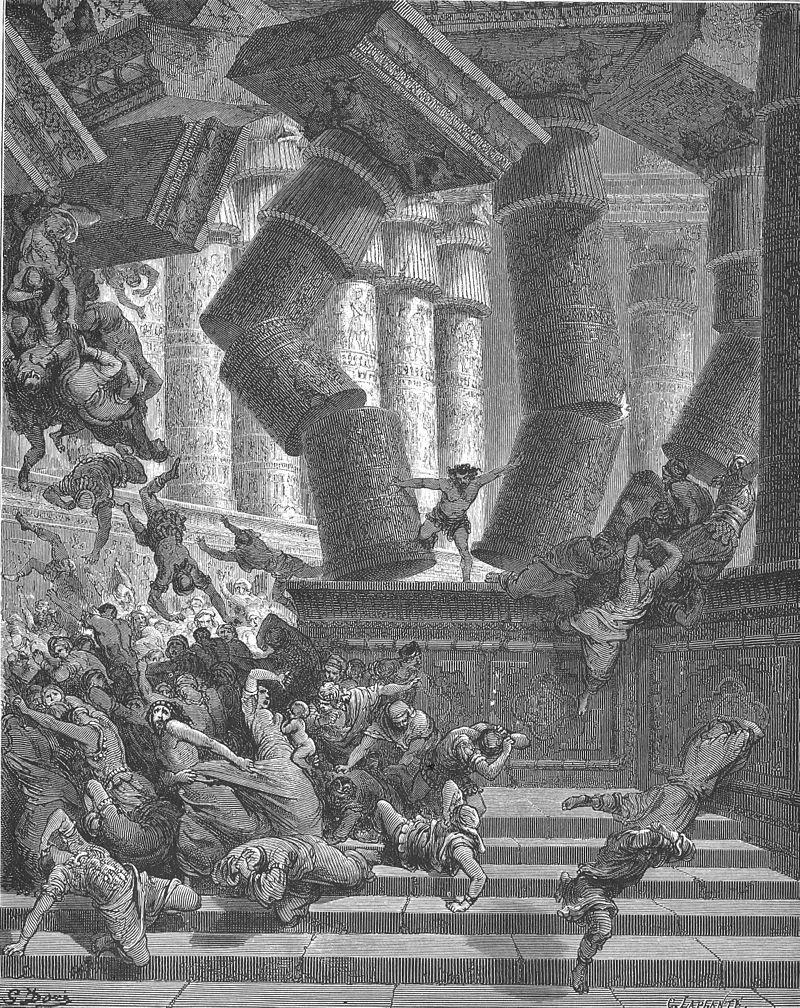
Shimshon called to the Lord, and said, O Lord God, remember me, I pray thee, and strengthen me, I pray thee, only this once, O God, that I may be avenged on the Pelishtim for one of my two eyes (Judges 16:28)

Gustav Dore, The Death of Samson, 1866.

The urge for vengeance is strong. The number of dead, injured and taken hostage keeps rising, at 800 fatalities and 2,400 wounded as I write this. Many still missing, corpses yet to be found, or snatched away as prisoners of Hamas, or adrift in the confusion. Yesterday I learned of the first bereavement of someone I know, a respected academic in the field of Israel Studies. His daughter and son-in-law were shot to death as they sheltered from rockets in their mammad, their reinforced room, protecting their son with their bodies. He survived but is seriously wounded. One of 800 heart-breaking stories, which will touch every Israeli family, leaving a scar in their memories and hearts. Someone must pay for this pain.

The scale of this atrocity is too large to contain. I recall the Ma’alot massacre in which Palestinian terrorists entered Israel from Lebanon in May 1974 and took more than 100 children hostage at a school for two days. It ended with 31 Israeli fatalities, most of them being killed as Israeli troops tried to rescue them. Maybe if the mass shooting by Hamas at the Supernova music festival had been the extent of their assault, I could conceive of something eight times as bad as Ma’alot. But to imagine twenty five Ma’alot massacres in one day, that’s more than I can process.

So when I hear and see on Israeli TV and radio politicians and so-called security experts calling for Gaza to be flattened, for Hamas to be wiped out, voices I normally can’t bear to hear, something visceral moves through me. Yes, they hurt us badly, so we should crush them. They think they can slaughter us and not pay the price, not face the consequences? We’ll wipe them out for this. They are guilty of awful brutality and heinous acts of cruelty, slaughtering the innocent. We have the right to unleash all our armed might against them.

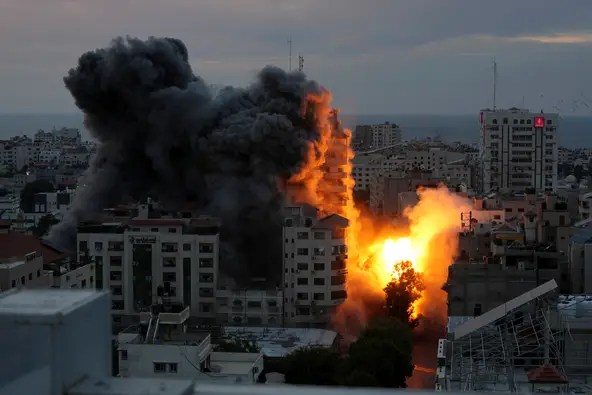
A ball of fire and smoke rise from an explosion on a Palestinian apartment tower following an Israeli air strike in Gaza City, Saturday, Oct. 7, 2023. Detroit News, 9 October 2023.

But where does it spring from, this emotion that grips my body with a fiery energy, pictures the annihilation of others and revels in vengeance? As did so many others, I thought back to 6 October 1973, to the fear I felt as a twelve-year old boy on Yom Kippur in Heaton Park Synagogue as whispers began to circulate about the surprise attack by Egypt and Syria. The shock of 7 October 2023 was as sharp as fifty years earlier. Although this time there was not a moment when I thought Israel might be wiped off the face of the earth, the words I have used previously to describe 1973 serve well in the face of the 25 Ma’alots in one day: “The terror of impending individual annihilation is compounded doubly. First, by a fear that in killing the individuals, the collectivity will also be extinguished and second, by a dread that this surely must not be happening, that now we are strong and able to defend ourselves, so if we are attacked, we will vanquish our foes.”

Consuming anger fuels vengeance but beneath the rage is the deep fear, the existential fear, the terror that is triggered by terrorism. Revenge is based in the fear of annihilation, the fear of my death, of all our deaths. It has been said that on 7 October more Jews were killed than on any other day since the Holocaust. Recounting the horror that Hamas brought to Kibbutz Be’eri, where more then 100 Israelis were murdered, Uri Ben Tzvi felt he was hiding like Anne Frank as the Kishinev pogrom happened around him. How could it be that with a state, with the strongest military in the Middle East, we are hurled back to the terrifying powerlessness we thought we had left behind?

There is another anger too, anger at the Israeli government and military establishment for being unprepared. How come the immensely resourced intelligence services did not see this coming? Why were there not enough troops around Gaza to prevent these pogroms? Why did it take so long for help to reach the villages and towns in the area? As in 1973, there must be an inquiry into the fatal failure of the state to provide a safe refuge for its citizens. But the failure runs deeper, down to the strategic failure of the “conflict management” model according to which the blockade on Gaza has continued for years and horrific episodes of armed violence in which thousands of civilians have died have been considered a price worth paying. Now we are paying the price of not having a strategy to end the conflict by making peace. We are paying the price of perpetual war.

Vengeance also carries a heavy cost. Who will pay that price? The flattening of Gaza, the elimination of Hamas, is a fantasy of rage that directs the excess of emotion onto faceless others, masked Hamas murderers. But I don’t want my nephew, called up for reserve duty to be sent into Gaza to perpetrate revenge. As his mother, my sister does, I am “Hoping he and his friends stay safe, don’t see anyone get hurt and don’t have to hurt anyone.” I don’t want my niece’s husband. called up to a tank unit to exact revenge in a ground invasion. I just want him home with his one year old son and my niece. If I cannot wish it on them, the ones dear to me, I cannot actually wish on anyone to be the perpetrator or victim of revenge.

When Shimshon (Samson) called on God for the strength to avenge at least one of his gouged eyes he was also in great pain, reduced to powerlessness by Delilah’s betrayal and taken hostage by the Philistines, then the mortal enemies of the Children of Israel. I cannot imagine the absolute dread in which “our eyes,” in Hebrew parlance the ones we love the most, who have been abducted by Hamas are going through. But I want them to come home, healthy and whole. All that Shimshon could do with his vengeful strength was to bring the house down on himself and his captors, killing more of Israel’s enemies than he had killed in the rest of his life as he also killed himself. But what if the question is not how should we die, how should we send our children, siblings, nephews and nieces to kill and be killed, but how should we live?

How should we live? To live, we will have to let others live too, the others who share this land between the river and the sea. The rage and fear that lead to vengeance leave us eyeless, blind to the humanity of the Palestinians who we reduce to the perpetrators of Hamas’ inhumane acts of brutality. Blind to the injustices, violence and oppression that we have perpetrated on the Palestinians, none of which justify what Hamas have done in any way. As Orly Noy wrote: “I keep reminding myself that ignoring this context is giving up a piece of my own humanity. Because violence devoid of any context leads to only one possible response: revenge.” We need to open eyes to what is uncomfortable to see if we are not to be condemned to avenge our eyes and bring the house down on ourselves as well as others. We also need to open our eyes and our imagination to the alternative to revenge that Hagai Matar could see even in the dark hours as the horror unfolded: “an end of apartheid, occupation, and siege, and promote a future based on justice and equality for all of us. It is not in spite of the horror that we have to change course — it is exactly because of it.”

So, let’s not seek revenge for our eyes like Shimshon. Let us instead find the way to live in peace and justice.