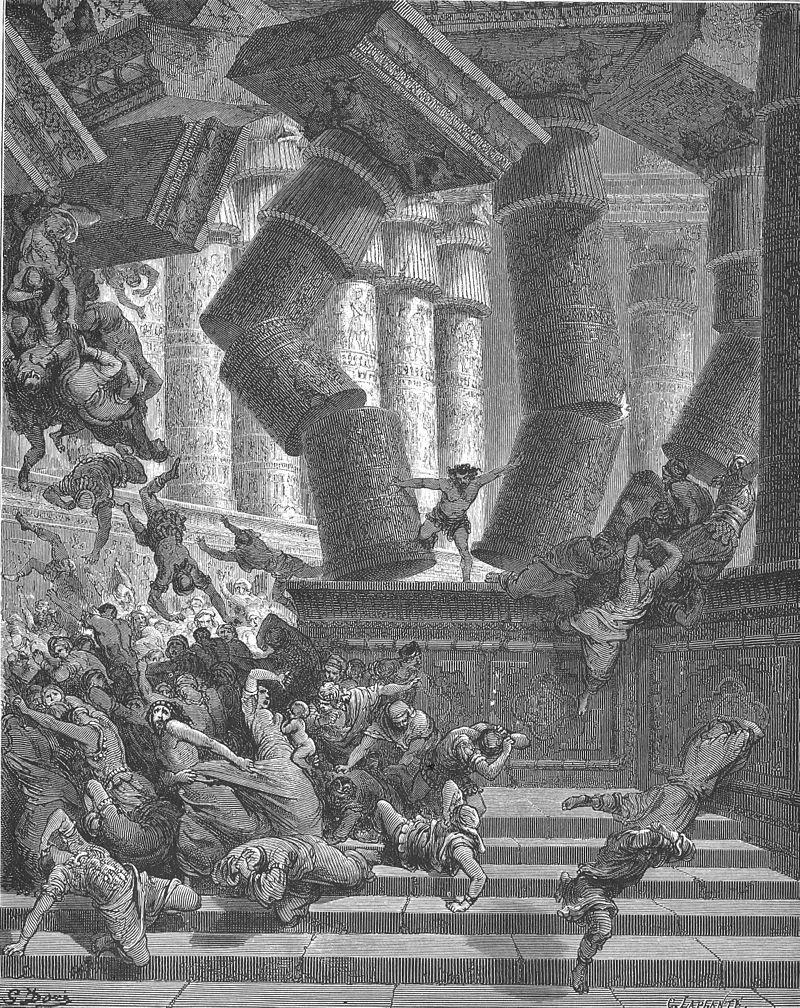
Shimshon called to the Lord, and said, O Lord God, remember me, I pray thee, and strengthen me, I pray thee, only this once, O God, that I may be avenged on the Pelishtim for one of my two eyes (Judges 16:28)
Gustav Dore, The Death of Samson, 1866.
The urge for vengeance is strong. The number of dead, injured and taken hostage keeps rising, at 800 fatalities and 2,400 wounded as I write this. Many still missing, corpses yet to be found, or snatched away as prisoners of Hamas, or adrift in the confusion. Yesterday I learned of the first bereavement of someone I know, a respected academic in the field of Israel Studies. His daughter and son-in-law were shot to death as they sheltered from rockets in their mammad, their reinforced room, protecting their son with their bodies. He survived but is seriously wounded. One of 800 heart-breaking stories, which will touch every Israeli family, leaving a scar in their memories and hearts. Someone must pay for this pain.
The scale of this atrocity is too large to contain. I recall the Ma’alot massacre in which Palestinian terrorists entered Israel from Lebanon in May 1974 and took more than 100 children hostage at a school for two days. It ended with 31 Israeli fatalities, most of them being killed as Israeli troops tried to rescue them. Maybe if the mass shooting by Hamas at the Supernova music festival had been the extent of their assault, I could conceive of something eight times as bad as Ma’alot. But to imagine twenty five Ma’alot massacres in one day, that’s more than I can process.
So when I hear and see on Israeli TV and radio politicians and so-called security experts calling for Gaza to be flattened, for Hamas to be wiped out, voices I normally can’t bear to hear, something visceral moves through me. Yes, they hurt us badly, so we should crush them. They think they can slaughter us and not pay the price, not face the consequences? We’ll wipe them out for this. They are guilty of awful brutality and heinous acts of cruelty, slaughtering the innocent. We have the right to unleash all our armed might against them.
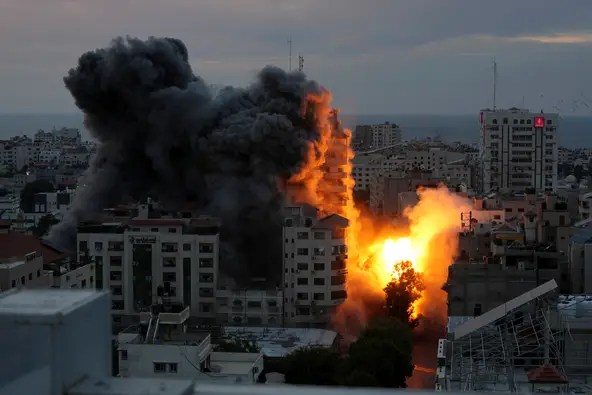
A ball of fire and smoke rise from an explosion on a Palestinian apartment tower following an Israeli air strike in Gaza City, Saturday, Oct. 7, 2023. Detroit News, 9 October 2023.
But where does it spring from, this emotion that grips my body with a fiery energy, pictures the annihilation of others and revels in vengeance? As did so many others, I thought back to 6 October 1973, to the fear I felt as a twelve-year old boy on Yom Kippur in Heaton Park Synagogue as whispers began to circulate about the surprise attack by Egypt and Syria. The shock of 7 October 2023 was as sharp as fifty years earlier. Although this time there was not a moment when I thought Israel might be wiped off the face of the earth, the words I have used previously to describe 1973 serve well in the face of the 25 Ma’alots in one day: “The terror of impending individual annihilation is compounded doubly. First, by a fear that in killing the individuals, the collectivity will also be extinguished and second, by a dread that this surely must not be happening, that now we are strong and able to defend ourselves, so if we are attacked, we will vanquish our foes.”
Consuming anger fuels vengeance but beneath the rage is the deep fear, the existential fear, the terror that is triggered by terrorism. Revenge is based in the fear of annihilation, the fear of my death, of all our deaths. It has been said that on 7 October more Jews were killed than on any other day since the Holocaust. Recounting the horror that Hamas brought to Kibbutz Be’eri, where more then 100 Israelis were murdered, Uri Ben Tzvi felt he was hiding like Anne Frank as the Kishinev pogrom happened around him. How could it be that with a state, with the strongest military in the Middle East, we are hurled back to the terrifying powerlessness we thought we had left behind?
There is another anger too, anger at the Israeli government and military establishment for being unprepared. How come the immensely resourced intelligence services did not see this coming? Why were there not enough troops around Gaza to prevent these pogroms? Why did it take so long for help to reach the villages and towns in the area? As in 1973, there must be an inquiry into the fatal failure of the state to provide a safe refuge for its citizens. But the failure runs deeper, down to the strategic failure of the “conflict management” model according to which the blockade on Gaza has continued for years and horrific episodes of armed violence in which thousands of civilians have died have been considered a price worth paying. Now we are paying the price of not having a strategy to end the conflict by making peace. We are paying the price of perpetual war.
Vengeance also carries a heavy cost. Who will pay that price? The flattening of Gaza, the elimination of Hamas, is a fantasy of rage that directs the excess of emotion onto faceless others, masked Hamas murderers. But I don’t want my nephew, called up for reserve duty to be sent into Gaza to perpetrate revenge. As his mother, my sister does, I am “Hoping he and his friends stay safe, don’t see anyone get hurt and don’t have to hurt anyone.” I don’t want my niece’s husband. called up to a tank unit to exact revenge in a ground invasion. I just want him home with his one year old son and my niece. If I cannot wish it on them, the ones dear to me, I cannot actually wish on anyone to be the perpetrator or victim of revenge.
When Shimshon (Samson) called on God for the strength to avenge at least one of his gouged eyes he was also in great pain, reduced to powerlessness by Delilah’s betrayal and taken hostage by the Philistines, then the mortal enemies of the Children of Israel. I cannot imagine the absolute dread in which “our eyes,” in Hebrew parlance the ones we love the most, who have been abducted by Hamas are going through. But I want them to come home, healthy and whole. All that Shimshon could do with his vengeful strength was to bring the house down on himself and his captors, killing more of Israel’s enemies than he had killed in the rest of his life as he also killed himself. But what if the question is not how should we die, how should we send our children, siblings, nephews and nieces to kill and be killed, but how should we live?
How should we live? To live, we will have to let others live too, the others who share this land between the river and the sea. The rage and fear that lead to vengeance leave us eyeless, blind to the humanity of the Palestinians who we reduce to the perpetrators of Hamas’ inhumane acts of brutality. Blind to the injustices, violence and oppression that we have perpetrated on the Palestinians, none of which justify what Hamas have done in any way. As Orly Noy wrote: “I keep reminding myself that ignoring this context is giving up a piece of my own humanity. Because violence devoid of any context leads to only one possible response: revenge.” We need to open eyes to what is uncomfortable to see if we are not to be condemned to avenge our eyes and bring the house down on ourselves as well as others. We also need to open our eyes and our imagination to the alternative to revenge that Hagai Matar could see even in the dark hours as the horror unfolded: “an end of apartheid, occupation, and siege, and promote a future based on justice and equality for all of us. It is not in spite of the horror that we have to change course — it is exactly because of it.”
So, let’s not seek revenge for our eyes like Shimshon. Let us instead find the way to live in peace and justice.

 Picturing Peace