![U.S. Secretary of State John Kerry is greeted by Israeli Prime Minister Benjamin Netanyahu prior to their meeting in Jerusalem on May 23, 2013. [State Department Photo/ Public Domain]](https://israelipeaceimages.com/wp-content/uploads/2013/05/kerry_pm_netanyahu_2.jpg?w=300&h=217)
U.S. Secretary of State John Kerry is greeted by Israeli Prime Minister Benjamin Netanyahu prior to their meeting in Jerusalem on May 23, 2013. [State Department Photo/ Public Domain]
Peace is generally thought to be a good thing, conjuring up positive, pastoral images of lions lying down with lambs, swords being beaten into ploughshares, and each person sitting unafraid under their vine and fig tree. Yet, this near-universal and enduring admiration of peace has been perverted in Israel/Palestine, not because of any honest, outspoken preference for war but because ‘peace’ has been contaminated by pseudo-peace. A key trigger for my project on Israeli peace images was a report in Ha’aretz on June 10th 2004 that some 40 Israeli and Palestinian media and public relations professionals would be meeting in Jordan ‘to try and find a way to promote the brand name of peace,’ and ‘to create a ‘local and international campaign to promote the image of peace’. The campaign was initiated by the director of the Peres Center for Peace, Ron Pundak, who was one of the negotiators of the 1993 Oslo Accords between Israel and the PLO. He acknowledged that the ‘image of the peace brand …. has been worn down over the past few years,’ but hoped that the public relations experts could achieve what the diplomats had been unable to do, namely ‘to define certain concepts, such as coexistence, in a way that will be acceptable to both sides’. As it happens, the peace branding campaign never got off the ground, because the Israelis and Palestinians participating in it could not agree on a concept of peace to promote. But what had tarnished the image of peace, and how has it been corroded even further since 2004?
The most obvious answer is that by 2004 the Oslo process had lost all credibility, in the wake of the failed Camp David talks between Israeli Prime Minister Barak and Palestinian President Arafat in 2000 and the violence of the Second Intifada. That answer suggests that the image of peace has been eroded because the promise of peace has not been fulfilled, and raised expectations have been dashed. Yet, equally significant in the context of 2004 was the international Quartet’s April 2003 road map for peace, which offered nothing that had not already been proposed under Oslo (It did, however, cover the withdrawal of Israeli armed forces from the positions they reoccupied inside the Palestinian areas during Operation Defensive Shield in 2002). Ironically, it is pursuit of the pseudo peace of the ‘peace process’ that has tarnished the image of peace among the very people in Israel (and Palestine) that do the most to build peace.
When I visited Israel in the summer of 2009, an academic colleague who has been active in anti-occupation groups and refused reserve military duty in the Palestinian Occupied Territories put it this way – that only a charlatan still speaks about peace. Retroactively, he considered the organization he co-founded, The Twenty First Year, and other groups to the ‘left’ of Peace Now during the first intifada such as End the Occupation, to have been directed against the occupation rather than for peace. Yet, one of our common protest chants at the time was ‘Peace – Yes! Occupation – No’, while the most concrete notion of peace we had in mind was of two states for two peoples, a proposal that was then radical if not unthinkable in Israeli political culture. It seemed clear to us in 1988 that ending the occupation and bringing peace implied each other. However, in June 2009, the charlatan-in-chief, Prime Minister Netanyahu, publicly and cynically endorsed the ‘two state solution’, while his government did as much as it could to ensure that such peace could not be achieved (such as expanding settlements).
It is not surprising, then, that currently Israeli and Palestinian peace-builders often do not identify as peace activists. In her book Struggling for a Just Peace: Israeli and Palestinian Activism in the Second Intifada, Maia Carter Hallward noted an accentuation of this trend between 2004-5 and 2008 among activists in Ta’ayush, Machsom Watch, Rabbis for Human Rights, and other groups (151, 158). For the mainstream Jewish Israeli public disillusion with ‘peace’ deepened because Israeli’s unilateral disengagement from Gaza in 2005 was taken to be a step towards peace taken by Israel to which Hamas responded with Qassam rockets. So much, then, for the formula of ‘territories in return for peace’. But for the activist peace camp, following the Israeli withdrawal Gaza was still under occupation, now out of reach for nearly all Israelis and West Bank Palestinians, and in effect under siege. Hallward considers it crucial as a researcher to focus on ‘peace work rather than peace words’ (54), noting how the latter has become so discredited that is has become a dirty word among activists (164).
Last week saw the end of yet another international effort to ‘revive the peace process’ that further eroded the image of peace. Unable to bring the Palestinian Authority and Israeli government any closer than they had been before, US Secretary of State John Kerry ended a spell of intensive diplomatic toing and froing with an announcement that the two sides needed to think about their positions and a plan to boost the Palestinian private economy (meaning the West Bank economy), so as to reduce the PA’s dependency on the foreign aid that actually supports the status quo. Under such circumstances, I can only agree with Noam Sheizaf of the +972 blog that:
what this moment calls for, more than anything else, is some honesty. Kerry would have done his own cause justice if he simply stated that there is no peace process, nor has there been one in recent times, and that the current trends on the ground are likely to continue in the foreseeable future.
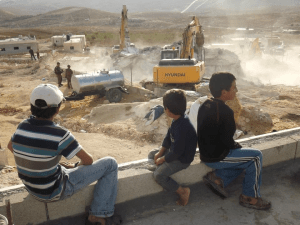
The peace process is a pseudo peace, a ‘peace’ in which there can be endless negotiations while at the same time occupation continues, settlements expand, a permit system and checkpoints obstruct Palestinian movement, the separation wall is completed, Palestinians can be imprisoned without trial, and the Palestinian economy is subordinated to the Israeli one. There is ‘peace’ and there is just peace, and the peace that Kerry has been peddling is the snake oil of the charlatan.

 Picturing Peace