Tag Archives: Syria

Who “only understands force”? On the limits of force in politics

The sudden, rapid and unanticipated collapse of Assad’s Ba’athist regime in Syria a few days ago is an historic episode that demonstrates the limitations of force in politics. A brutal regime that had crushed dissent for decades by using military and police violence, torture, incarceration and mass executions of opponents imploded in a matter of days. Yes, it did so in the face of an armed offensive by Hayat Tahrir al-Sham in the north of the country whose success soon prompted other armed rebels against the dictatorship to join in, notably the Southern Operations Room which seized control of Damascus. There were some battles on the roads to Aleppo, Hama, Homs and Damascus, but the key development was the melting away of the military might available to the regime. Soldiers stripped off their uniforms, abandoned their weapons and blended into the civilian population. The regime’s main ally, the Iranian government, evacuated its personnel because the Syrian government forces had no will to fight. The story here is that the seemingly formidable power of the regime vanished.

It is not surprising that some compared the regime’s collapse to the fall of the Berlin Wall in 1989, when German civilians demolished some of that symbol of the Soviet regime. These episodes in which regimes that rely on force and violent repression dissolve seem miraculous. Yet they are apprehensible according to theories of power that grasp that political power and obedience ultimately come from below, from the consent of those who are ruled. In Gene Sharpe’s approach to these theories, which were part of the playbook for the democratic movements of the Arab Spring, the emphasis is on non-violence as the appropriate strategy to bring down repressive regimes.

That was not quite the case in Syria, but the essence of the theory still pertains. Repressive regimes such as Assad’s dictatorship work only so long as the people believe the regime is to be feared and so long as the government’s agents believe that the people are afraid of them. Without the mantel of fear, statues of Assad, like the idols in Abraham’s father Terah’s shop, are just lumps of stone and metal. When the compact of fear fails for significant numbers of people, the repressive emperor has no clothes. The soldiers’ uniforms no longer signify that they command fear from the population, so they take them off and flee, afraid themselves that what they have done to others will be done to them. And hence the latest episode in the long struggle against Assad’s regime was relatively bloodless.

A truck pulls the head from the toppled statue of late Syrian president Hafez al-Assad through the streets of the captured Syrian city of Hama © MUHAMMAD HAJ KADOUR / AFP

Other autocratic regimes in the Arab world would do well to heed the warning about the limitations of violent repression and follow the example of those who have taken some steps towards democratic reform. But there is another regime in the region that relies on force and violent power, one which has never even sought to make itself legitimate in the eyes of its subjects. The Israeli occupation of Palestinians in the West Bank and Gaza has at best offered some crumbs of its own economic prosperity to non-citizen Palestinians under its rule in return for acquiescence. It has never given them any grounds to consent to Israeli rule, to appropriation of land and resources, restrictions on movement, denial of rights, other than fear of the consequences of resistance, whether armed or non-violent.

The apartheid character of the Occupation becomes daily more evident, more nakedly an assertion of alleged Jewish rights and disregard for Palestinian rights. The Occupation regime becomes ever more dependent on bare force. Ironically, it is Israelis who tell each other that “they” (Palestinians, Arabs, Muslims) only understand force, while subjecting Palestinians to rule that will last only as long as occupied and occupier believe that brute force can sustain Occupation. “We will always live by sword,” repeats Netanyahu and as his words are echoed and enacted, it becomes a self-fulfilling prophecy. As Palestinian historian Rashid Khalidi put it in a recent interview with Ha’aretz, when asked if Israel had a real opportunity to break out of the cycle of bloodletting: “It’s been the Iron Wall since Jabotinsky. Force and more force. You’ve been trying to impose a reality that has sent shock waves throughout the Middle East since the 1920s.”

The Israeli government’s response to the toppling of Assad’s regime has been a massive unleashing of military violence to destroy as much as possible of Syria’s military capacity. Israel has also occupied the demilitarized buffer zone between Israeli and Syrian positions established by the 1974 armistice agreement between the two countries. Other governments are opening channels of communication with the new rulers in Damascus, but the Israeli government assumes that Hayat Tahrir al-Sham and its partners will use military force against Israel if they have the means or let them fall into the hands of others who will, such as Hezbollah. We don’t have the luxury of others to get to know these people, an Israeli spokesperson tells Channel 4 news, so first we bomb them. He might as well add: we only understand force.

There is no guarantee of if or when force will cease to work as the compact between occupier and occupied. So far in this phase of violence since October 7th 2023, only a few Israelis such as Soul Behar have refused to put on their uniforms. Most are too afraid that what they have done to others will be done to them, a fear which has also been brought from other places where terrible things were done to their ancestors. Palestinians under Occupation have already shown that they are no longer afraid of the force wielded by the occupiers, notably at the start of the First Intifada when most of the resistance to Occupation was non-violent or unarmed. But what if more Israelis begin to see themselves as Palestinians see them, as inflicting force as violent, merciless and devastating as the Assads’ assaults on their own people? And what if more Palestinians who have survived the violence and are subject to Occupation can see that competing with Israeli violence is not a winning strategy? Assad’s regime has fallen because of the limits of force in politics. The Occupation will end for the same reason.
The trauma of October 1973

This is another autobiographical blog, an excerpt from Chapter 2 of a planned book about how my life has intersected with Israel-Palestine, the making and unmaking of a Zionist.

On October 6th 1973 I was in Heaton Park Synagogue for Yom Kippur attempting to complete the fast in my last year before my bar mitzvah, after which I would obliged to fast. I was seated with other youth in an area unused for most of the year, behind the bima (prayer platform) and flanked by the main doors, but needed during the well-attended services of the High Holidays. Other boys drifted in and out, but I was in my pious phase, taking repentance seriously and not joining the custom of hopping from one synagogue to another to see friends, treating the day as a seriously under-catered social event.

Sometime in the afternoon news began to trickle into the synagogue about the Egyptian and Syrian attack on Israel, which began at 2 pm local time. As we were not a very religious community, some of the congregation had perhaps turned on radios (in violation of the strictures of holy day) to find out how Manchester City were doing (it was a 1- 1 draw with Southampton). Even aged twelve, I knew this was a surprise attack, as there had been no escalation of tensions reported in the news. Common wisdom is that in 1967 Jewish communities in Israel and the Diaspora experienced the dread of annihilation for the first time since the Holocaust as tension mounted before Israel’s pre-emptive strike. Whatever the reality of the intentions and capacities of the neighbouring – or surrounding – Arab states, there was a palpable fear that Israel could be overwhelmed and destroyed less than two decades after its birth in war. Six and a half years earlier, I had picked up on that tension in 1967, so, perhaps for that reason, I was deeply fearful. This was not a distant fear, an anxiety that a country somewhere else could be defeated, but an immediate terror we would all be wiped out together. I summoned up the courage to walk across the synagogue to Rev Olsberg’s seat at the front, to ask him what he knew, whether the rumours were true. It was not the secular reassurance of my father I sought, but a higher cosmic authority. Rev Olsberg was as kind as ever, confirming he had also heard the reports and would be making an announcement in a break in the service. I prayed hard for the rest of the day, as if my repentance could somehow save Israel and bring God’s salvation.

The Yom Kippur services came to an end as night fell and we all hurried home to eat, turn on radios and televisions and learn the news, which was not good. But nor was it so bad that I remained gripped by terror. Instead of worrying that Israel was being overrun, concern shifted to former Habonim members my older sister knew who had settled on Mevo Hama, a kibbutz on the southern edge of the Golan Heights. If I remember correctly, they were evacuated in the confusion at the start of the war as Syrian troops advanced into the Golan. Mention of them was enough to shut up a classmate who made some off-colour remark to me about Israel not doing so well now, was it? Our youth leaders at Habonim gathered us together quickly and we spent an evening collecting money door to door for medical aid, though I am not sure which fund it did go to. Some of them also volunteered to go to Israel to work on kibbutzim, taking the place of mobilised reservists. A few days into the war, the news got better for Israel as its forces counter-attacked, and by the end of the fighting on October 25th Israeli forces had crossed onto the western side of the Suez Canal and encircled Egyptian forces who crossed onto the eastern side, in the Israeli occupied Sinai Peninsula. They had also blocked the Syrian advance into the Golan and captured a belt of Syrian territory that took them within striking distance of Damascus.  Yes, Israeli military dominance and confidence had been severely challenged by the initial surprise attack, but Israel was safe.

My understanding of the war was shaped by reporting in The Guardian and British television news – for a few weeks, at my older sister’s instigation, we watched both BBC and commercial ITV news, which we normally ignored.  More impressive for me than those media, though, was an Israeli propaganda film that was produced quickly and screened at Mamlock House, the local headquarters of the Zionist movement. The song that became the Israeli anthem of the war, Lu yehi (Let it Be) and which we had already learned in Habonim featured in it. The documentary ended on an optimistic note by picturing Israeli and Egyptian officers negotiating at Kilometer 101. I treated my classmates to a verbal version of it during an English class in which we read out some work. There was no divine intervention in this essay, but there were echoes of David and Goliath, with Israel as the small country surrounded by enemies attacked on its most holy day, with even school children mobilised in the war effort by painting car headlights blue. I was the perfect propagandist for Israel.

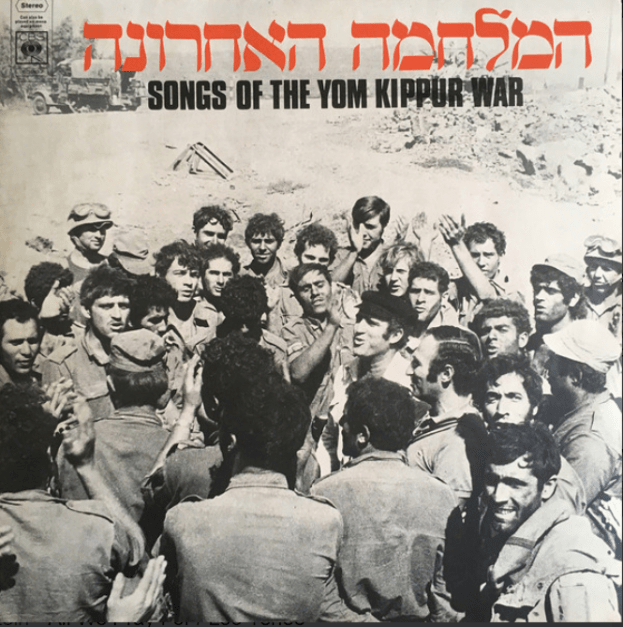
The Yom Kippur War – which is the only name I knew it by at the time, grew in significance for me in its aftermath. Our youth leaders came back with stories to tell, including stories about the torture and killing of Israeli prisoners of war by the Syrians, but also a more touching one about waving to a Jordanian farmer working on the other side of the border.[1] Soon after the war, my father went on a work trip to Israel and came back with what seemed like a whole suitcase full of gifts, including a record album titled “Songs Of The Yom Kippur War” in English but “The Last War” in Hebrew, after the song of that title performed by Yehoram Ga’on. I listened to it repeatedly, especially Chava Alberstein’s haunting rendition of Lu Yehi, while earnestly endorsing the sentiment of the Hebrew title song that this will be the last war – if only the Arabs would stop attacking us. Although it was only a few years before I began to acquire a more critical understanding of the war, at the time I would have been shocked if told what I know now; that the war could have been avoided if Israeli leaders had been more willing to heed President’s Sadat’s overtures of peace and territorial compromise; that the surprise attack was a major failure of Israeli political judgment and military intelligence, not for lack of information but for lack willingness to believe that Egypt and Syria would dare attack (as established by Israel’s Agranat Commission of inquiry, which led to the resignation of Prime Minister Golda Meir’s government in 1974); and that the Arab states aimed to recover territory captured by Israel in 1967, not to wipe out the country. In effect, Egypt achieved its war aims, opening the space for US Secretary of State Kissinger’s shuttle diplomacy and leading first to the 1975 disengagement agreement with Israel which returned some of the Sinai, and then less directly – including the rise of the Peace Now movement – to the 1978 Camp David Accords, which returned the rest of the peninsula to Egypt. For all the pain and loss it caused, it was a war in which diplomacy was waged violently and militarily.

And yet something still remains. My adult, critical understanding cannot undo the horror I felt when I listened to voice recordings of Israeli soldiers in positions on the edge of the Suez Canal as they were being overrun by Egyptian forces. The terror of impending individual annihilation is compounded doubly. First, by a fear that in killing the individuals, the collectivity will also be extinguished and second, by a dread that this surely must not be happening, that now we are strong and able to defend ourselves, so if we are attacked, we will vanquish our foes. It is the same dread I felt watching the scene in the film Saving Private Ryan in which the Jewish character, Stanley Mellish, is killed in hand-to-hand combat by an SS soldier, who makes calming sounds to his victim as he pushes the knife into his chest. This too should not be happening, my body screams, the Normandy invasion is underway, the Nazis are being defeated, Mellish should be victorious. But there it is on the screen, a little Holocaust, the death of a single Jew that for the unbearable moment of the scene symbolizes the death of us all. So, the trauma of 1973 lingers, attaching itself to other traumas which cannot be dispelled by critical historical awareness, only by confronting the trauma.


  1. The stories of Syrian atrocities were true. See Wikipedia, “Atrocities Against Israeli Prisoners,” https://en.wikipedia.org/wiki/Yom_Kippur_War#Atrocities_against_Israeli_prisoners. Accessed 21/1/2021.