Author Archives: Jon Simons

A Time for Mourning

It is difficult to throw off the sense of being trapped in a recurring nightmare, the same feeling of paralysis and powerlessness to prevent this happening again. If this is how I feel, far away and safe in the UK, how does it feel to be a Palestinian in Gaza? Reporting the number of dead – at least 232 Palestinians in Gaza, including 65 children, as well as 27 in the West Bank and Jerusalem, and twelve in Israel, including two children, two Palestinians with Israeli citizenship and three migrant workers – does not cut it. Even reciting the names of the dead who I do not know leaves me numb. I clutch at some words from amid the ruins and graves. Someone called Ismail writes:

I’ve noticed a new phenomenon on social media in Gaza: people are sending their loved ones farewell messages before their death… I cannot accept that you will see all the blood and cruelty in Gaza and will not care. That you are not willing to do a thing beyond settling for justifications that protect your military actions… I am writing to tell you that this struggle, before it is a political or historical or ideological struggle, is our human struggle. A struggle for our humanity

Ismail, “Here in Gaza, people are sending farewell messages to their loved ones” +972 Magazine, 17 may 2021
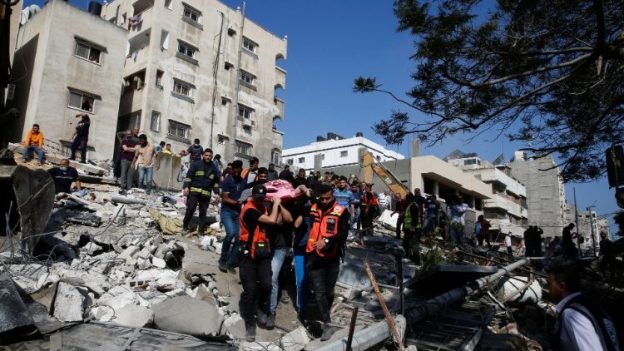
Rescue workers assist victims amid the rubble left by an Israeli air strike on Gaza City. Vatican News May 16 2021

Gazan lawyer and activist Fatima Ashour wrote on her Facebook page in Arabic:

I lost my home yesterday. And when I went there today, all was already destroyed…. I rescued whatever I was able to from there, but I left my spirit there, behind. We’re doomed to be exiled a thousand times, inside our country and outside of it… These are their memories that were also bombed, clothes, books, pictures, tears, laughter and dreams… all these were bombed and disappeared in a second, before your eyes, and there is nothing you can do but flee, with a naked spirit and bereft of everything.

Quoted by Ahmed on the אנחנו שמעבר לגדר (We who are on the other side of the wall) Facebook page, May 12, 2021

As I listen closely, I begin to feel something. I can also feel something of the anxiety that the Indian migrant care worker who looks after my father in Karmiel has, even though they are beyond the range of Hamas rockets. I can also feel the mixture of apathy and disappointment of the residents of the area in Israel bordering Gaza, a third of whom have left for safer locations, that their government that their government has not put an evacuation plan into action, so they rely on their own resources of mutual aid instead. Like the citizens in Gaza, they are pawns in someone else’s deadly game.

I can remind myself of what I wrote when this happened before, in 2014, in 2012 ( I was not writing in 2008-9). At least in 2014, although the misery and injury lasted seven weeks and interrupted my summer research, I diverted my energy into collating a special issue of the academic journal Theory and Event about the Israeli war on Gaza. I was coherent enough to write what I thought were seven insightful blogs about topics such as “This is what conflict management looks like,” and about how asymmetrical warfare, as between Israel and Hamas, is inevitably punctuated by moments in which civilian casualties capture public and political attention. But my earnest posts have not stopped the cynical Israeli practice of “mowing the grass” and shrugging off the public relations cost of cutting down all the flowers – all the Palestinian lives – that grow in it.

I also wrote in 2014 about the Israeli dissenters to their country’s war on Gaza, including the creative intervention of the Bereaved Families Forum to beg to end the flow of bereavement. I found hope in the slogan chanted at anti-war demonstrations, “Jews and Arabs refuse to be enemies,” claiming it is a radical chant, refusing the the ethno-national-religious grounds on which the conflict is conducted. But the cycle of bereavement has not stopped and the slogan is once again being chanted at anti-war demonstrations, this time against the background of ethnic-inter-communal violence within Israel. Now the slogan seems more like a leap of faith then ever. A ceasefire has been announced and I hope it holds, even though I know it is unlikely to be more than that – a ceasefire – a respite before the next round. Somewhere in the rubble there is some hope, but today it is still buried. It is a time for mourning.

On not seeing Kuwaykat

This is another excerpt from the third chapter of the book I am writing. This chapter covers the year I spent in Israel as part of a Zionist youth group, Habonim. The excerpt is about my time on Kibbutz Bet Ha’emek.

The months spent on Kibbutz Bet Ha’emek further instilled a deep sense of familiarity with and connection to the land. I enjoyed the beautifully landscaped and gardened grounds of the kibbutz as well as the productiveness of its agricultural fields. It certainly felt like home for a while, or at least a place in which I belonged.

One weekend I was late coming back to the kibbutz on a Saturday night (a night on which Israel won the Eurovision song contest with the song “Halleluya,” performed by “Milk and Honey”) after visiting my relatives in Jerusalem. I found myself in Nahariya after the usual sherut (shared taxi service) had ended so I had no choice but to hitch a ride, about which I was quite nervous. First a lorry driver took me to a junction closer to the kibbutz and then a sherut with three Arabs in it gave me a free ride for the rest of the way, and, as I wrote in my diary “did not stab or rob me.” Although that was meant humorously, the fearful thought had obviously crossed my mind that I was relying on the kindness of potentially hostile strangers. Why should I be anxious that I would be kidnapped or attacked by neighbours of the kibbutz where I was staying? I cannot remember any case in which a Jewish hitchhiker has been attacked by a Palestinian driver within the 1967 borders, though there have been such incidents during the intifada periods in the Palestinian Occupied Territories.

Zochrot. All that remains of the village. https://zochrot.org/en/village/49232. 2008.

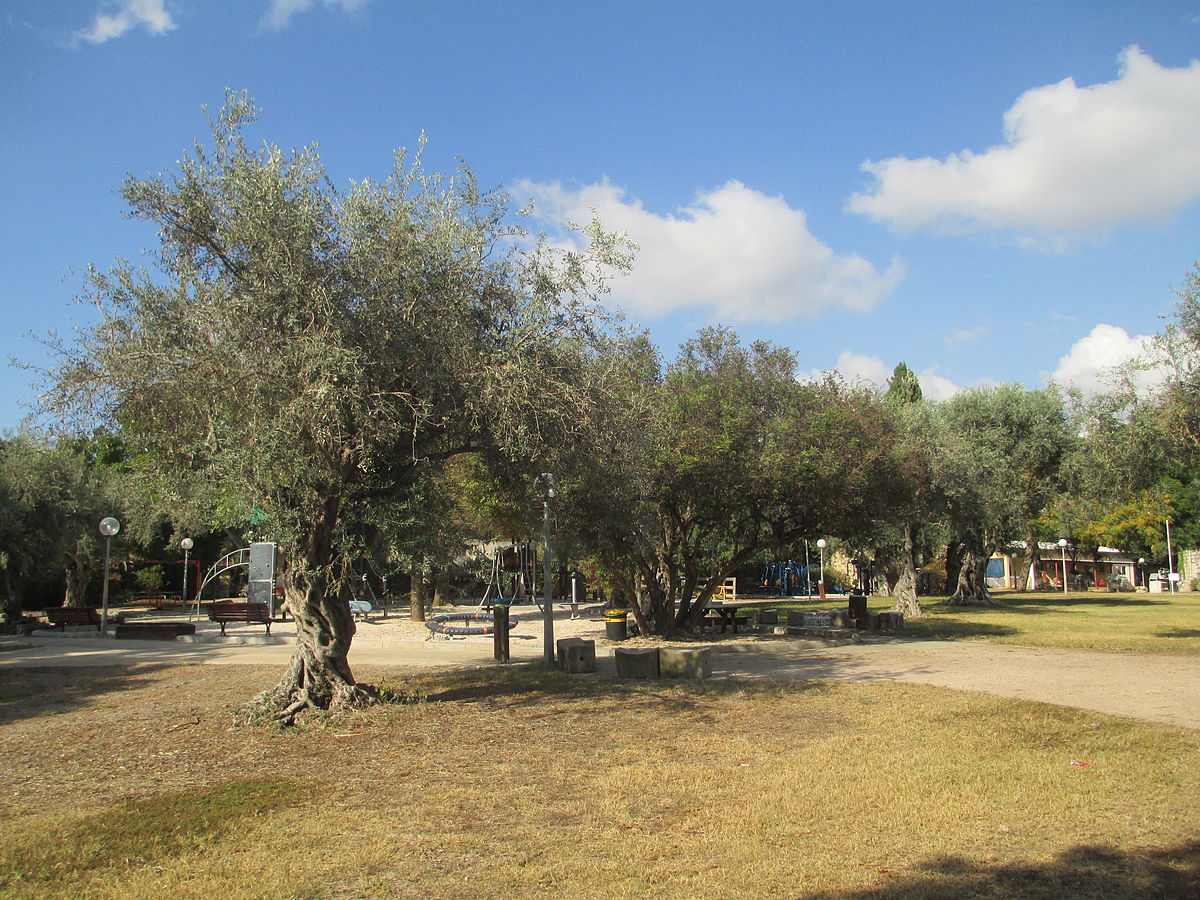
I would suggest that part of my fear stems from what I could see at Bet Ha’emek but did not acknowledge, what I was dimly aware of but did not want to know. On the road that connected the kibbutz to the main road there was a shrine which was visited by Arabs every now and again. It is the shrine of Shaykh Abu Muhammad al-Qurayshi, a Druze religious leader. I never asked, or even wondered, why this shrine was next to the kibbutz. There were also some old stone buildings on the kibbutz, one of which housed the dark room which my kibbutz father used for his photography hobby. I do not recall asking when they were built, or why there were so few such buildings around. If I had been paying attention, I would have noticed that the olive trees on the kibbutz looked older than the kibbutz. Perhaps others in the group asked more questions, but I did not.

Dr. Avishai Teicher, Olive Trees on Kibbutz Bet Ha’emek, https://commons.wikimedia.org/wiki/File:PikiWiki_Israel_40571_Olive_trees_in_Kibbutz_Beit_Haemek.JPG

It was not until many years later that the Israeli organisation Zochrot, which has worked “since 2002 to promote acknowledgement and accountability for the ongoing injustices of the Nakba, the Palestinian catastrophe of 1948,” produced a map and an app that told me about Bet Ha’emek.[1] When the kibbutz was established in 1949, it was on the site of the Palestinian village of Kuwaykat, which had about 1200 residents and whose land was considered to be among the most fertile of the district, growing grain, olives and watermelons.[2] It was captured and destroyed by Israeli armed forces as part of Operation Dekel in July 1948. The village had withstood three previous attacks in January, February and June, but in July a heavy bombardment forced out the villagers, most of whom fled to nearby Abu Sinan and Kfar Yusif.[3]

We were awakened by the loudest noise we had ever heard, shells exploding and artillery fire … women were screaming, children were crying… Most of   the villagers began to flee with their pyjamas on. The wife of Qassim Ahmad Sa’id fled carrying a pillow in her arm instead of her child...[4]

The car I was in that night was most probably on its way to Kfar Yusif, which gave shelter to many of the refugees from Kuwaykat. They were among the approximately 46,000 Palestinian refugees, or internally displaced persons, who remained within the new State of Israel, under the oxymoronic status in Israeli law of “present absentees.” They and their descendants, now numbering well over a quarter of a million souls, have never been allowed to return to their homes.[5] In her book, Erased from Space and Consciousness, Noga Kadman observes that even recently the publications of the kibbutz barely mention Kuwaykat or the previous residents. But they do mention the olive trees, which kibbutz youth now harvest to pay for their “root trips” to Poland where they visit sites of the Jewish catastrophe, the Holocaust. The Palestinians who gave me a ride that night probably knew that I was not an Israeli, but even if they took me for a foreign volunteer on the kibbutz, they would have known the history of the place in which I felt at home and which I was then certain that Jewish Israelis had a right to inhabit exclusively. I lived on Bet Ha’emek and I did not see Kuwaykat, even though its traces were around me. The fields on which I became a Zionist subject had been farmed by Palestinians before me and before the pioneers from British Habonim arrived. The Palestinians did not rob me, but I enjoyed the fruits that had been robbed from them.

A 1940s map of the area of Kuwaykat from the Survey of Palestine. https://commons.wikimedia.org/wiki/File:Historical_map_series_for_the_area_of_Kuwaykat_(1940s).jpg

[1] See Zochrot, “Our Vision,” https://zochrot.org/en/content/17. Accessed 3/16/2021. The Nakba app is especially useful for learning about the Palestinian presence that has been erased by Israeli settlements and forests, often planted by the Jewish National Fund, while traveling around Israel-Palestine, as it shows information according to one’s current location.

[2] Government of Palestine, Department of Statistics. Village Statistics, April, 1945. Quoted in S. Hadawi, Village Statistics of 1945: A Classification of Land and Area ownership in Palestine (Palestine Liberation Organization Research Center, 1970), p. 81.

[3] See Zochrot, “Kuwaykat,” https://zochrot.org/en/village/49232 . Accessed 3/16/2021.

[4] Walid Khalidi, All That Remains: The Palestinian Villages Occupied and Depopulated by Israel in 1948 (Washington D.C.: Institute for Palestine Studies, 1992), pp.  224-25.

[5] Wikipedia, “Present Absentees,” https://en.wikipedia.org/wiki/Present_absentee. Accessed 3/16/2021.