Tag Archives: Habonim

A Jewish-Arab government for Israel now

Open letter to the leaders of Israel’s “change coalition”

Dear Gadi, Naftali and Avigdor,

You don’t know me and I don’t know you. We don’t mix in the same circles. But I’d like you to hear me out anyway. Who am I? Take a look at me aged 14 in November1975, going to Manchester Grammar School wearing a badge saying “I’m a Zionist” as a response to the infamous UN Resolution equating Zionism with racism. The badges had been handed out at the local branch of Habonim, the Zionist youth movement in which I spent my teenage and early adulthood. I became the mazkir artzi (national secretary) of the movement from 1982-84, during which time I was the co-chair of the Zionist Youth Council and also a vice-president (or some such title) of the UK’s Zionist Federation. At the end of 1984, as I believed any genuine Zionist should, I came to Israel on aliya. I’ll hope that is enough to establish my Zionist credentials, because I know you want to create a new “Zionist government of those who serve.” (I’ll skip over the decade I spent in Israel, especially the bit when I refused to serve in the West Bank, as you’d probably stop listening to me, just another smolani (lefty), one who stopped calling himself a Zionist some decades ago).
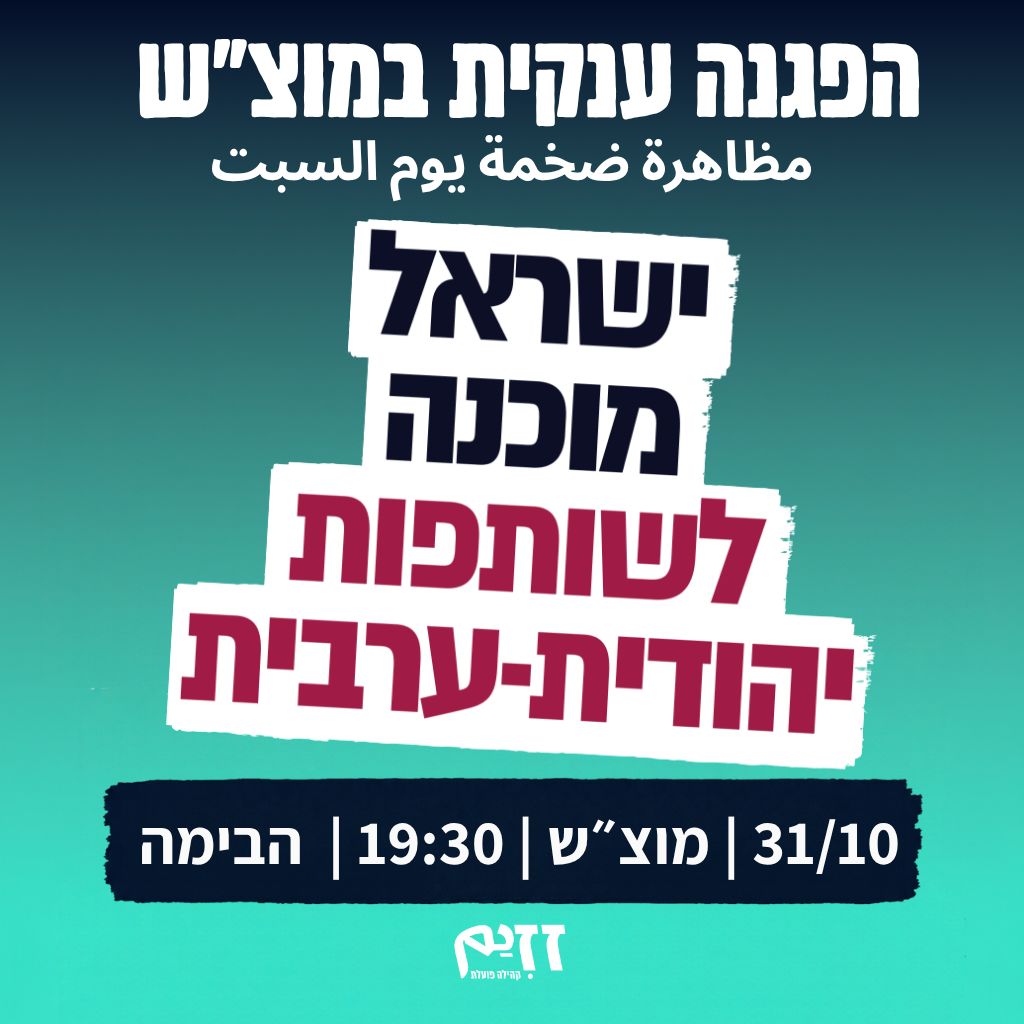
Electronic poster: Huge protest on Saturday night: Israel is ready for Jewish-Arab partnership

In any case, you don’t have to listen me. I’m joining a chorus of voices proposing the same thing. Hagai Elad reminds you: “Benjamin Netanyahu’s continued rule poses a real danger to the country’s future, the leaders of the ‘Change Bloc’ warned before the elections … If they want to save the country, they need … to hear the hundreds of thousands of great-grandchildren of Palestinians from the Nakba generation say in a clear voice, to themselves and to anyone who cares to listen: We are here.” Noa Landau wrote: “On election day, multitudes of Arab citizens reached out to the public that calls itself liberal in the State of Israel, saying that they want to be part of this country.” Sanaa Hammoud calls out to you: “From here it is in your hands, leaders of the change bloc. We have shown up. We are ready. We are the partner. Will you refuse our offer?” Will you?

I add to that chorus that if you establish a Jewish-Arab government, you will also create a Zionist government, probably the best one Israel has ever had. Gadi, you’ve laid down conditions for parties to join the coalition you want to lead, including adherence to the values of the Declaration of Independence. That document envisions a “country for the benefit of all its inhabitants … based on the precepts of liberty, justice and peace taught by the Hebrew prophets” that would also “uphold the full social and political equality of all its citizens, without distinction of race, creed or sex.” Creating Israel’s first Jewish-Arab government, by including the Joint List and Ra’am in your coalition, would be a wonderful fulfilment of the values you cherish. It would be an effective mechanism to work towards liberty, justice and peace. You could formulate policies, approve legislation and establish programmes in which young people could serve their country by advancing those values. There is more than one way to serve your country.

Would the Joint List and Ra’am be such terrible coalition partners? Much of what they demand is what any government should be able to do, notably to put an end to the terrible wave of criminal killings that plague Palestinian society in Israel. Other good tests of the meshulit (governability) that everyone was going on about recently would be to impose law and order on the violent settlers in the West Bank, by changing the orders given to the military and police there. This could also be the best Zionist government that Israel has seen by restoring the damage done to it as a “Jewish and democratic” state, protecting and reinvigorating its democracy and its independent judiciary. But it would also be the best Zionist government ever because it could extract Israel from its “forever wars,” which is the cost of living – and dying – under the current government. In the Declaration of Independence, the Zionist movement also offers “peace and amity to all the neighbouring states and their peoples.” Saving Israel from the current isolationist, extremist, violent, hateful and self-destructive path it is on would surely count as the foremost Zionist act.
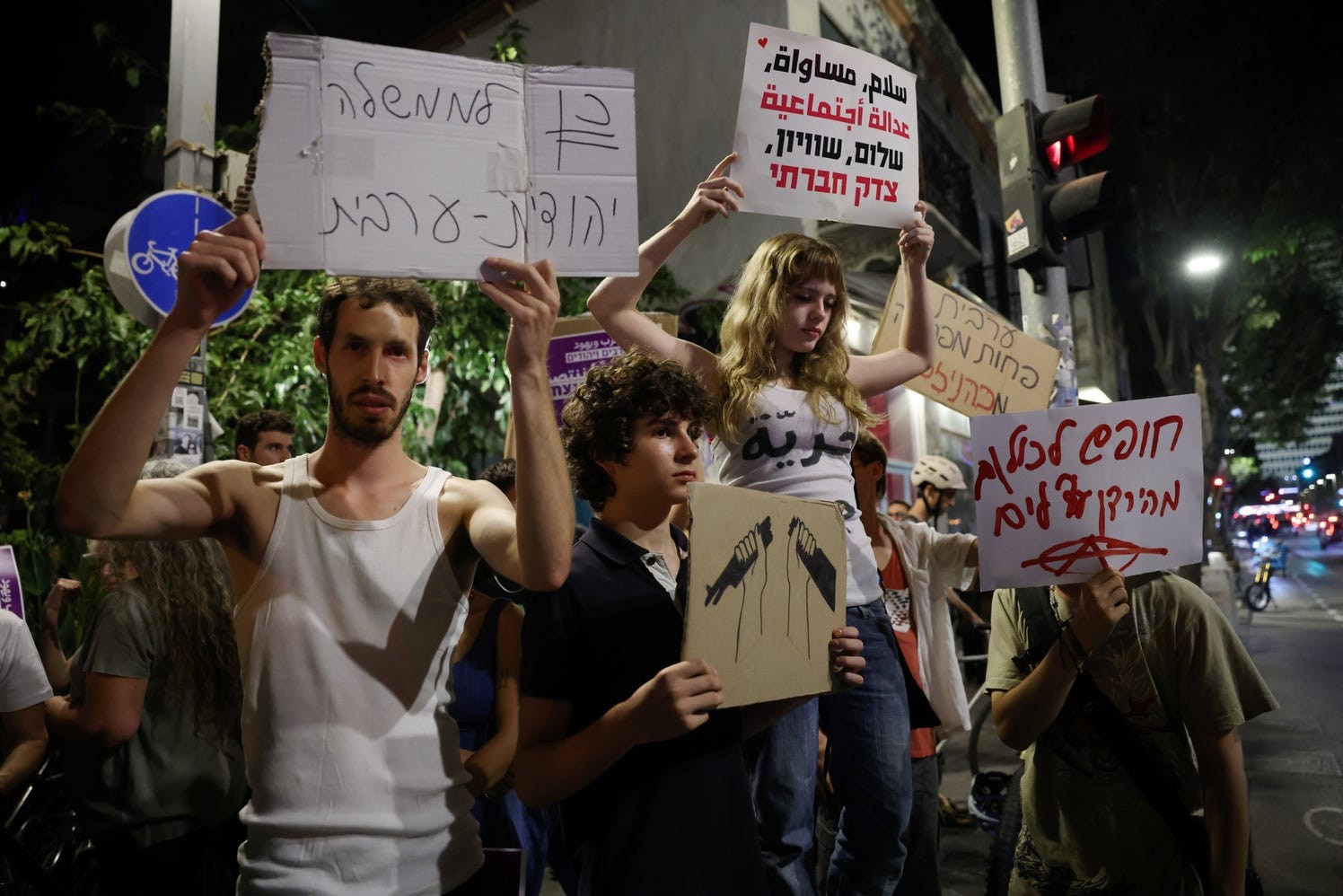
Protestors in Tel Aviv on 28/10/2026, holding placards saying “Yes to a Jewish-Arab government,” “Peace, equality and social justice,” “Freedom for all from the river to the sea.” Photo by Motti Milrod.

And if you pay no heed to my advice or the voices of the protestors who will gather on Saturday night to demand an Arab-Jewish government, what kind of Zionists will you be? The kind that lends weight to the claim that “Zionism is racism.” Because you will be demonstrating that for you Zionism means only Jews may participate in the government of Israel, that the representatives of the Palestinians in Israel do not have equal political rights to the representatives of the Jews. That you do not uphold the values of the Declaration of Independence, so that you should not be in your own coalition. That is where the dividing line of Israeli politics and society has now shifted to, following the unprecedented turnout of Palestinian society in Israel. On one side are the Zionists who are also Jewish supremacists, recognising only Jewish rights to their homeland, not Palestinian rights. On the other side are Zionists, who, true to the Declaration of Independence, invoke both the “self-evident right of the Jewish people to be a nation … in its own sovereign state” and the same rights of “all other nations” to be the same, which must include the Palestinian people too. The Zionism of those who claim exclusive rights to land and statehood is racist. If you fall into the trap laid for you by Netanyahu and his allies, by delegitimising the mandates of Israel’s Palestinian-majority parties, you will hand him an election victory he did not earn. As Gideon Levi wrote: “If the opposition leaders tell the Arabs ‘no’, it will be clear that they are Bibi-ists. That they prefer even the devil Netanyahu to conquering their racism.”

You will have to be bold to establish Israel’s first Jewish-Arab government. You will have to be statesmen, not politicians. You will need to fall in line with your coalition partner, Yair Golan. What I am and so many others are asking is political fantasy, I know. But Zionism began as a political fantasy that became a reality: “if you will it, it is no dream.”

On not seeing Kuwaykat

This is another excerpt from the third chapter of the book I am writing. This chapter covers the year I spent in Israel as part of a Zionist youth group, Habonim. The excerpt is about my time on Kibbutz Bet Ha’emek.

The months spent on Kibbutz Bet Ha’emek further instilled a deep sense of familiarity with and connection to the land. I enjoyed the beautifully landscaped and gardened grounds of the kibbutz as well as the productiveness of its agricultural fields. It certainly felt like home for a while, or at least a place in which I belonged.

One weekend I was late coming back to the kibbutz on a Saturday night (a night on which Israel won the Eurovision song contest with the song “Halleluya,” performed by “Milk and Honey”) after visiting my relatives in Jerusalem. I found myself in Nahariya after the usual sherut (shared taxi service) had ended so I had no choice but to hitch a ride, about which I was quite nervous. First a lorry driver took me to a junction closer to the kibbutz and then a sherut with three Arabs in it gave me a free ride for the rest of the way, and, as I wrote in my diary “did not stab or rob me.” Although that was meant humorously, the fearful thought had obviously crossed my mind that I was relying on the kindness of potentially hostile strangers. Why should I be anxious that I would be kidnapped or attacked by neighbours of the kibbutz where I was staying? I cannot remember any case in which a Jewish hitchhiker has been attacked by a Palestinian driver within the 1967 borders, though there have been such incidents during the intifada periods in the Palestinian Occupied Territories.

Zochrot. All that remains of the village. https://zochrot.org/en/village/49232. 2008.

I would suggest that part of my fear stems from what I could see at Bet Ha’emek but did not acknowledge, what I was dimly aware of but did not want to know. On the road that connected the kibbutz to the main road there was a shrine which was visited by Arabs every now and again. It is the shrine of Shaykh Abu Muhammad al-Qurayshi, a Druze religious leader. I never asked, or even wondered, why this shrine was next to the kibbutz. There were also some old stone buildings on the kibbutz, one of which housed the dark room which my kibbutz father used for his photography hobby. I do not recall asking when they were built, or why there were so few such buildings around. If I had been paying attention, I would have noticed that the olive trees on the kibbutz looked older than the kibbutz. Perhaps others in the group asked more questions, but I did not.

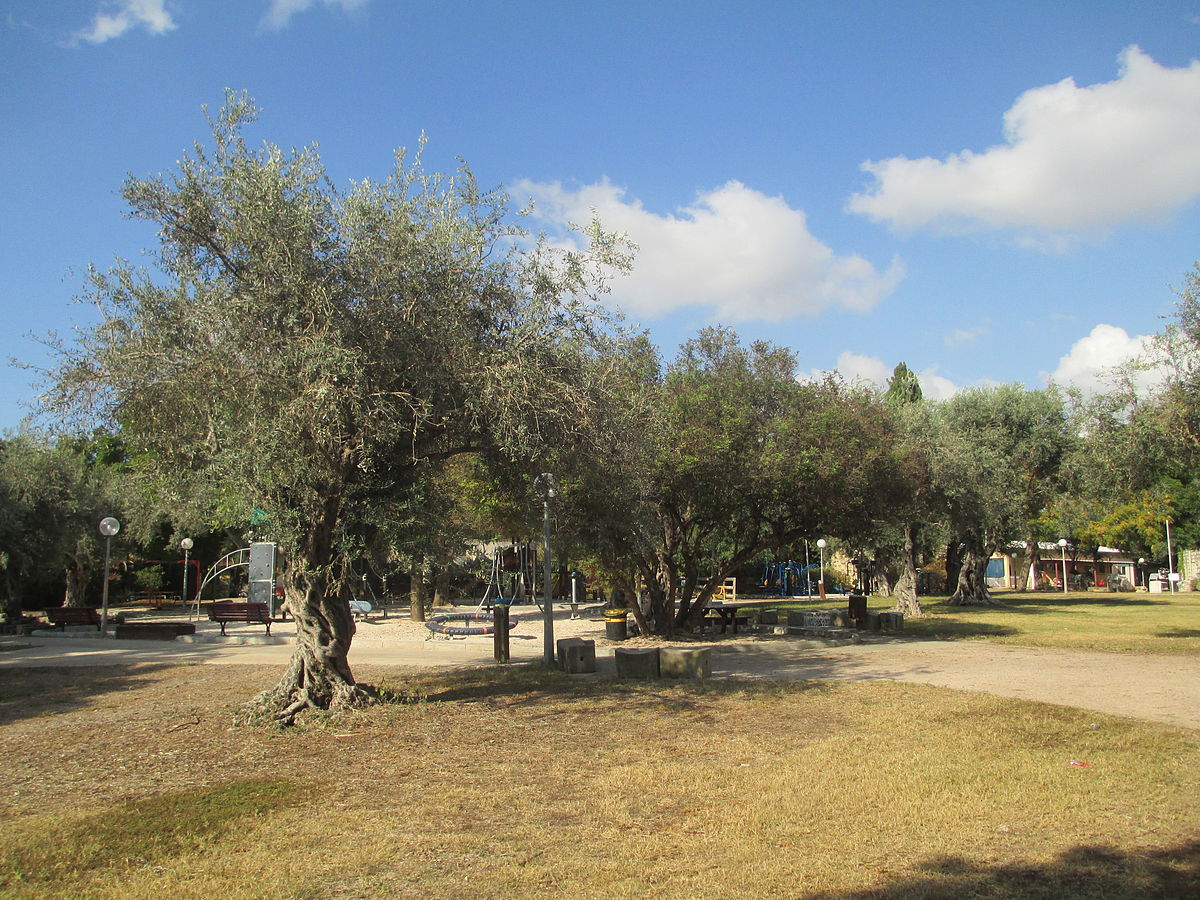
Dr. Avishai Teicher, Olive Trees on Kibbutz Bet Ha’emek, https://commons.wikimedia.org/wiki/File:PikiWiki_Israel_40571_Olive_trees_in_Kibbutz_Beit_Haemek.JPG

It was not until many years later that the Israeli organisation Zochrot, which has worked “since 2002 to promote acknowledgement and accountability for the ongoing injustices of the Nakba, the Palestinian catastrophe of 1948,” produced a map and an app that told me about Bet Ha’emek.[1] When the kibbutz was established in 1949, it was on the site of the Palestinian village of Kuwaykat, which had about 1200 residents and whose land was considered to be among the most fertile of the district, growing grain, olives and watermelons.[2] It was captured and destroyed by Israeli armed forces as part of Operation Dekel in July 1948. The village had withstood three previous attacks in January, February and June, but in July a heavy bombardment forced out the villagers, most of whom fled to nearby Abu Sinan and Kfar Yusif.[3]

We were awakened by the loudest noise we had ever heard, shells exploding and artillery fire … women were screaming, children were crying… Most of   the villagers began to flee with their pyjamas on. The wife of Qassim Ahmad Sa’id fled carrying a pillow in her arm instead of her child...[4]

The car I was in that night was most probably on its way to Kfar Yusif, which gave shelter to many of the refugees from Kuwaykat. They were among the approximately 46,000 Palestinian refugees, or internally displaced persons, who remained within the new State of Israel, under the oxymoronic status in Israeli law of “present absentees.” They and their descendants, now numbering well over a quarter of a million souls, have never been allowed to return to their homes.[5] In her book, Erased from Space and Consciousness, Noga Kadman observes that even recently the publications of the kibbutz barely mention Kuwaykat or the previous residents. But they do mention the olive trees, which kibbutz youth now harvest to pay for their “root trips” to Poland where they visit sites of the Jewish catastrophe, the Holocaust. The Palestinians who gave me a ride that night probably knew that I was not an Israeli, but even if they took me for a foreign volunteer on the kibbutz, they would have known the history of the place in which I felt at home and which I was then certain that Jewish Israelis had a right to inhabit exclusively. I lived on Bet Ha’emek and I did not see Kuwaykat, even though its traces were around me. The fields on which I became a Zionist subject had been farmed by Palestinians before me and before the pioneers from British Habonim arrived. The Palestinians did not rob me, but I enjoyed the fruits that had been robbed from them.

A 1940s map of the area of Kuwaykat from the Survey of Palestine. https://commons.wikimedia.org/wiki/File:Historical_map_series_for_the_area_of_Kuwaykat_(1940s).jpg

[1] See Zochrot, “Our Vision,” https://zochrot.org/en/content/17. Accessed 3/16/2021. The Nakba app is especially useful for learning about the Palestinian presence that has been erased by Israeli settlements and forests, often planted by the Jewish National Fund, while traveling around Israel-Palestine, as it shows information according to one’s current location.

[2] Government of Palestine, Department of Statistics. Village Statistics, April, 1945. Quoted in S. Hadawi, Village Statistics of 1945: A Classification of Land and Area ownership in Palestine (Palestine Liberation Organization Research Center, 1970), p. 81.

[3] See Zochrot, “Kuwaykat,” https://zochrot.org/en/village/49232 . Accessed 3/16/2021.

[4] Walid Khalidi, All That Remains: The Palestinian Villages Occupied and Depopulated by Israel in 1948 (Washington D.C.: Institute for Palestine Studies, 1992), pp.  224-25.

[5] Wikipedia, “Present Absentees,” https://en.wikipedia.org/wiki/Present_absentee. Accessed 3/16/2021.