Category Archives: anti-war

Why don’t the Abraham Accords look like peace?

It has often been noted that it’s easier to represent war visually than it is to represent peace. When did you last go to see a peace movie? But peace agreements provide photo opps of the signing of peace agreements by leaders who synecdochically stand in for whole nations. This has certainly been the case for previous peace agreements between Israel and its Arab neighbours under the auspices of the USA.

Consider two previous occasions on which peace agreements were signed at the White House, first in 1979 between Israel and Egypt, then in 1993 between Israel and the PLO. The hands of the leaders portray reconciliation and the relinquishing of weapons in different ways. President Carter demonstrates his mediating role by joining hands with President of Sadat of Egypt and Prime Minister Begin of Israel, just six years after the two countries fought each other in a bitter war. President Clinton’s outstretched arms and tall stature seem to create through magnanimous power the space in which Yasser Arafat and Yitzhak Rabin come together in an allegedly reluctant handshake. Clinton was also there to observe a much warmer handshake between Rabin and King Hussein of Jordan when the two countries signed a peace agreement on their border in 1994.
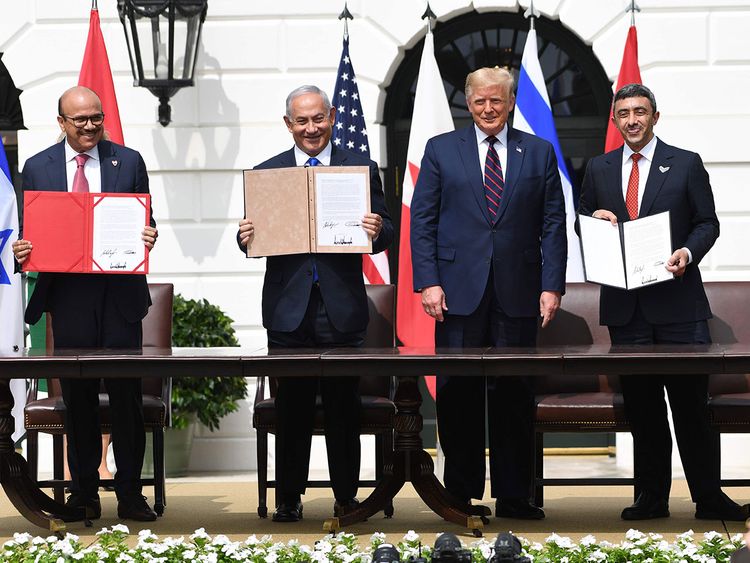
If this is the simple iconography of peace agreements, it should be straightforward to represent the agreements signed at the White House between the governments of Israel, the United Arab Emirates and Bahrain as peace. Yet, it doesn’t look that way to me.

Perhaps its the absence of hand-shaking, which might be attributed to Covid-19 precautions if there were any evidence of such precautions being taken throughout the event. As it is, it looks as if Bahraini Foreign Minister Abdullatif al-Zayani, Israeli Prime Minister Benjamin Netanyahu, and UAE Foreign Minister Abdullah bin Zayed Al-Nahyan have all just received a certificate of good behaviour from Trump.

This picture of peace is lacking not simply because of an absent iconographic element, but because of what is missing from it as what scholar W.J.T. Mitchell calls an “imagetext.” An “imagetext” is a hybrid of picture and text and the accompanying texts to the pictures of signing these peace agreements are the stories and dramas for which the pictures are culminating events. If a picture is going to speak a thousand words, you have to know the story. In 1979, the story included wars between Israel and Egypt, the media event of Sadat’s surprise visit to Israel in 1977, and the setbacks and breakthroughs of the negotiations at Camp David. The backdrop to the signing of the Oslo accords was the first intifada, revelations about track-two diplomacy behind the scenes, the apparent conversion of two main protagonists, Rabin and Arafat, from men of war of to peacemakers. To some extent then, as many have said, this doesn’t look like a peace treaty because Israel has not been at war with the UAE or Bahrain. So there has been little drama – other than surprise – to provide the text for this image.

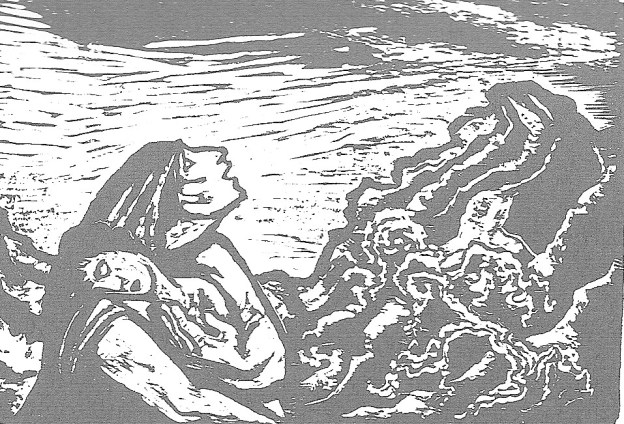
There is more to it than that. This doesn’t look like peace because, even while the agreement claims that the normalization of relations between states is intended to contribute towards peace in the region, including a negotiated solution to the Israeli-Palestinian conflict, it does the opposite. Not only is its context the conflict between the Gulf States and Iran, but like its predecessor, Trump’s “Vision for Peace,” it undermines the prospects for a just peace between Israelis and Palestinians. Normalization of relations with Arab states was one of the diplomatic carrots held out in the 2002 Arab peace initiative for Israel to end its occupation and creeping annexation of the Palestinian Territories. As things stand, the occupation has become normalized by Israel, especially under Trump’s administration. Israel no longer pays any evident price for its relentless and continuing injustices, except perhaps for erosive moral corruption, as remarked by Raja Shehadeh. On the same day that the agreement was signed in Washington, Israeli newspaper Ha’aretz reported that a Jerusalem court had ordered the “eviction of dozens of Palestinian residents from their homes in East Jerusalem. The beneficiaries will be settler associations who argued that the homes belonged to Jews before 1948.” Needless to say, Palestinian refugees who owned property in Jerusalem until 1948 are not eligible to reclaim their homes as they are not Jewish. That is one of the injustices that the “Abraham Accords” sanctions, seemingly taking inspiration not from mythical shared ancestry but from the Biblical story of Abraham’s expulsion of Hagar and Ishmael, depicted here by Israeli artist Jakob Steinhardt in 1950, with the refugees of 1948 in mind.

There’s nobody to talk peace with (even when you’re speaking to them)

DSC00106

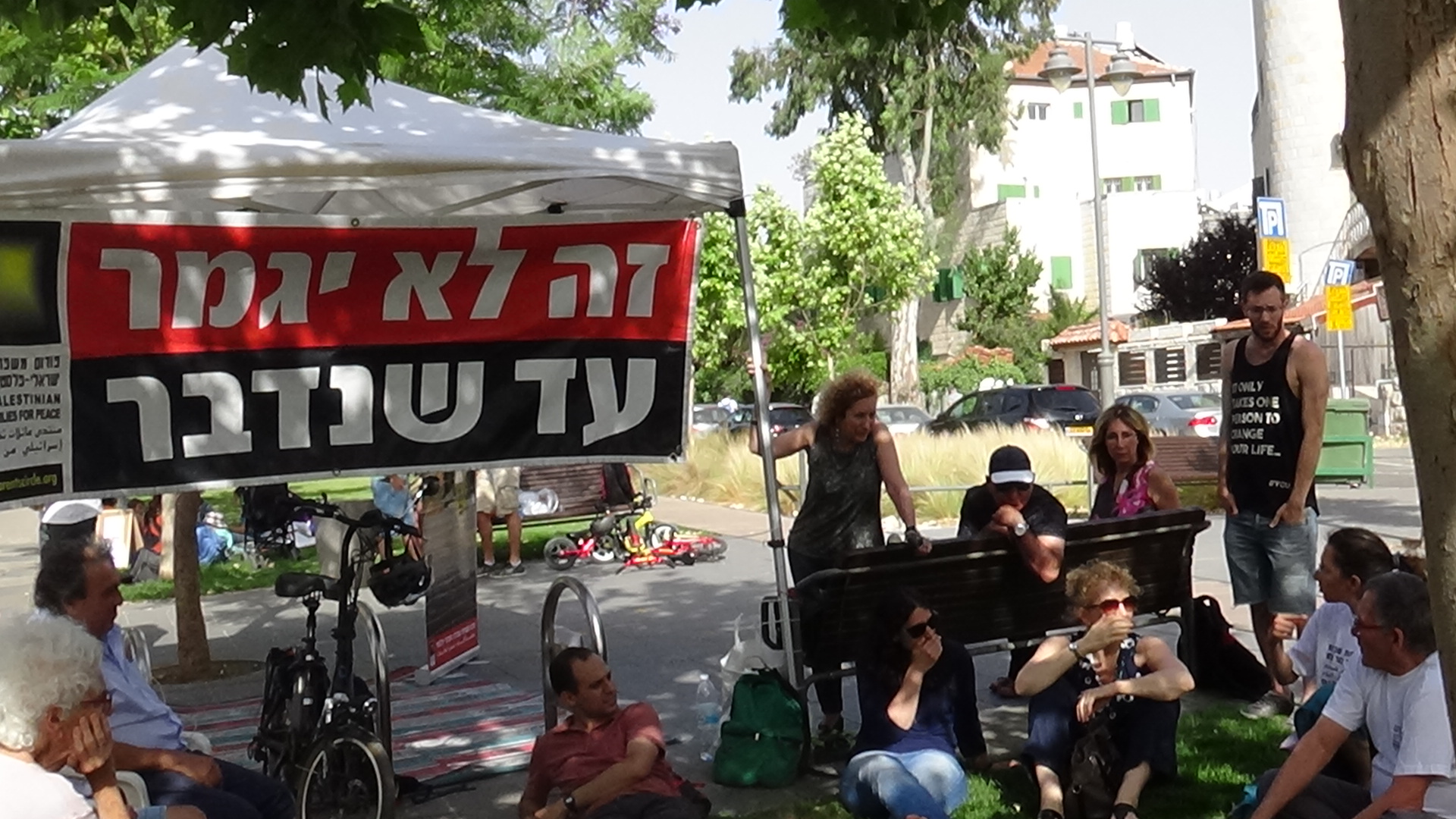
Peace Square (Bereaved Families Forum), Jerusalem, June 5 2016

The simplicity of the slogan of the Bereaved Families Forum, “It won’t end until we talk,” is already an answer to the simplistic and often repeated phrase “there is nobody to talk to,” (ein im mi l’daber). (The forum’s slogan rhymes in Hebrew: zeh lo y’gamer ad shen’daberI wrote about this slogan in the context of the 2012 war on Gaza). Reassuring themselves in the certainty that talking and dialogue is pointless, Jewish Israelis often convince themselves that while they want peace, “they” (the Others, Arabs, Palestinians) do not. It can hardly be an entirely comforting belief, because it condemns the citizens of the Jewish State to be at war, “to live by the sword,” for the foreseeable future. Inevitably, that means there will be more bereaved Israeli as well as Palestinian families. But we humans are peculiar creatures, so sometimes it makes more sense to us to repeat the trauma of personal and collective loss, to enfold it in a tragic narrative of good versus evil, the peaceful versus the belligerent, the victims versus the perpetrators, than to break through the loss. What could be more horrifying than to think that perhaps our loved one was lost because there was something we didn’t do, especially when that something was as simple as talking to your enemy. So it’s better to insist that there’s nothing that can be done.

Perhaps that is some of the feeling that I could hear in the anger of one of the people who passed by the Peace Square set up by the Parents Circle Families Forum in the German Colony neighbourhood of West Jerusalem. The tent, which I’ve written about previously from a distance, was part of a series of events to reclaim Jerusalem Day in the name of tolerance.  The day marks the “reunification” of Jerusalem when Israeli forces conquered (or some would say “liberated”) East Jerusalem, then under Jordanian control, and has become a festival of the national religious settler movement whose idea of liberation is one of exclusive Jewish control.

Two members of the forum, Rami Elhanan and Roni Hirshinzon, were there to explain the work of the Forum, to answer questions, and once again to open their hearts and tell the story of the loss of their children to the conflict. For the most part, the discussion in the shade of the small park among those who had chosen to come to the event was quiet, somewhat curious, respectful. But not everyone who chanced by and stopped wanted to listen, or even to take note of whose banner marked the square. Foremost among them was Mr. Shouty, who succeeded in rousing other sceptical and critical observers to shout among themselves and close down the discussion.

DSC00105

Rami Elhanan sitting with a picture of his daughter Smadar and his friend Bassam’s Aramin’s daughter Abir, both killed in the conflict.

Mr. Shouty (for the sake of this blog I’ve absorbed the statements of some others into this one character) had all the regular answers to the Forum’s slogan, all of which add to “there’s nobody to talk to” (ein in mi l’daber). We are only here because we’re strong. If they had the power, we’d all be dead. They vote for Hamas. If the Peace Square can’t be held in the open air in Hebron, that shows we’re the peace lovers and they aren’t.

I was less prepared to hear Mr. Shouty’s brutal put down when Roni told him he’d lost two sons in war: “And did you hand out sweets?” With one sharp rebuke, he dismissed the loss of Palestinians in conflict to dehumanized celebration of the sacrifice of martyrs. We are bereaved, he said in other words, but they are so consumed by hate that they don’t feel loss. Maybe it would have made some difference if a bereaved Palestinian had been there to voice her own pain, but I doubt Mr. Shouty would have been any more ready to listen. To talk.

Earlier a woman had passedby and rebuked “us” for airing Israel’s dirty laundry in the international public, clearly without knowing who “we” were. I asked Rami how he felt that someone could be so dismissive even as he asked her questions. He talked about how much harder it is when he goes into classrooms and the kids shout at him, but that all he hopes for is one hint of acknowledgement from someone at the back of the room – a glance that suggests that he has made once crack in the wall of enmity, that he might have saved one drop of blood. So Rami, Roni, and other member of the Forum keep on talking, hoping that someone will listen, even when they are being shouted at by people who won’t let them talk. They cannot know which small crack in the wall (the title of the Forum’s Hebrew and Arabic community Facebook page) will open the floodgates and stop the last drop of blood from flowing.