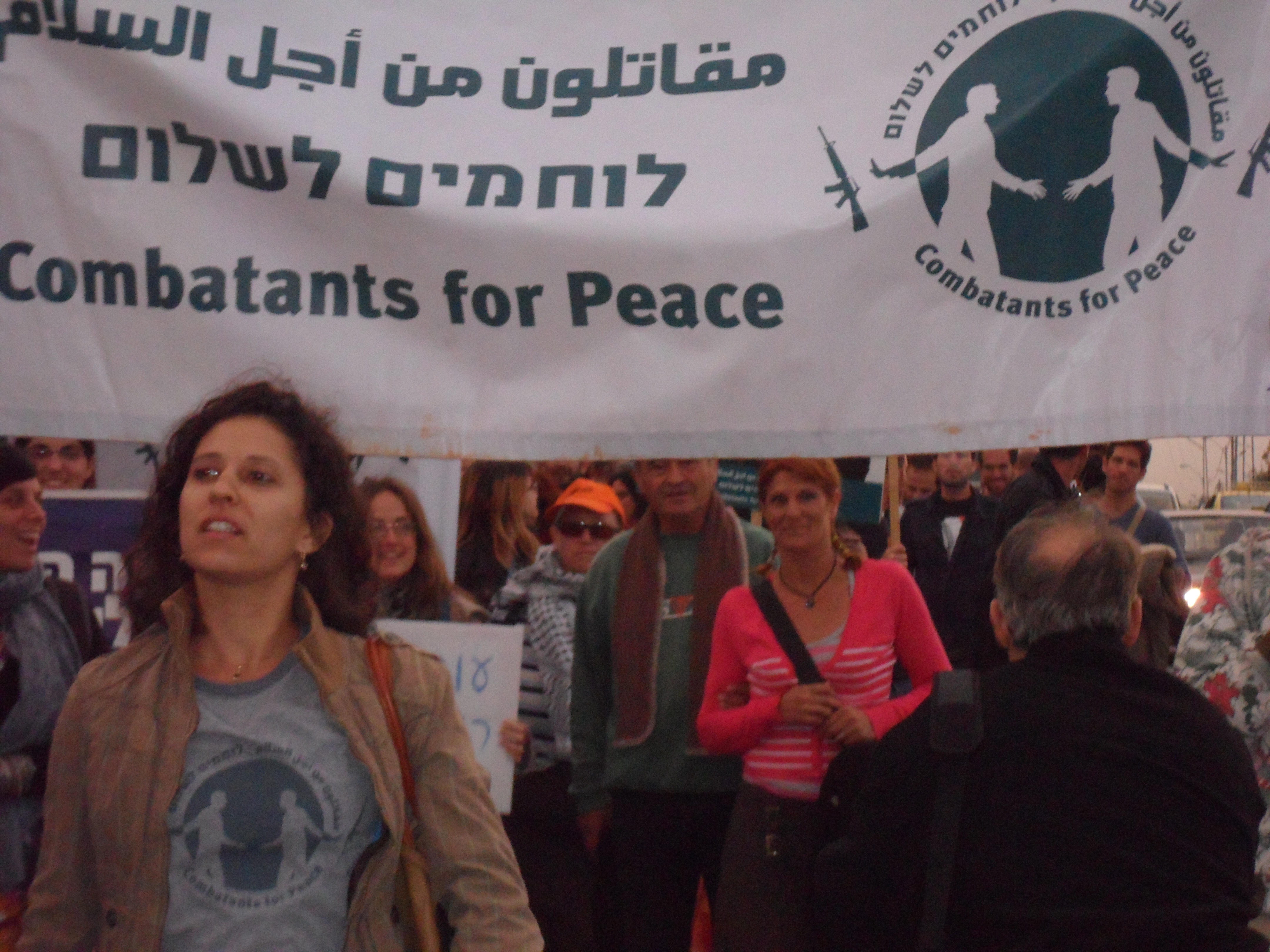
Combatants for Peace rally in Beit Jala
Peace-making is an art, an art that demands much skill, patience, a deep, empathetic understanding of the human material of which is peace is made, and willingness to try and fail many times before succeeding. The bi-national Israeli-Palestinian group Combatants for Peace practiced its art of peace-making in its rally against the “Pillar of Cloud” war on Saturday evening, 17thNovember 2012. The movement was started jointly in 2005 by Palestinians and
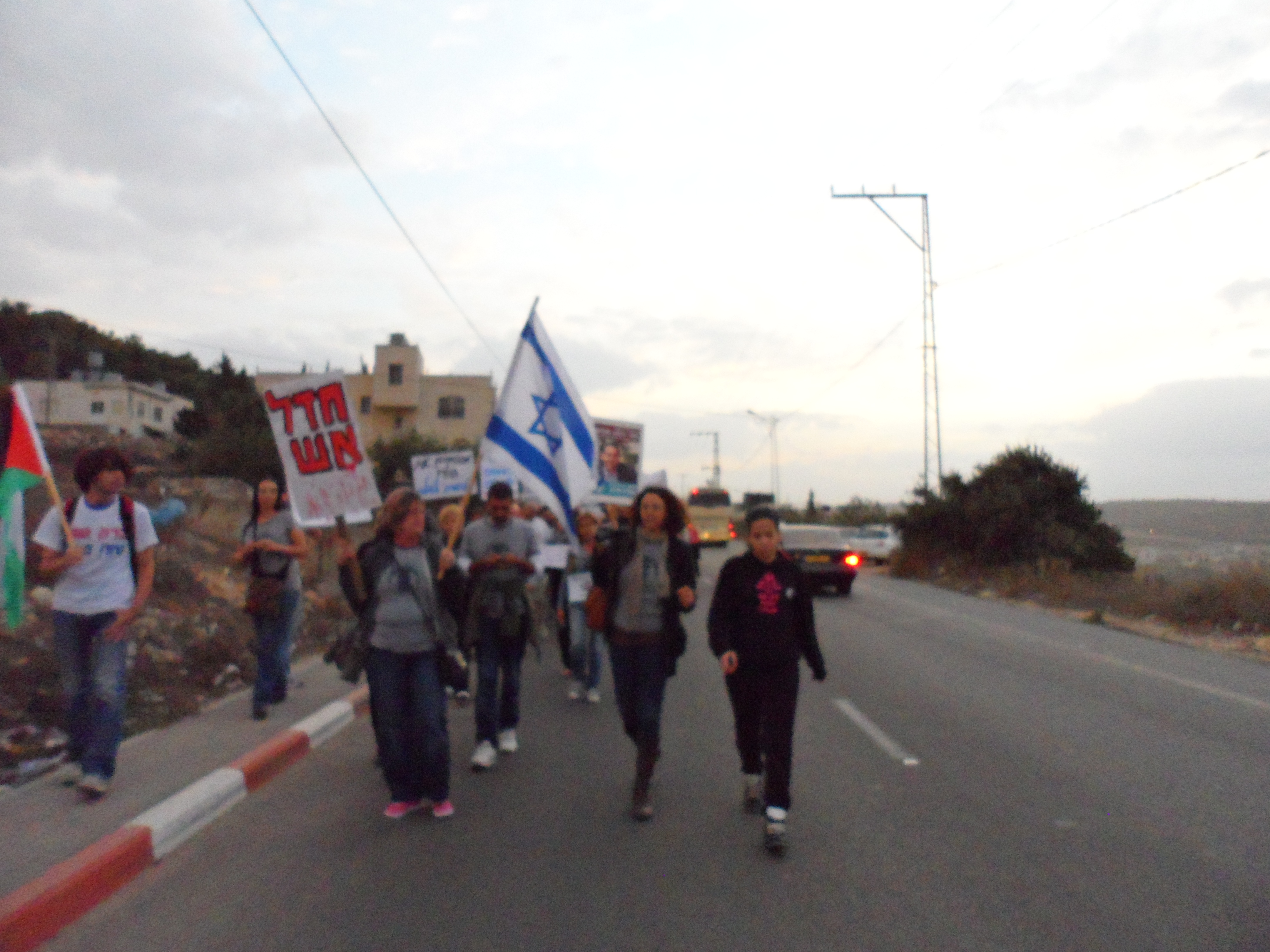
Israeli contingent marching to Beit Jala
Israelis, who have taken an active part in the cycle of violence; Israelis as soldiers in the Israeli army and Palestinians as part of the armed struggle for Palestinian freedom. Not only have members of the group renounced violence in favour of dialogue and reconciliation, but they have also committed to working together, as former enemies, to achieve an end to the occupation and independence for Palestine alongside Israel.
Before the latest Gaza war broke out last week, Combatants were planning a remarkable event for that evening, a screening on the separation wall of Shelley Hermon’s documentary film, Within the Eye of the Storm. I blogged on another occasion about the Tel Aviv premier of that film. But to show a film about how two former fighters, bereaved by the violence of the occupation, came to be close friends on the very structure that embodies all the forces separating Israelis and Palestinians will be a deeply symbolic event. The war caused the postponement of the event, and in its place Combatants organized a joint demonstration calling for a cease fire and a peaceful resolution of the conflict. Organising such an event in short time is no easy feat. Israelis may not enter Area A of the West Bank, which is under full Palestinian Authority control, without a special permit, while the movement of Palestinians other than within the “islands” that Area A is composed of is restricted by the Israeli military. But a point was found in Beit Jala, by Bethlehem, that enabled access to the Israelis coming for the Tel and Jerusalem area as it is in Area C and which the Palestinian members of Combatants could also reach.
So, we marched separately, about 100 Israelis from where the buses dropped us off on a rural road on the outskirts of Beit Jala in the hilly countryside around Jerusalem, and about 100 Palestinians from within Beit Jala. With only a few onlookers, we Israelis (and others) chanted in Hebrew to those ancient hills: “The people demand a ceasefire,” and “War is a disaster, only peace is the solution.” But along the way, a little peace making had to be done. A couple of Palestinians saw the Israeli flag one member of the group was carrying, and signaled that it be taken down. The Israeli and Palestinian organisers had it seems agreed between themselves that an Israeli flag would be there, but not everyone present was happy with that, or knew about it. The Israeli flag is a symbol of occupation and oppression to Palestinians, not a symbol of Jewish freedom. But by the time we arrived at the meeting point, an acceptable arrangement was found: the two flags were held together. Yet, they were both dwarfed by a huge Palestinian flag being held by the youth across the road at which we met, a fabric affirmation that we were now in Palestine.
Short speeches were read out in Hebrew and Arabic, calling on both sides to cease fire, stop targeting and hurting civilians, stop the incitement, and reach immediately the same agreement that will be reached later in any case but after more casualties and pain. Then the chanting began again, the drummers got their rhythm going, and bodies began to move to it, relaxing the stiffness of two sides standing with placards, banners and flags. One Palestinian kid who was enjoying the rhythm was holding a placard with Netanyahu’s picture and the slogan “Peace refusenik”. Waltzing with Bibi. Maybe the bored Israeli soldiers standing in a line to stop us spilling over into other roads wanted to dance too. It was a Saturday night, after all.
One can’t say we all made peace with each other that day, or had a chance to make friends. The activists of Combatants in their grey tea shirts already knew each other, had worked together, consulting each other frequently to keep the event running as planned. But there we were together, Israelis and Palestinians, at a time of war when it is easiest to care only for one’s own pain and injured and dead, to use it as ground to hate the enemy, to demonize them, to believe that they don’t love their children as much as we do, or that they won’t stop until they’ve killed all of us. There we were, determined to find a place to insist together that the violence stop. But even before it stops, Combatants continue the painstaking work of making peace out of the ruins and desperation that the conflict and occupation have left. Last Saturday night, they another added another quick sketch to their portfolio. With much effort, many more helping hands, disagreements about flags and colours and exactly where to place lines, these sketches could become a tapestry of peace across those hills.
 Picturing Peace