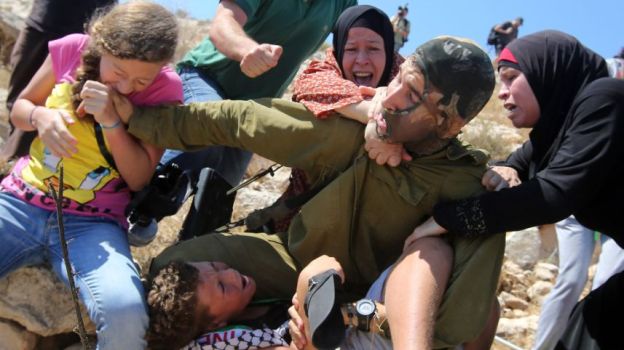
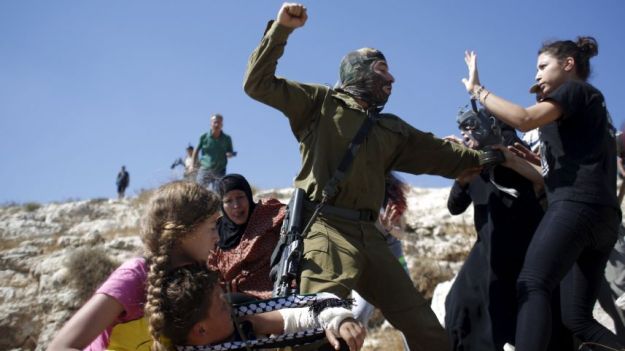
Palestinians scuffle with an Israeli soldier as they try to prevent him from detaining a boy during a protest against Jewish settlements in the West Bank village of Nabi Saleh, near Ramallah. Reuters
When camera images “go viral” it speaks to their resonance with their publics, and their power to command the attention of viewers. They also declaim loudly about the situations they depict, echoing resoundingly the events framed by the lenses through which we see them at a distance. Such are the images of the attempted arrest by an Israeli soldier of 12-year-old Mohammad Tamimi near the Palestinian village of Nabi Saleh on Friday August 28th 2015. Attempted, because women from Mohammed’s family struggled with the soldier to prevent the arrest.
The images did not go viral because it is unusual for Israeli soldiers to arrest Palestinian children. According to a UN report on human rights in the Palestinian occupied territories, “on average, around 700 children are detained and prosecuted per year, most commonly on charges of throwing stones,” which could have been Mohammad’s fate. Nor is it especially unusual to see still and moving images of these arrests. In one example about which I wrote in July 2013, Israeli soldiers from the Givati Brigade stationed in Hebron detained Wadi’ Maswadeh, aged five years and nine months, after he allegedly threw a stone at an Israeli car. Wadi’s arrest was documented on video by Palestinian field researchers for the Israeli human rights organization B’Tselem.
It was also not unusual that there were images of a demonstration at Nabi Saleh. The village is now famous for its weekly demonstrations in which its residents protest the confiscation of their land and the appropriation of the spring (owned by the Tamimi family) by the nearby Israeli settlement, Halamish, in 2009. As the villagers march towards the spring, the protests generally become violent, as Israeli forces block them. Palestinians throw stones and Israeli forces break up the march with skunk water, teargas and live fire, as a result of which two of Mohammed’s relatives, Mustafa (in 2011) and Rushdi (2012), were killed. Events are recorded regularly, appearing on the Nabi Saleh Solidarity blog, local Bilal Tamimi’s YouTube channel and Israeli artist David Reeb’s YouTube channel. Both David and Balil were arrested without ground on Friday August 21st, then released by the court.
The difference between David’s and Bilal’s videos filmed last Friday indicate why some of the images went viral. In David’s video we see the “routine”: beginning with marching and chanting, the road blocked by Israeli troops who fire teargas, then other rounds, Palestinian youths using slingshots for stones and to return the still smoking teargas canisters. There is a shot of a lone soldier running at full pelt after a youth in a blue shirt, then as one of the youths is bound and detained by four other soldiers, we hear some shouts and women shrieking out of sight of the camera. Nothing exceptional here to go viral.
Bilal’s short video begins as the running solder changes direction to capture Mohammad in a choke hold and force him to the ground, fends off a young woman activist (he calls her “leftist trash”) who pulls at Mohammed’s right arm (the left one is broken and in plaster), and calls for back up. A little over a minute later, Mohammad’s sister Ahed arrives, tugging determinedly at his arm as she yells in English to leave her little brother alone, shortly followed by his mother Nariman and another Palestinian woman, and a small crowd of locals, activists, and cameras. The three women grab hold of the soldier, smacking him on the head, pulling of his net balaclava. The soldier fends them off with his hands and keeps hold of Mohammed until, some 2 minutes after he grabbed the boy, the soldier’s commander arrives, pushes one woman in the face, and then has the soldier let Mohammad go. As he is helped away by another soldier, his parting gift for the people left around the boy is a stun grenade. According to the +972 blog, both Ahed and Nariman were hurt in the tussle, needing hospital treatment, which went unreported in the Israeli press, at first, until a subsequent report by Amira Hass.
Perhaps, though, the video images of the event, including this shorter video clip that appears on the Ramallah City Facebook page and has had more than 2.2 million views, would not be so arresting without the still images. The shaky, hand-held filming and the confusion of voices in the videos certainly have a raw documentary power, but they do not quite hold the viewers to the intensity of the event. There are several stills which can be seen in this report by Ha’aretz that reflects the army’s version of events and this dismissive one by the right-wing Daily Mail. I will focus on just one image.

Palestinians try to prevent Israeli soldier from detaining a boy during a protest in the West Bank village Nabi Saleh, August 28, 2015. Reuters
There are four faces in the frame. The soldier’s is central, Mohammad’s below him, his sister Ahed to the left and his mother the other woman closely bracketing the soldier. It is a scene of struggle, an image of power relations. There is a Zionist literary and cinematic trope of being “the few against the many.” The soldier is besieged and outnumbered, his hand bitten, his neck and shoulder pulled in different directions. The soldier also seems vulnerable, having emerged for the chase without a helmet or body armor. Yet, the trope doesn’t work in this context. He is the one with the rifle. The soldier’s father told Israeli army radio that while his son had been attacked, he was subject to a provocation, perhaps planned in advance, and was proud of the restraint he’d shown. No question for him, then, of who was really in control. Mohammad’s father Bassam tells a different story: fearing the consequences if the Palestinian youths ran to the soldier who might then start shooting, setting off a bloody chain of events, he shouted for the commander to come over.
The photograph evokes most clearly all a scene of women and a girl defending their child and relative, pinned in fear and pain under the armed man. The adult women are marked by their traditional dress that leaves only their faces and hands exposed. Ahed appears unthreatening in her pink T shirt with its Tweety Pie cartoon, her bite that of a child without the strength to combat a grown man. The pulling in different direction symbolizes the pulls between different laws, reminiscent of Sophocles’ play Antigone. The soldier claims possession of the boy according to the law of the father, of the state, and the occupation. If the boy threw a stone, he has become a weapon, and the state brooks no infringement of its monopoly on the use of force. The boy is subjected to force, to violence. The women claim the boy, Mohammad, son and brother, according to the law of familial bonds. Their hands, arms (and Ahed’s teeth) weigh against the force of the armed man. And according to the same law of human bonds, Mohammad’s mother judges the soldier to be a child too, a victim of policies that he ought to question. On this occasion the struggle between the law of the father state and the law of the family ended well relatively for the sons. To say the incident ended peacefully would be untrue, but at least it ended without any mothers keening for the dead sons.


 Picturing Peace