Review of: Atalia Omer, When Peace Is Not Enough: How the Israeli Peace Camp Thinks about Religion, Nationalism, and Justice
(Chicago: University of Chicago Press, 2013).
[A slightly different version of this review was published in Quest. Issues in Contemporary Jewish History 9 (October 2016) ]
During the first intifada, for most of which I was a graduate student at the Hebrew University, I went on many demonstrations at which I chanted what then seemed to be the radical slogan “Israel and Palestine; two states for two nations.” Since the 1993 Oslo accords the principle of “two states” has been the official position of Israeli governments, and the cornerstone of both international peace diplomacy and the “mainstream” Israeli peace movement, much of which (including Peace Now) is now connected under the umbrella of the Peace NGO Forum. Yet, since 1993, and especially since the collapse of the Israeli-Palestinian peace talks in 2000, Israel’s more radical peace, anti-Occupation and human rights activists have not only come to understand that the Oslo process entails the perpetuation of the Occupation in the post-1967 territories and the infinite deferment of Palestinian self-determination, but also that the “two state solution” would not be a solution at all, not for the Palestinian refugees seeking to return, not for Palestinian citizens of Israel seeking equality, not for the internal ethnic and religious conflicts within Israeli society. For them, the “peace” of Oslo is not enough.
When Peace Is Not Enough is a thoughtful, deeply felt and well-researched book that, while critical mostly of the mainstream or liberal Zionist peace camp, also challenges some of the perceptions and actions of the radical peace camp. It does so not by formulating another solution, such as some version of a one state, binational state, or federal state, but by interrogating the question of “who we are,” the underlying logic of the conflict in terms of Zionist, Jewish Israeli identity, which Atalia Omer argues is particularist, Orientalist and ethnocentric (though she doesn’t go as far as to call it racist). “Euro-Zionism is the “root cause of the conflict” (p. 275) and the source of multiple injustices.
Omer musters an impressive range of disciplinary and theoretical approaches. From peace studies, she adopts the principle of “positive peace” according to which the transformative practice of peacebuilding leads to “justpeace.” From cultural theory she expands the analysis of power relations and structures that perpetuate injustices to include symbolic violence. From political theory she considers critically liberal models of multiculturalism and theories of socioeconomic redistributive justice that take cultural recognition into account in order to avoid the “misframing” of justice for Palestinian Israelis as a question of minority rights. From postcolonial theory she borrows the notion of hybrid identities, in this case those of Arab (Mizrahi) Jews and Palestinian Israelis, whose subaltern voices, she argues, must be integrated into an inter-Jewish and inter-Israeli reformulation of national, religious and ethnic identity that attends to the differences between each of those terms. From poststructuralist theory she attends to the defamiliarization of stable identities so that the colonial subjugation that is “forgotten” in Israeli ethnorepublicanism and the illiberalism of its liberal version of nationalism can be acknowledged. At the same time, and not entirely consistently, Omer insists that deconstruction of Jewish and Israeli identity be matched with reconstruction: “reimagining belonging, without dismissing and decontextualizing collective passions of identity” (p. 225) as in the formulation “a state of all citizens.” The ethical insights of Western, Ashkenazi Diasporic Jewish thought, its embrace of alterity and self-estrangement, need to be reconfigured along with Mizrahi experience of belonging in the Middle East. That is an impressive array of perspectives, and it comes at the cost of some “theoretical belaboring” (p. 113) and repetition but, as I will suggest below, it may not be comprehensive enough.
Central to Omer’s multiperspectival approach is her inclusion of religious peace studies, through which (in Chapter 1) she argues that the secular, liberal Zionist peace camp is fundamentally flawed by conceptual blindness: its unacknowledged reliance on a political theology, its incorporation of Jewish religious symbolism at the same time as it attempts to secularize Biblical mythology. Consequently, liberal Zionism is immersed in a messianic historical narrative even as it excoriates the militant illiberalism of religious settler Zionism and marginalizes the non-secular voices of Mizrahim. Redemption of exile by means of return to the land, according to this eschatology, and the subsuming of Judaism by the secular religion of Zionism, blinds the Zionist peace camp to the injustices (colonialism and conquest) entailed by establishing and sustaining an ethnodemocratic Jewish state. Hence, the Zionist peace camp, as exemplified by Peace Now, focuses on ending the Occupation of 1967 in order to ensure a majoritarian Jewish state, while overlooking the Nakba of 1948. In contrast to such militant secularism, Omer calls for a post-secular secularism through which Jewish religious tradition can be reinterpreted and pluralized, such that its role in Israeli nationhood can be directed away from a messianic teleology and reimagined as “distinctly Middle Eastern” (p. 265). Similarly, in overcoming the Orientalist ethnorepublicanism of Euro-Zionism, especially through the polycentric multiculturalism of the new Mizrahi discourse, Omer calls to reimagine “Israeli identity as Levantine” (p. 240).
Omer understands that a de-Zionized Israel would need more than a “thin” civic identity if it is “to be invested with a substantive meaning that will generate commitment for its continuous cultivation” (p. 83). Middle Eastern identity could surely be part of the “reimagining of collective passions” (p. 273). Perhaps some of that imagining could also be a remembering of shared lives in Palestine.[1] Perhaps some of that imagining could be the revival of the music of the piyutim, Jewish liturgical music and lyrics that embrace Diasporic culture, both Middle Eastern and European, and which appeals to secular as well as religious Israelis (and Diaspora Jews). Perhaps some of that imagining could be the work of Zochrot which not only advocates redress of the colonial injustice of the Nakba but also engages in projects that plan an Israel in which the refugees will have returned.
Taken together, Omer’s multiple perspectives provide with an analytical-normative “metric by which [she] … evaluate[s] peace agenda” (p. 156). Omer judges Israeli peace activists and subaltern social discourses according to a set of “criteria … for thinking about peace and justice in zones of ethnoreligious national conflicts” (p. 252). She does so on the understanding that the Israeli Zionist peace camp’s efforts at peacebuilding have been hindered primarily by conceptual blinders which could be removed by incorporating the subaltern voices of the victims of Euro-Zionism, Palestinian Israelis and Arab Jews, into an intra-Jewish and intra-Israeli conversation, which she calls a “hermeneutics of citizenship” (elaborated in Chapter 3).
The liberal Zionist peace camp is found wanting on all levels, although it would have been helpful if the book had considered a group that has more current standing than Peace Now, which is a shadow for its former self. Would an analysis of Combatants for Peace, which is an Israeli-Palestinian group advocating a two-state solution, have the same flaws as Peace Now, or does its bi-national composition modify its apparent adherence to Jewish majoritarianism in Israel? The religious Zionist peaceniks, exemplified by Rabbis for Human Rights, are credited with challenging ethnocentrism through an ethos of recognition of the non-Jewish Other (the “stranger in our midst”) and distinguishing the Judaic tradition from Zionism. But they fail the test because they accept the political theology of Zionism and Jewish majoritarianism, while mistaking the ethnoreligious Israeli context for one in which Western, liberal religious Zionism could thrive.
In addition to the discourses of peace organizations Omer turns to those of the subaltern social groups whose voices are vital to the conceptualization of justpeace. Israeli Palestinian parties and coalitions certainly challenge Zionist ethnocentrism and articulate socioeconomic and civic equality with peace, critiquing the colonial character of Zionism and foregrounding the Nakba in their narrative. But, she says, they misframe their status in term of minority rights, separately from the injustice suffered by other Palestinians, while assuming that the framework of Israeli democracy is liberal enough to accommodate their demands. They also treat religious affiliation as an individual right, in secularist terms. Omer finds more promise in the coalitions and discourse of “New Mizrahi” intellectuals, who deploy postcolonial and multicultural perspectives as a challenge to Ashkenazi Eurocentrism. They articulate socioeconomic injustice with Euro-Zionist orientalist antagonism to Arabs and the denigration of Middle Eastern Jewish religion, ethnicity and culture (which Mizrahi immigrants were compelled to abandon in favor of hegemonic Israeli nationalism, culture and religious orthodoxy). Mizrahi reattachment to Diasporic life offers Israeli Jews a sense of belonging in the Arab-Muslim world, and an Arab-Jewish hybrid identity. The New Mizrahim, however, have not yet elaborated a post-secularist conception of the relationship between national identity and religion.[2]
There are some aspects of these subaltern voices that might deserve more attention for Omer’s holistic approach to peacebuilding than she gives them. She points out, correctly, that the Zionist “left” is not left because it offers no alternative to neoliberalism which is incompatible with the social justice aspect of justpeace (pp. 54-55). Omer does note that a core voice of new Mizrahi discourse, the Black Panthers, was informed by the radical left anti-Zionism of Matzpen, and she does include the Israeli Communist Party among the voices of Palestinian Israelis. Yet she does not develop a perspective that would, as do these marginalized voices, offer a systematic critique of neoliberalism and capitalism. There might be two reasons for this. First, the holistic approach to peacebuilding on which she draws, which entails “concern with systematic injustices” (p. 67), is ill-equipped to analyze such injustices without some recourse to theories (such Marxism and neo-Marxism) that identify the root causes of social injustice and social conflict in systematic exploitation. Secondly, Omer wants to both uphold “the principles and values undergirding liberal democracies” and critique “the systems of domination that rearticulate and limit their implementation” (p. 220). But what if (as Marxists and some poststructuralists claim) liberal democracy necessarily entails domination?
Even without incorporating more radical perspectives, Omer would clearly be too radical for some. Her approach to justpeace entails recognition of Zionist colonialism, the injustice of the Nakba, and Ashkenazi ethnic supremacy. Omer speaks from the perspective of the radical Israeli (more appropriately, now Palestinian-Israeli) “peace” activists, some of whom regard themselves as post-, non-, or anti-Zionists, and who often refer to themselves as anti-occupation or human rights (rather than peace) activists. Similarly to Palestinian-Israeli discourse, which as Omer notes is unpalatable to liberal as well as mainstream Zionists, such activism is rejected by most of the Jewish Israeli public as delegitimization of the Jewish character of the Israeli state, if not as treason. Moreover, the book will not be persuasive to Zionist Israelis (and Diaspora Jews), as well as many others inside and outside academia, who regard Arab (and Muslim) hostility to the Jewish state and intransigence as the obstacle to peace, a point Omer notes on p. 23. From their perspective also, the peace movement is blind – in this case to a harsh reality.
Omer also acknowledges that Jewish (even if mostly Azhkenazi) Diasporic history of persecution and in particular the Holocaust frame the way in which Jews experience the conflict as victims, and she conceives a holistic approach to conflict transformation to entail “a form of cultural therapy” and “trauma healing” (p. 67). Yet, social psychology is not among the many perspectives and disciplines she includes in her approach to peacebuilding,[3] nor does she refer to the extensive literature on and examples of dialogue in this and other conflicts.[4] It is hard to see Omer’s approach as the starting point for the intra-Israeli debate which she advocates about the character of Jewish and Israeli ethnic, religious, and national identity, rather than as a desirable point along that journey. At the same time, Omer gives the radical activists much to think about with regards to the role of religion in the conflict and in peacebuilding, even if she offers little by way of analysis and reconceptualization other than the notion of post-secular secularism. Would de-Zionized Israeli Judaism look like Jewish liberation theology?
When Peace is not Enough stands out from other studies of the Israeli peace camp by not approaching it as a social movement, but instead by focusing on the concepts and texts of the groups and social sectors, for which the book pays a price. Tamar Hermann’s analysis of the shortcomings of the Israeli peace movement[5] recognizes its failure to attract Palestinian Israelis and Mizrahim. Omer notes that “broad and effective coalitions” that articulate ‘“domestic” struggles of the Mizrahim and Palestinian Israelis for justice and the “external” struggle of the Palestinians for national self-determination” (p. 258) have not materialized. But does her framework help us understand why such coalitions have not formed or grown? Why, for example, has the Arab-Jewish group Tarabut which directly addresses “the division in Israeli oppositional politics between struggles against the occupation and struggles against inequality and for social justice within Israel itself,” not had more traction than it has? Is it because it has a secularist conception of religion, or because of its organizational structure, or something else? Hermann analyzes the waxing and waning success of the peace movement, and its public appeal, primarily in terms of the changing political circumstances of the time.[6] In other words, there are material circumstances, not only conceptual blinders, which explain why peace activism has not been enough.
In her focus on conceptual blinders rather than material practices, Omer also assumes that the former are the key hindrance for the latter, but is that the case? For example, Omer argues that Rabbis for Human Rights differentiates normatively between the rights of Israeli Palestinians (among a Jewish majority) and Palestinians in the occupied territories (p. 158). During the week in which I read this book, in June 2015, Rabbis for Human Rights was engaged in its usual work, combining solidarity activity on the ground with legal activism to prevent the destruction of a Palestinian village within the Green Line (Umm al-Hiran) and one beyond it (Susiya). In practice, whether or not its members define themselves as Zionists committed to a two-state solution, its activities blur the normative boundary. Omer devotes only half a sentence to the concrete activities of Rabbis for Human Rights that address “house demolitions, poverty, foreign labor rights, and uprooted olive groves” (p. 160). She may well be right that in doing so, the group deals only with “practical subsystemic problems” rather than systemic ones. That is the sort of question that a social movement study of the group might pose.
Maia Carter Hallward’s study of several Israeli and Palestinian peace activist groups, including Rabbis for Human Rights, looks for answers to such questions by focusing on “actions and deeds” rather than “beliefs and visions.” The subtitle of Omer’s book is “How the Israeli Peace Camp Thinks about Religion, Nationalism, and Justice.” But perhaps the question should be how do peace groups perform and practice peace in what they do, in how they relate to each other, their opponents, and their publics? Even if Hallward’s conclusion is that the activists lack “an overall strategy for undermining the regime’s ‘pillars of support’,” they also engage in significant acts of peacebuilding in that they “used rhetorical, positional, and relational forms of power in an effort to combat structural violence and exclusivist categories of identification.”[7] If Hallward also concludes that the peace activists have not been able to do enough to bring just peace, she suggests that they need to change their strategies, not their concepts.
Omer might consider that many of the multiple, generally small groups and organizations active for peace, human rights and resisting occupation are engaged in different fragments of a “hermeneutics of citizenship.” Yet, that is an odd phrase for the radical practice of peacebuilding she envisages. Repeatedly, she turns to the terms “imagination” and “reimagination” to characterize the work that has to be done on the way to “justpeace.” Omer is leading us towards an inspiring vision of Israel-Palestine, one which is at home in the Middle East and enables all its inhabitants to feel at home. To achieve that vision what is required are not only multiple perspectives but also multiple material acts, affects, bodies. Perhaps the vision is utopian, but as co-founder of Zochrot Normah Musih puts it: “Utopia is a form of concretization that requires detailed planning.”[8] As I see it, it’s enough that the peace activists who still engage in Palestinian-Israeli peacebuilding, in spite of the difficult circumstances under which they work, imagine peace concretely.
[1] See for example Menahem Klein, Lives in Common : Arabs and Jews in Jerusalem, Jaffa and Hebron (London : Hurst & Company, 2014).
[2] An interesting development in that direction is the Tikkun movement in Israel.
[3] See, for example, Daniel Bar-Tal, “Psychological obstacles to peace-making in the Middle East and proposals to overcome them,” Conflict and Communication Online 4/1 (2005): 1-15.
[4] An interesting example of intra-Jewish dialogue that engages deeply with Judaic conceptions of peace and challenges Western ones is the Talking Peace project.
[5] Tamar Hermann, The Israeli Peace Movement: A Shattered Dream (Cambridge: Cambridge University Press, 2009).
[6] See also Lev Grinberg, Politics and Violence in Israel/Palestine: Democracy versus Military Rule (London: Routledge, 2009), who analyzes the failure of the Oslo process (rather than the peace movement) in terms of changing political circumstances, the fluctuating openness of the political system, and the actions of and power balance between political elites.
[7] Maia Carter Hallward, Struggling for a Just Peace: Israeli and Palestinian Activism in the Second Intifada (University of Florida Press, 2011), p. 49, p. 104, p. 232.
[8] Norma Musih, “Hannah Farah – Kufr Bir’im”, in Solution 196-213: United States of Palestine-Israel, ed. Joshua Simon (Berlin, Sternberg Press, 2011), 72.
 For this first time (June 3, 2016) I’ve been able to participate in the monthly Palestinian-Israeli “Freedom March” held at “machsom haminharot,” an Israeli checkpoint on Route 60 to the south of Jerusalem, just by the Palestinian town of Beit Jala. The march is organized by a coalition, in which Combatants for Peace are a key partner, along with another organisation called “omdim beyachad” in Hebrew (standing together). The group has operated since an upsurge in violence in October 2015, offering a clear alternative to the usual pattern in which Israeli Jews and Palestinians each increase their antipathy to and fear of the other.
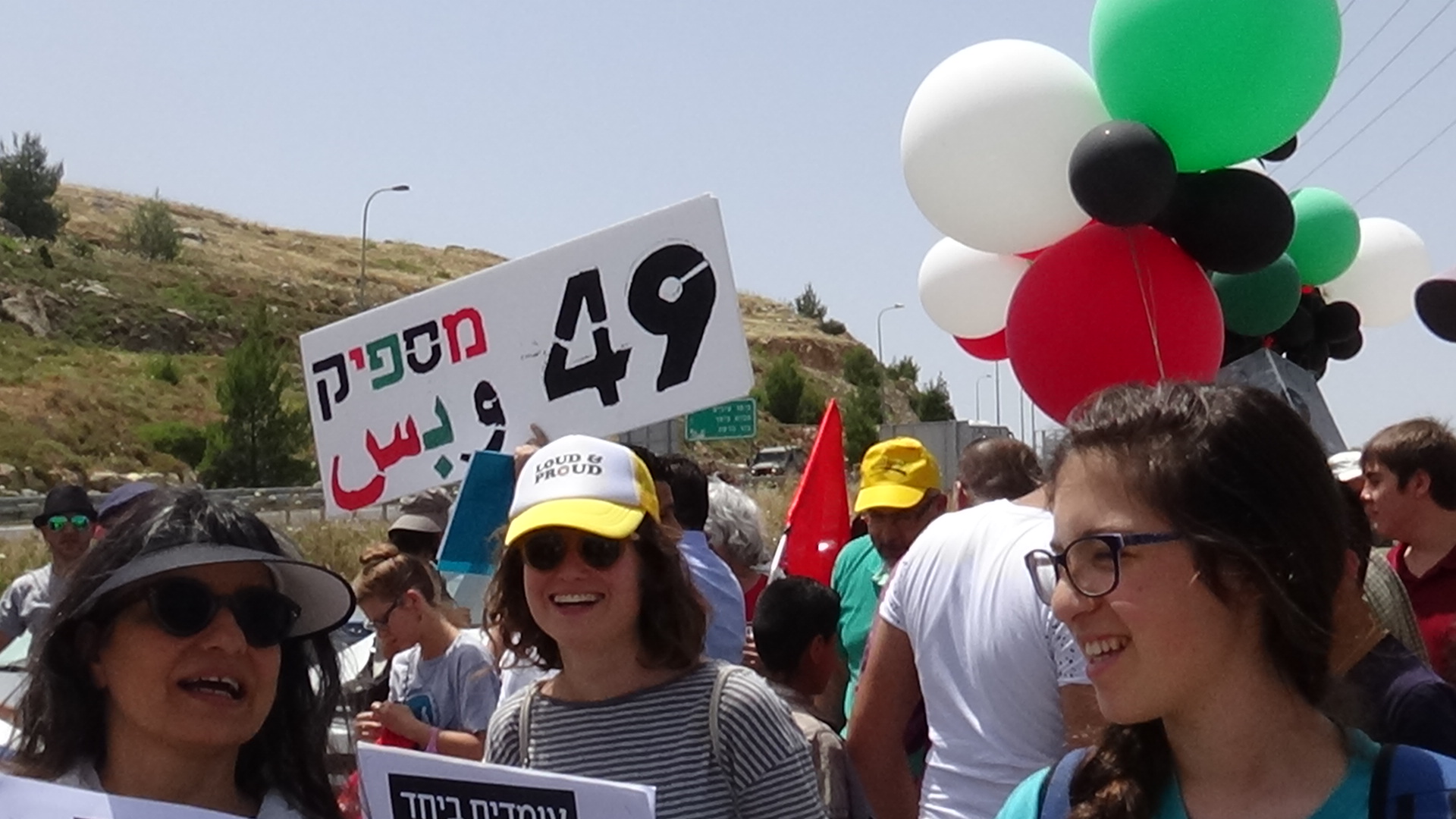 el Aviv arrived at the meeting point. The protest procession crossed the main road slowly, but did not block it, and amid the shouting of slogans and the displaying of placards, found shelter from the sun under the monumental concrete overhang of the separation barrier at this point.
 The protest ended with short speeches (translated into Hebrew and Arabic) by MK Aiman Oudeh, the charismatic leader of the Joint List, Leah Shakdiel, a long time feminist and social activist who represented the religious peace group Oz v’shalom, and representatives of Combatants for Peace. But I won’t talk today about the content of the speeches, the formulation of slogans (also translated and transliterated between Hebrew and Arabic), or even the ritual of releasing the balloons from under the concrete canopy into the freedom of the skies.
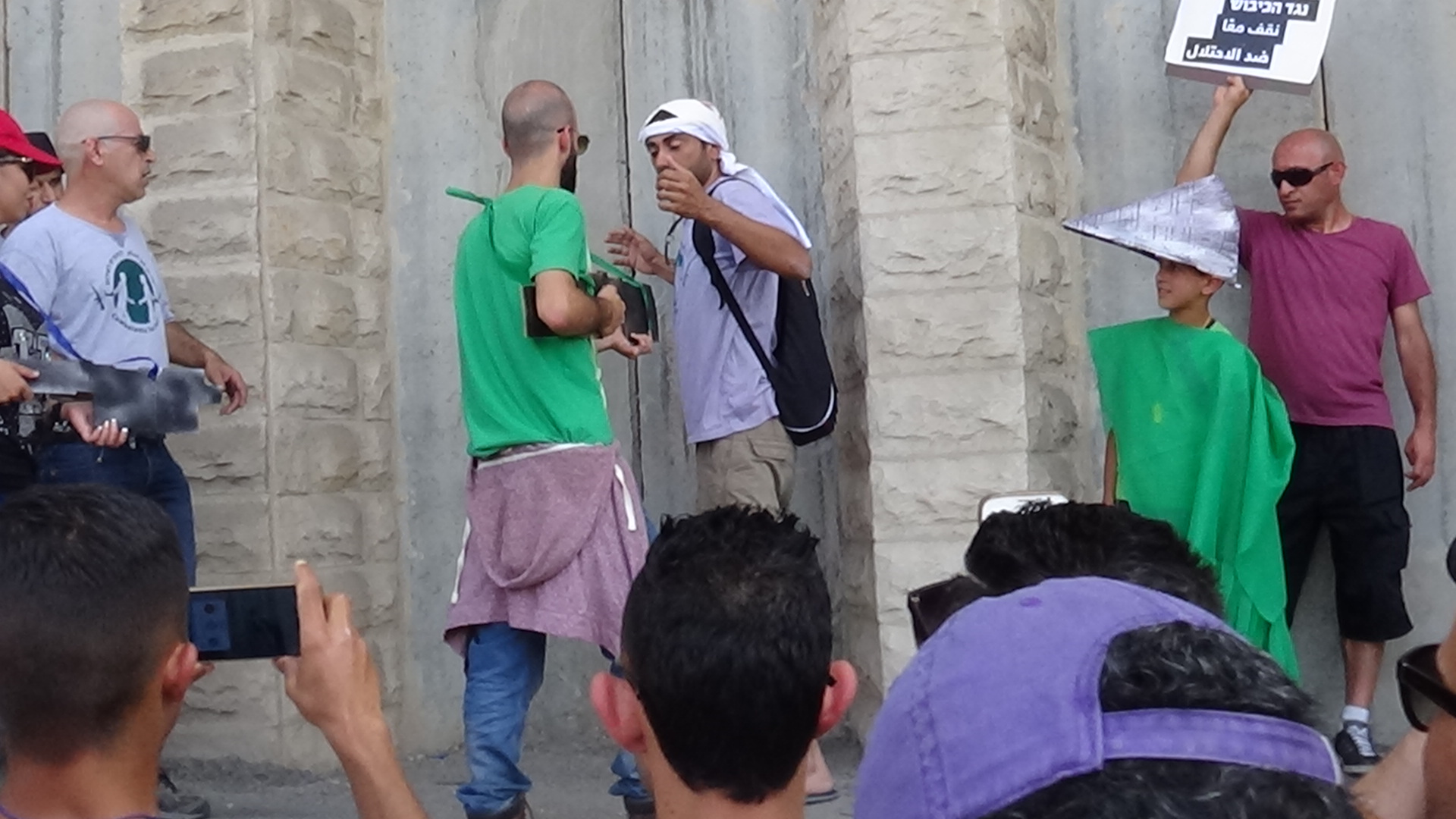 “Standing together” itself performs the vital political position of “refusing to be enemies” at a time of heightened tension, and in the context of a conflict to which no political resolution can be seen on the horizon. Combatants for Peace, along with other groups participating in the freedom march, such as the Bereaved Families Forum, and the Jewish-Arab parliamentary bloc Hadash, have performed this partnership, including acts of co-resistance, for years now. Combatants for Peace has also turned consistently to the “theatre of the oppressed” as a key element of its activities, often in more rehearsed ways and in settings in which the audience could participate more easily. They have documented some performances, and I have written about one I saw a few years ago.


