Tag Archives: Israel

Are we safer, now that Huda Al-Sosi is dead?

Are we, Israeli and Diaspora Jews, safer now that Huda Al-Sosi is dead? Do we sleep more easily, feel more secure on the street, less wary at work, worry less about our children’s futures, now that she is dead? She “was killed in an Israeli air strike on Oct. 23 which also took the lives of relatives. The status of her two children is unconfirmed,” according to the tribute to her on the We are Not Numbers website. Huda had not yet had a chance to contribute to the project which “tells the stories behind the numbers of Palestinians in the news and advocates for their human rights.” Now more than ever it’s vital to cherish the personhood of those, Palestinian, Israeli and others, who are being killed in this horrendous war, the Black Shabbat and the War on Gaza. “Every person has a name” goes the Hebrew song that is used on memorial days for soldiers and the Holocaust. Her name was Huda. Her colleagues describe Huda as ” a beacon of strength and kindness,” having “a way of lighting up any room with her infectious energy and her radiant smile.” I imagine myself back in my days of university teaching. Would I enjoy Huda being a student in my class? I think so, very much.

Maybe that’s not good enough though. In this time of turmoil and tension, perhaps some readers will insist that Huda’s “love of Palestine” and determination “to reveal to the world the stories and struggles of those living in the shadow of the Israeli occupation” mean she was a propagandist, an enemy of we Jews. She loved her country; is that wrong? Don’t you? Perhaps some readers will doubt the good standing of the organisations behind the project, Nonviolence International and the Euro-Mediterranean Human Rights Monitor because they are too Palestinian. Maybe I should have picked a better example, whose innocence could not be challenged. Here, then, is Reevana al-Hussain, a one year-old also killed in an Israeli airstrike. Nothing else is written about her on the Instagram post, but I saw a news clip of a despairing father crying at a bomb site somewhere in Gaza that his one year old daughter had been killed. When did she have time to become Hamas, he lamented. When indeed.

But we are safer, we’re told, not because Huda and Reevana are dead, but because they were “collateral damage” in the targeting of Hamas terrorists, who use the Palestinians civilian population as human shields. So, are, Israeli and Diaspora Jews, safer because Ibrahim Biari, a target of some of the intense, deadly and destructive bombing in Jabalia, is dead? He is said to have been responsible for some of the horrific Hamas attacks on October 7th, so he won’t be doing any more of that. But how many more Ibrahim’s will there be? Weren’t we told that we’d be safer after Hamas founder and leader Sheikh Yassin was assassinated in 2004, followed by his deputy Abdel Aziz al-Rantisi later the same year? And weren’t we told we would be safer after Yahya Ayyash, the Hamas “Engineer” who made the bombs for a series of horrendous suicide attacks from 1993-95, sabotaging the Oslo peace process, was killed in January 1996? No, his death was followed by four suicide bombings that killed seventy-eight Israelis in February and March 1996, undermining the authority of Shimon Peres as the successor of Yitzhak Rabin, the Israeli Prime Minister at the time of Oslo who was assassinated by a Jewish religious terrorist in November 1995. Netanyahu was elected in stead of Peres. There has not been another Rabin, another Israeli leader with the trust of enough Israelis to lead the country to peace.

None of the killing has made us safer, not in Israel-Palestine or in the Diaspora. Antisemitism always spikes when one of these wars happen, and this time even more so. Here in the UK, the official representative body of the organised community, the Board of Deputies, put out A GUIDE FOR JEWISH EMPLOYEES NAVIGATING WORKPLACE ISSUES ARISING FROM THE WAR IN ISRAEL. There’s some sound advice about addressing harassment, victimisation and discrimination. But when it comes to “How to handle difficult conversations” the guide offers Israeli hasbara talking points. The key point should be that Jews in the UK should not be held responsible for the actions of the Israeli government and military, just as Muslims in the UK are not responsible for the actions of Hamas. One is antisemitism, the other is Islamophobia. Instead, the Board of Deputies encourages UK Jews to make our safety dependent on defending what are almost certainly indefensible war crimes, if not genocide.

It cuts both ways, of course. Are Palestinians in Gaza, in the West Bank, in pre-1967 Israel, in the diaspora, safer because Hayim Katsman is dead? Hayim was an academic, someone I would have liked to meet as a colleague, who had also been active with Machsom Watch, given testimony to Breaking the Silence and (as I have done occasionally) spent time accompanying Palestinian farmers in the South Hebron Hills to protect them from settler and soldier harassment. No, Palestinians are not safer. Palestinians citizens of Israel are no closer to equality; Palestinians in the Occupied Territories are no longer closer to freedom, to independence; and Diaspora Palestinians are no closer to justice, to fulfilling their right of return.

Photo:  Hannah Wacholder Katsman

No, none of us are safer because of all the killing. And none of us will be safer if more Hudas, Reevanas and Hayims are killed, with whatever justifications. There must be an immediate ceasefire. It’s being called for in Israel, especially by those for whom freeing the hostages is the highest priority. It’s being called for by progressive Jews in the Diaspora, such as the anti-occupation group in which I’m active, Na’amod. The call for a ceasefire is also heard at the many solidarity protests with Palestinians. Because a ceasefire is what is needed now, I joined one of those protests in my home city, Nottingham. It was not always comfortable for me, and I did not join in all the chants. But what is my discomfort when the alternative to a ceasefire is more Hudas, Reevanas and Hayims?

Protestors against the war in Tel Aviv, October 28 2023. Photo: Oren Ziv

The trauma of October 1973

This is another autobiographical blog, an excerpt from Chapter 2 of a planned book about how my life has intersected with Israel-Palestine, the making and unmaking of a Zionist.

On October 6th 1973 I was in Heaton Park Synagogue for Yom Kippur attempting to complete the fast in my last year before my bar mitzvah, after which I would obliged to fast. I was seated with other youth in an area unused for most of the year, behind the bima (prayer platform) and flanked by the main doors, but needed during the well-attended services of the High Holidays. Other boys drifted in and out, but I was in my pious phase, taking repentance seriously and not joining the custom of hopping from one synagogue to another to see friends, treating the day as a seriously under-catered social event.

Sometime in the afternoon news began to trickle into the synagogue about the Egyptian and Syrian attack on Israel, which began at 2 pm local time. As we were not a very religious community, some of the congregation had perhaps turned on radios (in violation of the strictures of holy day) to find out how Manchester City were doing (it was a 1- 1 draw with Southampton). Even aged twelve, I knew this was a surprise attack, as there had been no escalation of tensions reported in the news. Common wisdom is that in 1967 Jewish communities in Israel and the Diaspora experienced the dread of annihilation for the first time since the Holocaust as tension mounted before Israel’s pre-emptive strike. Whatever the reality of the intentions and capacities of the neighbouring – or surrounding – Arab states, there was a palpable fear that Israel could be overwhelmed and destroyed less than two decades after its birth in war. Six and a half years earlier, I had picked up on that tension in 1967, so, perhaps for that reason, I was deeply fearful. This was not a distant fear, an anxiety that a country somewhere else could be defeated, but an immediate terror we would all be wiped out together. I summoned up the courage to walk across the synagogue to Rev Olsberg’s seat at the front, to ask him what he knew, whether the rumours were true. It was not the secular reassurance of my father I sought, but a higher cosmic authority. Rev Olsberg was as kind as ever, confirming he had also heard the reports and would be making an announcement in a break in the service. I prayed hard for the rest of the day, as if my repentance could somehow save Israel and bring God’s salvation.

The Yom Kippur services came to an end as night fell and we all hurried home to eat, turn on radios and televisions and learn the news, which was not good. But nor was it so bad that I remained gripped by terror. Instead of worrying that Israel was being overrun, concern shifted to former Habonim members my older sister knew who had settled on Mevo Hama, a kibbutz on the southern edge of the Golan Heights. If I remember correctly, they were evacuated in the confusion at the start of the war as Syrian troops advanced into the Golan. Mention of them was enough to shut up a classmate who made some off-colour remark to me about Israel not doing so well now, was it? Our youth leaders at Habonim gathered us together quickly and we spent an evening collecting money door to door for medical aid, though I am not sure which fund it did go to. Some of them also volunteered to go to Israel to work on kibbutzim, taking the place of mobilised reservists. A few days into the war, the news got better for Israel as its forces counter-attacked, and by the end of the fighting on October 25th Israeli forces had crossed onto the western side of the Suez Canal and encircled Egyptian forces who crossed onto the eastern side, in the Israeli occupied Sinai Peninsula. They had also blocked the Syrian advance into the Golan and captured a belt of Syrian territory that took them within striking distance of Damascus.  Yes, Israeli military dominance and confidence had been severely challenged by the initial surprise attack, but Israel was safe.

My understanding of the war was shaped by reporting in The Guardian and British television news – for a few weeks, at my older sister’s instigation, we watched both BBC and commercial ITV news, which we normally ignored.  More impressive for me than those media, though, was an Israeli propaganda film that was produced quickly and screened at Mamlock House, the local headquarters of the Zionist movement. The song that became the Israeli anthem of the war, Lu yehi (Let it Be) and which we had already learned in Habonim featured in it. The documentary ended on an optimistic note by picturing Israeli and Egyptian officers negotiating at Kilometer 101. I treated my classmates to a verbal version of it during an English class in which we read out some work. There was no divine intervention in this essay, but there were echoes of David and Goliath, with Israel as the small country surrounded by enemies attacked on its most holy day, with even school children mobilised in the war effort by painting car headlights blue. I was the perfect propagandist for Israel.

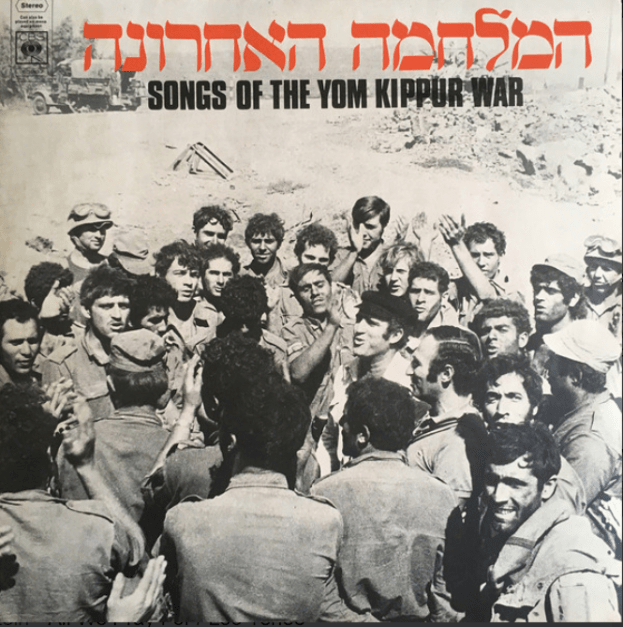
The Yom Kippur War – which is the only name I knew it by at the time, grew in significance for me in its aftermath. Our youth leaders came back with stories to tell, including stories about the torture and killing of Israeli prisoners of war by the Syrians, but also a more touching one about waving to a Jordanian farmer working on the other side of the border.[1] Soon after the war, my father went on a work trip to Israel and came back with what seemed like a whole suitcase full of gifts, including a record album titled “Songs Of The Yom Kippur War” in English but “The Last War” in Hebrew, after the song of that title performed by Yehoram Ga’on. I listened to it repeatedly, especially Chava Alberstein’s haunting rendition of Lu Yehi, while earnestly endorsing the sentiment of the Hebrew title song that this will be the last war – if only the Arabs would stop attacking us. Although it was only a few years before I began to acquire a more critical understanding of the war, at the time I would have been shocked if told what I know now; that the war could have been avoided if Israeli leaders had been more willing to heed President’s Sadat’s overtures of peace and territorial compromise; that the surprise attack was a major failure of Israeli political judgment and military intelligence, not for lack of information but for lack willingness to believe that Egypt and Syria would dare attack (as established by Israel’s Agranat Commission of inquiry, which led to the resignation of Prime Minister Golda Meir’s government in 1974); and that the Arab states aimed to recover territory captured by Israel in 1967, not to wipe out the country. In effect, Egypt achieved its war aims, opening the space for US Secretary of State Kissinger’s shuttle diplomacy and leading first to the 1975 disengagement agreement with Israel which returned some of the Sinai, and then less directly – including the rise of the Peace Now movement – to the 1978 Camp David Accords, which returned the rest of the peninsula to Egypt. For all the pain and loss it caused, it was a war in which diplomacy was waged violently and militarily.

And yet something still remains. My adult, critical understanding cannot undo the horror I felt when I listened to voice recordings of Israeli soldiers in positions on the edge of the Suez Canal as they were being overrun by Egyptian forces. The terror of impending individual annihilation is compounded doubly. First, by a fear that in killing the individuals, the collectivity will also be extinguished and second, by a dread that this surely must not be happening, that now we are strong and able to defend ourselves, so if we are attacked, we will vanquish our foes. It is the same dread I felt watching the scene in the film Saving Private Ryan in which the Jewish character, Stanley Mellish, is killed in hand-to-hand combat by an SS soldier, who makes calming sounds to his victim as he pushes the knife into his chest. This too should not be happening, my body screams, the Normandy invasion is underway, the Nazis are being defeated, Mellish should be victorious. But there it is on the screen, a little Holocaust, the death of a single Jew that for the unbearable moment of the scene symbolizes the death of us all. So, the trauma of 1973 lingers, attaching itself to other traumas which cannot be dispelled by critical historical awareness, only by confronting the trauma.


  1. The stories of Syrian atrocities were true. See Wikipedia, “Atrocities Against Israeli Prisoners,” https://en.wikipedia.org/wiki/Yom_Kippur_War#Atrocities_against_Israeli_prisoners. Accessed 21/1/2021.