Tag Archives: Israeli peace activism

Wrecking the world together

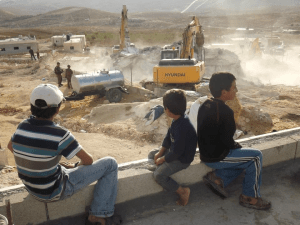
Children watching Hyundai demolition machine: Demolition in south Hebron hills by IOF 6.11.2012, photo 50 of 96 by Operation Dove.

Images can have strange and strained relations with each other. In this case, the strained relation is between the corporate image of the Hyundai corporation and activists’ image of the Israeli occupation. The South Korean corporation is now best known for making Hyundai and Kia cars. As is the case with other global corporations, it is very conscious of its brand image. According to Hyundai’s Chairman and CEO Mong-Koo Chung’s corporate message of May 2012, its “brand value rose to over USD 6 billion, ranking 61st among the world’s top 100 brands.” Branding isn’t only about marketing; it’s not only about sales figures. The corporate message states that: “our goal is not to be the worlds’ biggest automaker, but to be the worlds’ most-loved automaker.” One of the ways in which Hyundai makes itself more lovable is by fulfilling “its duties as a global corporate citizen through its widespread corporate social responsibility programs.” So, on the corporation’s worldwide website one of the five heading options draws attention to Hyundai’s collaboration with UNICEF in its Global Endpoverty campaign, trumpeted under the slogan “Moving the World Together.”
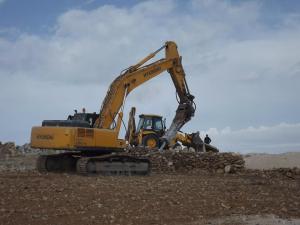
Hyundai demolition monster: Demolition in south Hebron hills by IOF 6.11.2012, , photo 83 of 96 by Operation Dove

But Hyundai doesn’t only make cars. A photograph credited to “Operation Dove” displays the Hyundai brand name in a rather less lovable context, as a piece of its building equipment is put to use by the Israeli army to demolish a stone wall built by Palestinians in the south Hebron Hills area to pen in sheep. The Hyundai machine looks like a monstrous single-toothed dinosaur that has come not to move the world forward but to wreck it.

Another of the current five heading options on the corporate website leads visitors to Hyundai’s “live brilliant” branding campaign, one of the video advertisements for which features laughing children amazed at the world that they see during car journeys. The caption for the campaign is: “Hyundai makes every moment brilliant”. But in another photo of the same event, Palestinian children are pictured looking on in seemingly bored resignation as the Hyundai and other machines demolish another building. They may well remember this moment their whole lives, but not as a brilliant one.

The pictures (along with a description of the demolition operation, and a video posted by Operation Dove) will not only remind the children of this violent incident. They also threaten to damage Hyundai’s corporate image, which has been crafted as carefully as the dry stone wall. Like the flocks that can no longer be penned in by the wall, Hyundai’s brand value is in danger of becoming scattered. And if the brand value is lost, the corporation’s value could collapse like the house attacked by its machine.

The Israeli army is demolishing these structures in the South Hebron Hills region in Area C of the West Bank, which remains under full Israeli control following the 1993 Oslo agreement, on the pretext that it needs the land for live firing zone 918.  According to the Israeli military, the 1,800 or so Palestinians living in the area do so illegally, because the military law forbids residence in a live fire zone. And hence the army periodically demolishes buildings in the area that it also considers to be illegal. But a brief glance at a map of the area drawn by Israeli human rights organization B’tzelem suggests that the alleged military necessity for more training ground is underwritten by an Israeli political strategy of effective, creeping annexation of Area C, which comprises about 60% of the West Bank.

The photographs posted by Ta’ayush activists following this particular incident on November 6, 2012 are peace images that undermine Hyundai’s, and other corporations’, brand images. Ta’ayush is an Israeli-Palestinian grass-roots movement that engages in non-violent direct action to resist the occupation. It has been particularly active in the South Hebron Hills area in recent years, along with other Israeli peace groups such as Rabbis for Human Rights. These are peace images in that they vividly portray that the Israeli occupation is violent and oppressive, a state of affairs that must be ended to bring peace. They are also peace images in that they reflect Ta’ayush’s aim to “to break down the walls of racism, segregation, and apartheid by constructing a true Arab-Jewish partnership”. Building the partnership is peace-making.

Thus far, Hyundai has attracted less negative attention from the BDS (Boycott, Divestment, Sanctions) movement than other corporations whose equipment is used by the Israeli military in the occupied Palestinian territories, such as Caterpillar. Documentation of the incident shows the Israeli military deployed Caterpillar and JCB machines as well as the Hyundai monster, and the Electronic Intifada blog puts them in the same basket.  Hyundai’s brand managers should be aware that Hyundai will know no peace if the brand is associated with occupation and war.

Putting Peace Back in the Picture

Banksy graffit art, Separation Wall

There’s very little talk in Israel about peace nowadays. Since the failed negotiations between the Israeli and Palestinian leadership in 2000, the predominant belief in Jewish Israeli public opinion is that “there’s no partner for peace”. Yes, Israeli Prime Minister declares every now and again that he’s ready to talk to the Palestinian President Abu Mazen any time, but there’s been no movement at all since October 2010 when the talks promoted by the Obama administration ran aground on the issue of settlements: the Israeli government refused to freeze them, and the Palestinian Administration refused to negotiate while their land was being taken from them. Even if there were negotiations, talk about peace isn’t the same as peace.

The “Arab Spring’s” potential and actual dangers to Israel are far more often reported in the media and mentioned in conversation (attacks launched by Islamists from the Egyptian Sinai peninsula; concerns about the future of the Israeli-Egyptian peace treaty of 1979; anxiety about what sort of regime will take over in Syria). As seen in Netanyahu’s presentation of a cartoon bomb in his UN speech on September 27, in the Israeli mediasphere it’s simply assumed that Iran will use a nuclear bomb if it enriches enough uranium, posing an existential threat to Israel. And certainly for Israelis who live close to Gaza, the presence of war rather than peace seems to be confirmed regularly when rockets and mortars fall on them, often as part of a routine exchange of violence following Israeli “targeted killings” of Palestinians there.

Those Israelis who prefer not to watch or listen to any news and just get on with their lives can imagine that the relative quiet in relations between Israelis and Palestinians is a kind of peace, especially because the mainstream news long ago forewent reporting the daily assaults by West Bank settlers and on-going displacement of Palestinians by the military government. If on this side of the Separation Wall’s it’s peaceful, what does it matter what happens on the other side?

In an effort to get people talking about peace again, women activists in a group called Israeli Palestinian Bereaved Families for Peace, often known as The Parents Circle – Family Forum, has launched a campaign to Put Peace Back in the Picture. Launched on a dedicated Facebook page titled A Crack in the Wall, the campaign invites the public “to dream, talk and think anew about peace.” Everyone is asked to post a picture of themselves on the page while holding a sign that says:  “I also want to bring peace back into the picture,” mostly in in Hebrew or Arabic, but also English and other languages too. The web page for the campaign says:

 We can blame the other side, the circumstances or ourselves, but the fact is that slowly but surely, peace as an option has vanished from our midst and we’ve come to terms with the fact that it’s not possible, certainly not in the foreseeable future.

…And when there is no vision of peace, nothing will happen to lead us there. Other visions and other aims will continue to lead us to more and more years of conflict and alienation between us and our Arab neighbors.

We stand here together – Israeli and Palestinian women of the Forum of Bereaved Families for Reconciliation and Peace. We want to bring peace back into the conversation of Israeli and Palestinian society; and to then call on our leaders to act, in any way possible, to bring about peace in our region and end the cycle of hatred and bloodshed.

In addition to the Facebook campaign which currently shows over 160 photos, the women activists also held a three hour event on Internatio

Jon Simons at Parent Circle – Family Forum event

nal peace Day, Friday 21 September, placing a few stalls by an entrance to Tel Aviv’s busy Carmel Market at which passers-by were invited to be photographed with a sign. Some were happy to do so, others were reluctant, and inevitably a few people wanted to argue. Taking turns to use the megaphone, the women activists dressed in white repeated the message of the

Parent Circle – Families Forum event, Bring Peace Back Into the Picture

Children painting peace at Parents Circle- Familes Forum event

event, while a young woman was on hand to photograph the willing. At the stall there were also blank placards on which children drew their images of peace (why do we imagine that only children can imagine peace?) and there were stickers handed out too bearing the group’s slogan “It won’t be over until we talk” (in Hebrew this rhymes as: ze lo y’gamer ad sh’ndaber). The highlight of the event for the women was the arrival of their Palestinian friends, allowed on this occasion to travel from the West Bank with military permits. Their presence didn’t prevent those who wanted to pick a verbal fight from insisting loudly, in line with Israeli “common sense of the age,” that “we want peace, but they don’t. They’d kill us if they could.” This obvious projection of intentions is sustained by an image of the enemy Other that is stronger than any reality.

The campaign is shaped by two metaphors that are slightly different, one visual, one spatil, yet that reinforce each other. The women have understood that if there is to be peace, we have to be able to see it, to envision it, to imagine it. But given current circumstances, it’s hard to imagine the kind of peace that would put an end to the killings that have bereaved these families (in contrast to the imagined “peace” that is the relative quiet on the Israeli side of the Separation Wall). And so there also has to be a new space opened up to see and imagine peace; there has to be a crack in the wall. This remarkable group, Parents Circle – Family Forum, both embodies such a peace and opens a crack in the wall, because instead of allowing bereavement to feed the cycle of violence and revenge, they have chosen reconciliation and dialogue. Their hope is that by example more people on both sides will see each other as partners for making peace rather than as antagonists for waging war. The campaign is a start, or rather another of many small efforts by Israeli and Palestinian peace groups to at least keep a crack in the wall open so that peace can be imagined and made real.