Tag Archives: Israeli peace activism

Flags, place, and people

Growing up in the UK in the 1970s, I had no love for the British flag which had been appropriated by the racist far right, especially the National Front. As I was a keen Zionist at the time, I’m pretty sure I felt a lot more affinity to the Israeli flag then. I’m visiting Israel again, but without the Zionist identity that brought me as an immigrant to this country in 1985. It’s not long after Independence Day, so there are perhaps more flags around than at other times of the year, but there seem to be a lot of them. Living in the US, I’ve grown used to seeing the red, white and blue on the houses of neighbours, on massive poles outside shopping malls and in the town square. Perhaps it’s unfair, but I can’t help feeling that when a nation feels the need to brand a place so insistently with its flag, there’s some insecurity there about the land belonging to the new nation rather than the people who lived there before.

It was hard to feel ambivalence at all about the Israeli flag on “Jerusalem Day,” a day that marks the Israeli conquest in June 1967 of the eastern part of Jerusalem, which had been under Jordanian rule since 1948. There might be something to celebrate about the reunification of a city torn apart by war, but the unilateral annexation of East Jerusalem by Israel makes it clear as can be that the city is not united but deeply divided along the lines of the Palestinian-Israeli conflict. The “celebration” of the day has been thoroughly appropriated by the religious nationalist settler movement which re-stages the conquest of East Jerusalem, especially the Muslim Quarter of the Old City, each year with the “dance of the flags.” The “dance” has been accompanied by physical and verbal violence on the part of the conquerors and the police who enforce their passage through the streets placed on lock down, but less so this year. The Israeli flag in the hands of the marchers has become a symbol of an exclusive Jewish claim to the place of Jerusalem, of racist superiority over the Palestinians who live in the place, and of possession of place by violent means.

Over the years, the British union flag has become cool again, reclaimed from the racists even if it’s been appropriated as a fashion item. There are Jewish Israelis opposed to the settler nationalists who also want to claim the flag for themselves. Peace Now has its own flag for Independence Day, which replaces the Star of David at the center with the word “shalom.”
Last night in Zion Square gay rights activists did their best to engage mostly religious protagonists while holding the rainbow flag embellished with the Star of David.

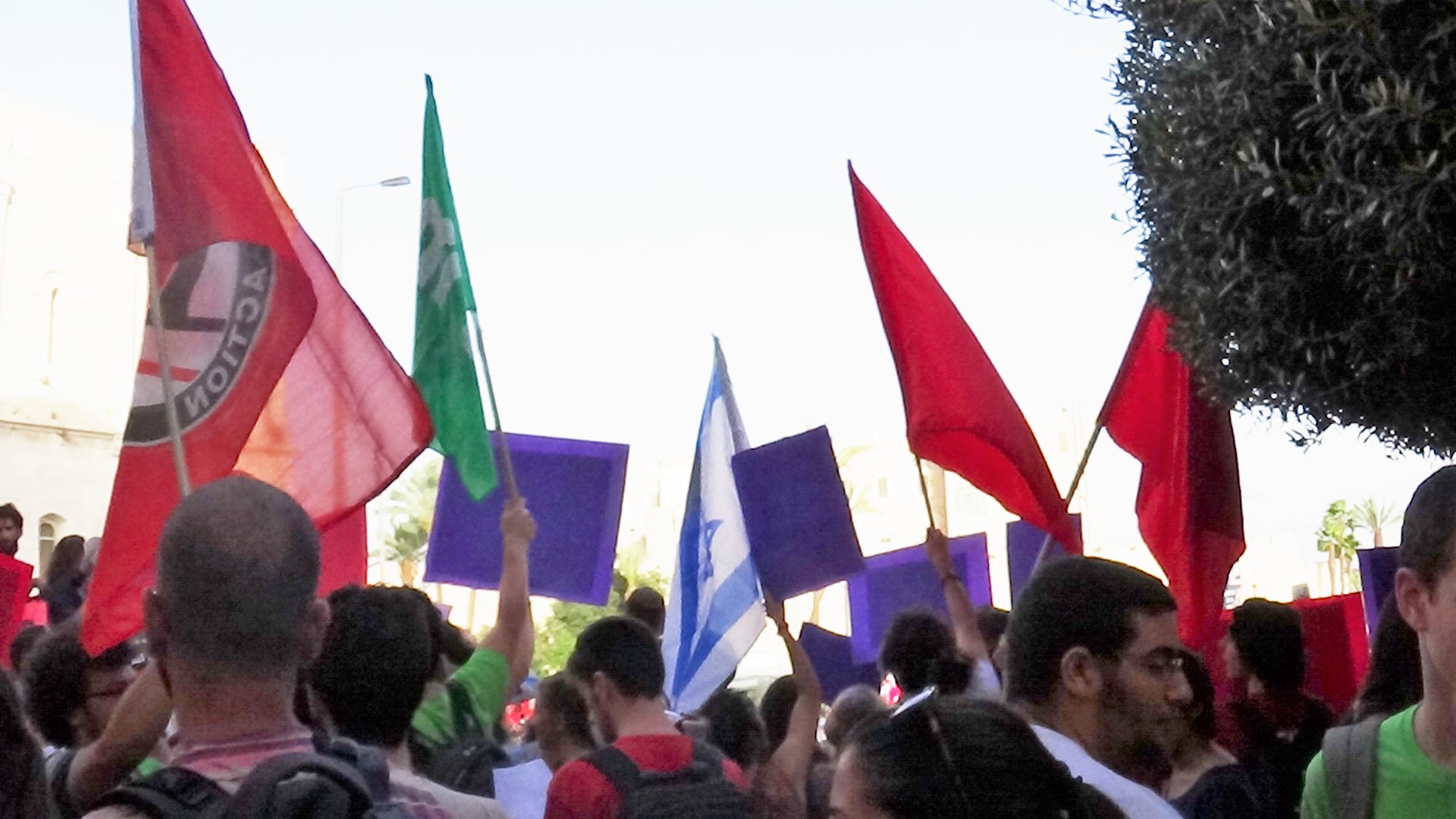
At the counter-demonstration to the flag march organised by Free Jerusalem someone held the blue and white flag among the red flags of Hadash and other socialists and the green banner of the liberal Meretz party.
DSC00119

Free Jerusalem Facebook photo

Free Jerusalem Facebook photo

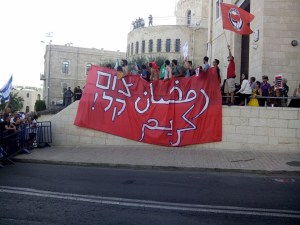
The flags confronted each other across barriers, with a small proportion of the thousands of marchers lingering to stand opposite the small number of counter-demonstrators corralled into a balcony overlooking the street corner, like a bunch of hobbits hoping to hold off the orcs. There were drum rhythms and slogans from the balcony: “End the occupation.” “Jews and Arabs refuse to be enemies.” The conquerors also chanted and sang songs which in another peaceful contexts of mutual recognized attachment to place would have been tuneful. It was hardly an opportunity for a frank and free exchange of views, as we regraded each other with mutual dislike and disdain. Indeed, the largest of the counter-demonstrator’s banners (which I didn’t see from where I stood within our corral until I saw this photo on Facebook) spoke over the heads of the conquerors to wish the Muslim residents of the Old City Ramadan Kareem.

People on flags. Design by Ariel Katz, produced with her by John and Hazel Varah from Same Sky.

People on flags. Design by Ariel Katz, produced with her by John and Hazel Varah from Same Sky.

I don’t feel like reclaiming the Israeli flag for peace and tolerance, not least because its symbolism excludes its non-Jewish citizens. People are more important than the flags with which they brand places with their identities. When that’s forgotten racism and chauvinism blot out the identities and belonging to place of those who don’t adhere to your banner. If there must be flags, these are the ones I can identify with. Women and men, Palestinians, stand together, refusing the monopoly of national identities and looking for ways to reach across to each other. Flags don’t dance, but people do, and there’s no place we can’t dance, not even divided Jerusalem.


There’s nobody to talk peace with (even when you’re speaking to them)

DSC00106

Peace Square (Bereaved Families Forum), Jerusalem, June 5 2016

The simplicity of the slogan of the Bereaved Families Forum, “It won’t end until we talk,” is already an answer to the simplistic and often repeated phrase “there is nobody to talk to,” (ein im mi l’daber). (The forum’s slogan rhymes in Hebrew: zeh lo y’gamer ad shen’daberI wrote about this slogan in the context of the 2012 war on Gaza). Reassuring themselves in the certainty that talking and dialogue is pointless, Jewish Israelis often convince themselves that while they want peace, “they” (the Others, Arabs, Palestinians) do not. It can hardly be an entirely comforting belief, because it condemns the citizens of the Jewish State to be at war, “to live by the sword,” for the foreseeable future. Inevitably, that means there will be more bereaved Israeli as well as Palestinian families. But we humans are peculiar creatures, so sometimes it makes more sense to us to repeat the trauma of personal and collective loss, to enfold it in a tragic narrative of good versus evil, the peaceful versus the belligerent, the victims versus the perpetrators, than to break through the loss. What could be more horrifying than to think that perhaps our loved one was lost because there was something we didn’t do, especially when that something was as simple as talking to your enemy. So it’s better to insist that there’s nothing that can be done.

Perhaps that is some of the feeling that I could hear in the anger of one of the people who passed by the Peace Square set up by the Parents Circle Families Forum in the German Colony neighbourhood of West Jerusalem. The tent, which I’ve written about previously from a distance, was part of a series of events to reclaim Jerusalem Day in the name of tolerance.  The day marks the “reunification” of Jerusalem when Israeli forces conquered (or some would say “liberated”) East Jerusalem, then under Jordanian control, and has become a festival of the national religious settler movement whose idea of liberation is one of exclusive Jewish control.

Two members of the forum, Rami Elhanan and Roni Hirshinzon, were there to explain the work of the Forum, to answer questions, and once again to open their hearts and tell the story of the loss of their children to the conflict. For the most part, the discussion in the shade of the small park among those who had chosen to come to the event was quiet, somewhat curious, respectful. But not everyone who chanced by and stopped wanted to listen, or even to take note of whose banner marked the square. Foremost among them was Mr. Shouty, who succeeded in rousing other sceptical and critical observers to shout among themselves and close down the discussion.

DSC00105

Rami Elhanan sitting with a picture of his daughter Smadar and his friend Bassam’s Aramin’s daughter Abir, both killed in the conflict.

Mr. Shouty (for the sake of this blog I’ve absorbed the statements of some others into this one character) had all the regular answers to the Forum’s slogan, all of which add to “there’s nobody to talk to” (ein in mi l’daber). We are only here because we’re strong. If they had the power, we’d all be dead. They vote for Hamas. If the Peace Square can’t be held in the open air in Hebron, that shows we’re the peace lovers and they aren’t.

I was less prepared to hear Mr. Shouty’s brutal put down when Roni told him he’d lost two sons in war: “And did you hand out sweets?” With one sharp rebuke, he dismissed the loss of Palestinians in conflict to dehumanized celebration of the sacrifice of martyrs. We are bereaved, he said in other words, but they are so consumed by hate that they don’t feel loss. Maybe it would have made some difference if a bereaved Palestinian had been there to voice her own pain, but I doubt Mr. Shouty would have been any more ready to listen. To talk.

Earlier a woman had passedby and rebuked “us” for airing Israel’s dirty laundry in the international public, clearly without knowing who “we” were. I asked Rami how he felt that someone could be so dismissive even as he asked her questions. He talked about how much harder it is when he goes into classrooms and the kids shout at him, but that all he hopes for is one hint of acknowledgement from someone at the back of the room – a glance that suggests that he has made once crack in the wall of enmity, that he might have saved one drop of blood. So Rami, Roni, and other member of the Forum keep on talking, hoping that someone will listen, even when they are being shouted at by people who won’t let them talk. They cannot know which small crack in the wall (the title of the Forum’s Hebrew and Arabic community Facebook page) will open the floodgates and stop the last drop of blood from flowing.