Tag Archives: israeli peace movement

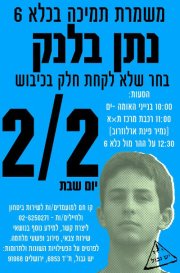
Open Letter to Natan Blanc, an Israeli conscientious objector

Poster for Yesh Gvul solidarity protest for Natan Blanc

Poster for Yesh Bgvul solidarity protest for Natan Blanc

Natan Blanc

Natan Blanc

Dear Natan,
I am sorry that I cannot be with you in solidarity today on the hill opposite Atlit prison, taking part in the protest against your detention. I am far away in the Unites States, on a wintry, snowy day in Indiana, though rain or shine, I would much rather be spending my day with other activists on the buses organised by the refuser-group, Yesh Gvul, bringing you some moral support as you serve your fifth spell in military jail no. 6. Outside jail, the 20 days of this sentence, in addition to the previous four sentences since November 19, 2012, would slip by quickly. Inside, the time and boredom must weigh heavily on you. It takes a great deal of fortitude to be willing to serve one sentence after another, to persist in your refusal to serve in the Israeli armed forces. We have been privileged to read recently the intimate account by another conscientious objector, Moriel Rothman, of his spell in military jail. From afar, I can only admire your determination and commend the sacrifice you are willing to make for the sake of justice and peace.

I don’t know how much it helps you as you serve your sentence to imagine the people in Israel and beyond who want to give you their strength in support of your ethical stance. But in any case, let me say a little about myself. Some 18 years ago, as a (by then not so new) immigrant, I was inducted into the Israeli armed forces but refused to get on a bus taking us for basic training in the Occupied Territories. I, however, was lucky enough not to have to test my mettle for more than an hour, when an officer prompted me to come up with a personal problem so that I could stay at Tel Hashomer (the induction base) for another week. The same officer then released me until another induction date a few months later, and by the time that day came around I had found my first academic position in the UK and left Israel. It was hard enough to stand my ground for an hour in the car park in the face of various threats and cajolements: I don’t know what it feels like to persist and endure for more than 70 days.

Unlike myself, who grew up in Britain, for most of my teens in the warm environment of a Zionist youth movement, Habonim-Dror, you have had to find your way through the intensive socialization of the Israeli education system on the value and benefits of military service. More than that, you must have to contend with a huge amount of peer pressure, to toe the line, to do your duty to “defend” your country, to prove yourself as a man, to turn yourself into a “full” Israeli citizen, to take on your share of the burden that so many voices today clamor to share equally. In your refusal declaration, you show how clearly you see the blindness, denial, and even outright hypocrisy in all these statements about duty, defense and nationalism. As you say:

It is clear that the Netanyahu Government … is not interested in finding a solution to the existing situation, but rather in preserving it. From their point of view, there is nothing wrong with our initiating a “Cast Lead 2″ operation every three or four years … and we will prepare the ground for a new generation full of hatred on both sides. As … citizens and human beings, [we] have a moral duty to refuse to participate in this cynical game.

Somehow in your 19 year old wisdom you have already learned to see through the ingrained militarism of Israeli culture and society. You already practise the principles of New Profile, the feminist anti-militarism organisation that opposes the occupation, advocates the right of conscientious objection to military service, and supports you and other refusers practically. In their charter, they write that:

we refuse to go on raising our children to see enlistment as a supreme and overriding value. We want a fundamentally changed education system, for a truly democratic civic education, teaching the practice of peace and conflict resolution, rather than training children to enlist and accept warfare.

So, you do not see military service as a value, but instead have taken on another burden, another duty, an ethical duty to refuse to participate in the ongoing oppression and violence of the occupation.
But I do not share equally with you the burden of that duty. Nor when I was 19 could I see as clearly as you do now. No doubt at some point you will be – have been – called a coward. But you are braver than your conformist accusers. You will be told that you are naïve, a lover of your enemies. Yet, you are wiser than your detractors, the purveyors of hate. You will be told that you are a shirker, yet you have taken on a greater burden than any of those cogs in the machines of war and occupation. Thank you for your service.

To Be at Peace with Oneself: Reconciliation through Israeli Testimony of the Nakba

Catalogue cover for Towards a Common Archive exhibition

Catalogue cover for Towards a Common Archive exhibition


Last week a demanding and harrowing exhibition closed. The exhibition was called Towards a Common Archive: Video Testimonies of Zionist Fighters in 1948, consisting of more than 30 testimonies of Jewish fighters filmed especially for this project, one video of clips from documentaries by Israeli filmmakers with fighters’ testimonies, another video compilation of representations of the Nakba in Israeli feature films, and a video of testimonies by second- and third-generation Israelis who have heard first-hand reports of the Nakba. I attended the opening in October while on sabbatical in Tel Aviv.The exhibition was a collaboration between Zochrot, an organization that seeks to raise public awareness among Jews in Israel of the Palestinian Nakba, Israeli filmmaker Eyal Sivan, who now works at the University of East London and Israeli historian Prof. Ilan Pappé, now at the University of Exeter.

The ambition of the Common Archive project is both historical – to cross-reference testimonies by both Palestinian refugees and soldiers and commanders involved in the expulsion of some 700,000 Palestinian refugees in 1947-49 – and an exercise in peace-making. It may seem odd to consider the screening of testimonies about the Nakba to have anything to do with peace. Nothing is more likely to make Jewish Israelis and Zionists in general more defensive and less open to the needs of the Palestinians than confronting them with Israel’s ‘original sin’ – the uprooting of so many Palestinians to ensure that the nascent state would have a clear Jewish majority. Yet, the exhibition organizers take a different, more difficult path to peace through reconciliation, in which Israeli acknowledgment and accountability for the Nakba paves the way to tackling the most intractable issue of the Israeli-Palestinian conflict – the right of Palestinians to return.

I did not watch all of the hours of video testimony (which is viewable on both the Common Archive project’s and Zochrot’s YouTube channels) either at the crowded opening in the small gallery in an industrial building, nor on my return visit to the exhibition, or even on the DVD that came with the exhibition catalogue. It is more of an education than an exhibition, too much to bear in one sitting. It is an education not in the sense that unknown events are revealed, other perhaps than a detail here and there, but in that for the first time the perpetrators are the witnesses. It is not a question of Israelis being accused of crimes by Palestinian victims. Veteran Israeli fighters of the founders’ generation, often members of its elite commando unit, the Palmach, are the ones telling the stories of expulsions, killings, mutilations and massacre. We have known collectively all along, but preferred to repress, actively to forget these stories.

The testimonies I have seen tell of painful personal memories that merit repression yet need to be spoken and watched. None of the perpetrators have a problem characterizing what they did in the war of 1948 as “expulsion” of the Palestinians. The interviewers, Eyal Sivan and Ronit Chacham, ask the witnesses to specify what was involved in “cleaning” villages, the answers ranging from mostly shooting at the homes with small or heavy arms, sometimes shooting at those who fled, though mostly we are told they fled under cover of darkness, and sometimes entering the villages to throw grenades into houses. Some of the testimony tries to disconnect the violence perpetrated from the flight of the Palestinians: Yitzchak Tischler insists on saying that places “became empty” after being hit by fire; Esther Boss tells how shocked she was on entering the town of a-Lydd (Lod) to see so many corpses of Palestinian civilians on the streets, but is sure that Israeli loudspeakers calling on the remaining inhabitants in Arabic not to flee. Some witnesses like to distinguish between themselves who “conquered” Palestinian villages and those who came in afterwards to “clean” them. Some say that there was no order to blow up the homes, or that it came only later when Palestinians tried to return to them; others that they blew up homes, burnt crops, and killed camels so that there would be nothing to return to.

Some witnesses find it difficult to speak about certain incidents: Benyamin Eshet is reluctant to say more about what happened to those Palestinians who buried the 120 victims of the Dahamsh mosque massacre in Lydda on 12 July 1948. 10 years earlier he’d been called into the General Security Services offices after talking to a journalist about it. (The report by Guy Erlich was printed in the Tel Aviv newspaper Ha’ir on 6 May 1992).But through his hesitant and indirect testimony he reports that the buriers were shot. Lyddah was traumatic for Eshet. In contrast, the perpetrator of the massacre, Yerachmiel Kahanovich, seems unabashed when he tells how he shot a Piat anti-tank missile into the mosque’s hall. Only when he recounts his single glance into the building, in which he saw the bodies of all those who had taken shelter in it smeared on the walls, does the camera catch a glimpse of some deeper, troubled emotion in struggling within him to find expression.

For the most part, the perpetrators explain, if not justify, what happened as occurring in the context of a war in which there was no alternative, to clear terrain in case the armies of other Arab states attacked, to ensure a majority in the nascent Jewish State. But there are varying degrees of acknowledgements of ethical questions. Everyone regrets ‘unnecessary’ atrocities. Kahanovich is not proud of all the acts he perpetrated under such conditions. Esther Boss feels responsible for some acts, such as the wanton shooting of a Palestinian kiosk owner, but had no notion of ‘immoral orders’ at the time. Benyamin Eshet says there was no time to talk about what happened at the time, but others such as Yitzhak Tischler remember organised discussions about whether the revenge killings at Balad a-Sheikh on 31 December 1947 were justified. Much of the witnesses’ ethical reflection on the ‘purity of arms’ is displaced onto the issue of looting, of whether refugees were looted in their homes, or as they fled, or if only their abandoned homes were pillaged. In the Biblical tale of the conquest of Ai by Joshua, the first attempt failed because of divine punishment for a single act of pillage when Jericho fell. The conquerors of Palestine in 1948 are similarly clearer about the immorality of looting than of killing and expulsion.

The most telling testimony is the witnesses’ own comparisons of the columns of fleeing Palestinian refugees with Jewish refugees and victims in Europe during the Holocaust. Benyamin Eshet, himself a Holocaust survivor who had only been in Palestine for 1½ years before the war, is particularly haunted by the parallels, but it surfaces in the testimony of Yitzhak Tischler too. Micha Lin says at one point that he is not at peace with himself for the destruction of villages (the children of which he’d played with as a child), even though he’s not sure it could have been otherwise at a time of war. In Hebrew, to be at peace with yourself is to be shalem, to be whole, highlighting the connection between the Hebrew concept of peace, shalom, and wholeness. The Common Archive project, and Zochrot, build towards peace by demanding that Jewish Israelis become at peace with ourselves, to hold together our past and our present, to attempt to make ourselves whole. The exhibition demands not only that we acknowledge and take responsibility for the acts of expulsion and death perpetrated by Israel’s founding generation. It also demands that we reconcile our own traumatic history with the trauma we inflicted on the Palestinians. It is the most painful of reconciliations, to relinquish the role of victim and to accept that of perpetrator, but this is what the exhibition demands; and this is what a just peace demands.