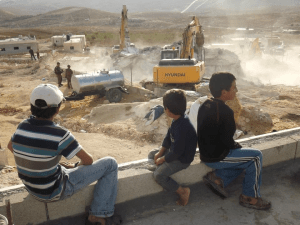
Children watching Hyundai demolition machine: Demolition in south Hebron hills by IOF 6.11.2012, photo 50 of 96 by Operation Dove.
Images can have strange and strained relations with each other. In this case, the strained relation is between the corporate image of the Hyundai corporation and activists’ image of the Israeli occupation. The South Korean corporation is now best known for making Hyundai and Kia cars. As is the case with other global corporations, it is very conscious of its brand image. According to Hyundai’s Chairman and CEO Mong-Koo Chung’s corporate message of May 2012, its “brand value rose to over USD 6 billion, ranking 61st among the world’s top 100 brands.” Branding isn’t only about marketing; it’s not only about sales figures. The corporate message states that: “our goal is not to be the worlds’ biggest automaker, but to be the worlds’ most-loved automaker.” One of the ways in which Hyundai makes itself more lovable is by fulfilling “its duties as a global corporate citizen through its widespread corporate social responsibility programs.” So, on the corporation’s worldwide website one of the five heading options draws attention to Hyundai’s collaboration with UNICEF in its Global Endpoverty campaign, trumpeted under the slogan “Moving the World Together.”
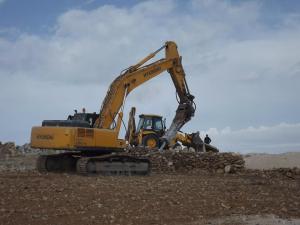
Hyundai demolition monster: Demolition in south Hebron hills by IOF 6.11.2012, , photo 83 of 96 by Operation Dove
But Hyundai doesn’t only make cars. A photograph credited to “Operation Dove” displays the Hyundai brand name in a rather less lovable context, as a piece of its building equipment is put to use by the Israeli army to demolish a stone wall built by Palestinians in the south Hebron Hills area to pen in sheep. The Hyundai machine looks like a monstrous single-toothed dinosaur that has come not to move the world forward but to wreck it.
Another of the current five heading options on the corporate website leads visitors to Hyundai’s “live brilliant” branding campaign, one of the video advertisements for which features laughing children amazed at the world that they see during car journeys. The caption for the campaign is: “Hyundai makes every moment brilliant”. But in another photo of the same event, Palestinian children are pictured looking on in seemingly bored resignation as the Hyundai and other machines demolish another building. They may well remember this moment their whole lives, but not as a brilliant one.
The pictures (along with a description of the demolition operation, and a video posted by Operation Dove) will not only remind the children of this violent incident. They also threaten to damage Hyundai’s corporate image, which has been crafted as carefully as the dry stone wall. Like the flocks that can no longer be penned in by the wall, Hyundai’s brand value is in danger of becoming scattered. And if the brand value is lost, the corporation’s value could collapse like the house attacked by its machine.
The Israeli army is demolishing these structures in the South Hebron Hills region in Area C of the West Bank, which remains under full Israeli control following the 1993 Oslo agreement, on the pretext that it needs the land for live firing zone 918. According to the Israeli military, the 1,800 or so Palestinians living in the area do so illegally, because the military law forbids residence in a live fire zone. And hence the army periodically demolishes buildings in the area that it also considers to be illegal. But a brief glance at a map of the area drawn by Israeli human rights organization B’tzelem suggests that the alleged military necessity for more training ground is underwritten by an Israeli political strategy of effective, creeping annexation of Area C, which comprises about 60% of the West Bank.
The photographs posted by Ta’ayush activists following this particular incident on November 6, 2012 are peace images that undermine Hyundai’s, and other corporations’, brand images. Ta’ayush is an Israeli-Palestinian grass-roots movement that engages in non-violent direct action to resist the occupation. It has been particularly active in the South Hebron Hills area in recent years, along with other Israeli peace groups such as Rabbis for Human Rights. These are peace images in that they vividly portray that the Israeli occupation is violent and oppressive, a state of affairs that must be ended to bring peace. They are also peace images in that they reflect Ta’ayush’s aim to “to break down the walls of racism, segregation, and apartheid by constructing a true Arab-Jewish partnership”. Building the partnership is peace-making.
Thus far, Hyundai has attracted less negative attention from the BDS (Boycott, Divestment, Sanctions) movement than other corporations whose equipment is used by the Israeli military in the occupied Palestinian territories, such as Caterpillar. Documentation of the incident shows the Israeli military deployed Caterpillar and JCB machines as well as the Hyundai monster, and the Electronic Intifada blog puts them in the same basket. Hyundai’s brand managers should be aware that Hyundai will know no peace if the brand is associated with occupation and war.
 Picturing Peace