Tag Archives: combatants for peace

Protest Theatre of the Occupation

Earlier in the week, as the “pillar of cloud” war raged in Gaza and southern Israel, Combatants for Peace had planned a demonstration for Friday afternoon calling for a ceasefire. This bi-national Israeli-Palestinian organization opposed to violence and dedicated to achieving a peaceful resolution of the conflict had no trouble switching the emphasis of the demonstration (after the ceasefire was agreed on late on Wednesday) to the acute need for direct and immediate negotiations to address the conflict. But the demonstration could have happened on any other Friday afternoon of the year. The world’s attention has been directed in the past couple of weeks to one area of Palestine striving for independence, the enclave of Gaza, but there has been no let-up in the Israeli occupation of the West Bank.
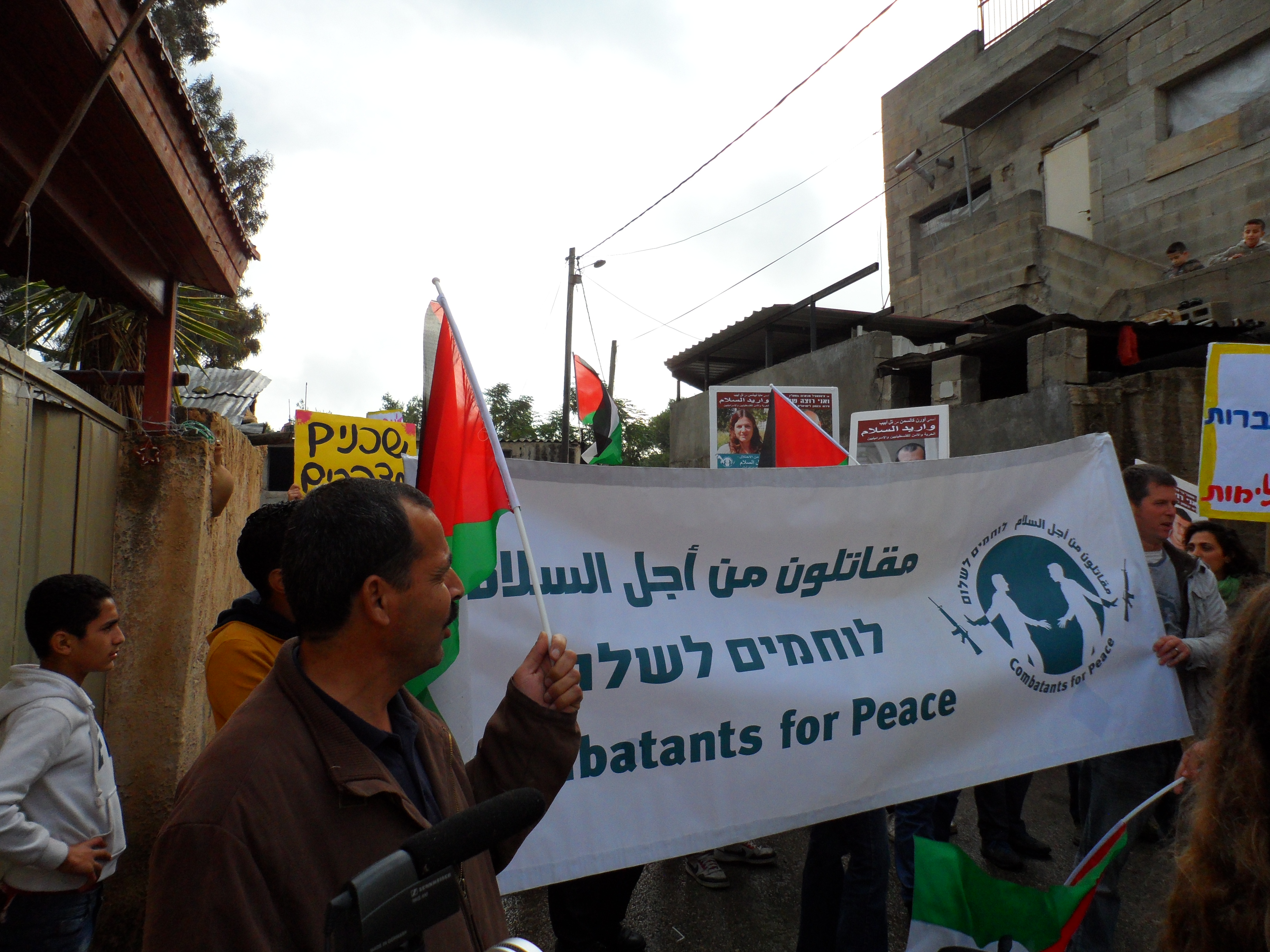
Combatants for Peace demonstration in Izbat Tabib, 23.11.12

In the last few months Combatants for Peace has been supporting the struggle of a small, isolated Palestinian village, Izbat Tabib, that is close to the Palestinian town Kalkilya and the large Israeli settlement, Alfei Menasheh. Izbat Tabib is in Area C of the West Bank, the area constituting about 60% of the West Bank that according to the Oslo agreements of 1993 remains under full Israeli civil and military control until a later agreement. It’s nearly 20 years later since then, and Israeli rule is increasingly permanent and restrictive. For Izbat Tabib that has meant losing about 45% of its land to the building of the Separation Wall in 2011 and demolition orders, issued by the military government, for most of the homes and the village school that also serves as a community centre.

The group of about 100 Palestinians of Izbat Tabib and Israelis from the Tel Aviv area marched the short distance from the school to the junction with the main road. Protesting  the occupation in general and the demolitions in particular we chanted slogans in Arabic, Hebrew and English: “No, no to war; yes, yes to peace,” “One, two, three, four, occupation no more; five, six, seven, eight, end the killing, end the hate,” “Jews and Arabs refuse to be enemies.” We held placards, mostly in Hebrew, on which were written slogans such as “There is a partner,” “it won’t end until we talk,” and “yes to dialogue, no to violence.” But other than passing traffic and the rain clouds quickly crossing the windy sky, nobody was listening or watching.
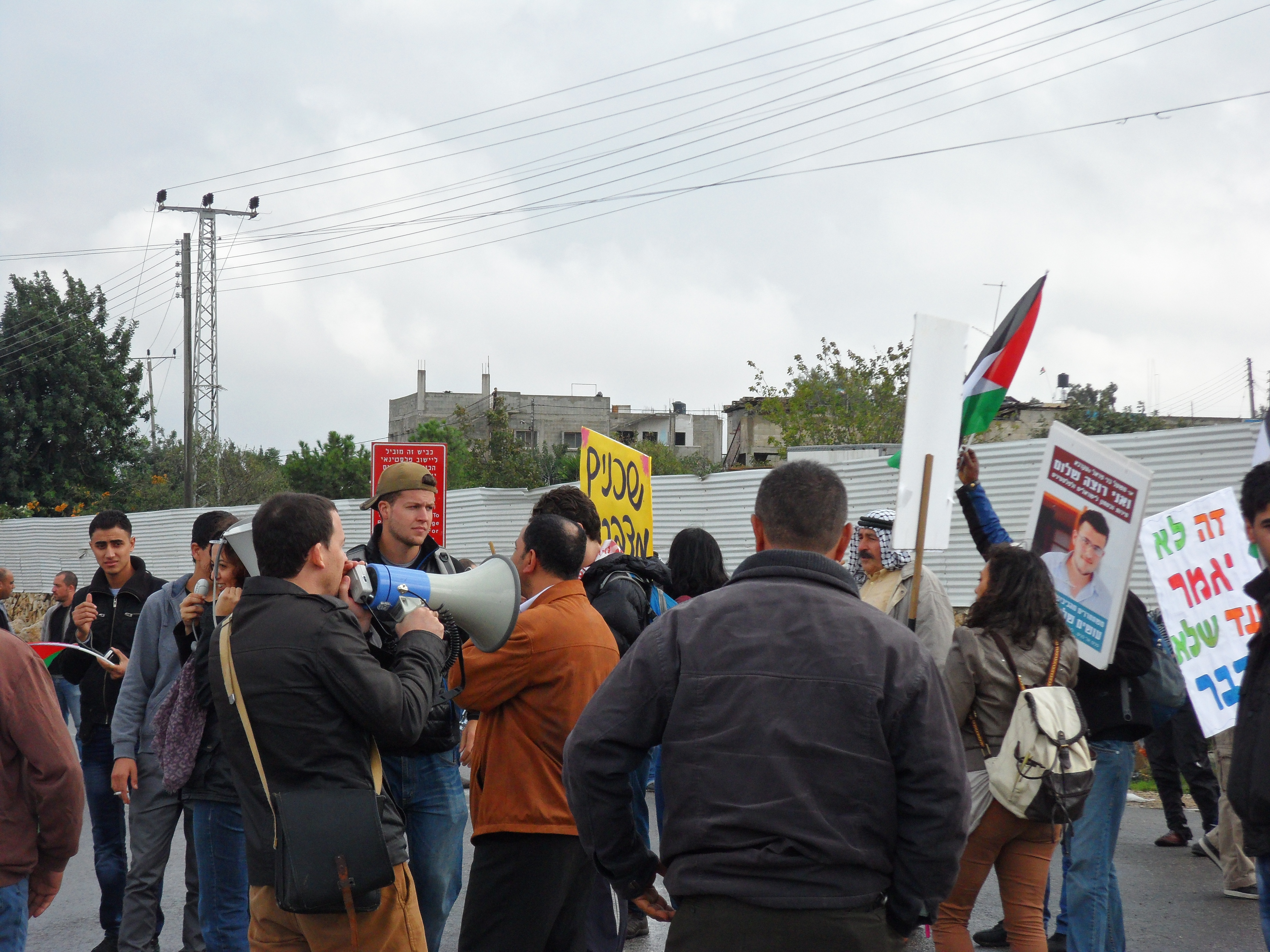
Combatants for Peace demonstration, Izbat Tabib, 23.11.12

And then our audience arrived. Hesitantly at first, they kept their distance. Then they must have called some friends, and a small group of military vehicles and soldiers came and stood close by. The Tel Aviv – Tulkarem group of Combatants for Peace use theatre as one of their approaches to non-violent resistance to occupation, and have previously performed for the villagers. Today, the improvised performance was for the soldiers. At first a couple of the demonstrators took up stances showing the soldiers how we saw them, how they held their guns, how they watched us. They turned to show us what they were doing, and then more demonstrators became actors, moving and standing in ways that showed the soldiers how we thought they saw us. A rainbow joined in. Then we all crammed in together to show that we could all be that close, without fear, without hatred, without any need for the red sign that warns Israelis it is dangerous to enter a Palestinian village.

Demonstrators acting the roles of the watching soldiers

The audience didn’t seem very appreciative. They came over-dressed, with far too many military accessories. Some seem to have got bored and left early in their armoured vehicle. One guy kept his distance throughout, staying with his vehicle on the other side of the road. Perhaps they were wondering why they had to be there and when they could go home. Maybe we should have brought snacks for them. We didn’t have a programme for them to take as reminder of the event. And really, they didn’t need to be there. Really, the Israeli military doesn’t need to be in the West Bank at all. They don’t need to come and demolish homes and schools, to build a Separation Wall on Palestinian land. We can get along fine without an audience, performing for each other the roles that neighbours play for each other. We’ve been playing a theatre of cruelty for too long, a theatre of domination and oppression, a theatre of fear and hatred. Combatants for Peace are writing a script for a new play and are ready in the wings to perform it. They just need a bigger troupe of actors and a larger audience.

Demonstrators acting as demonstrators
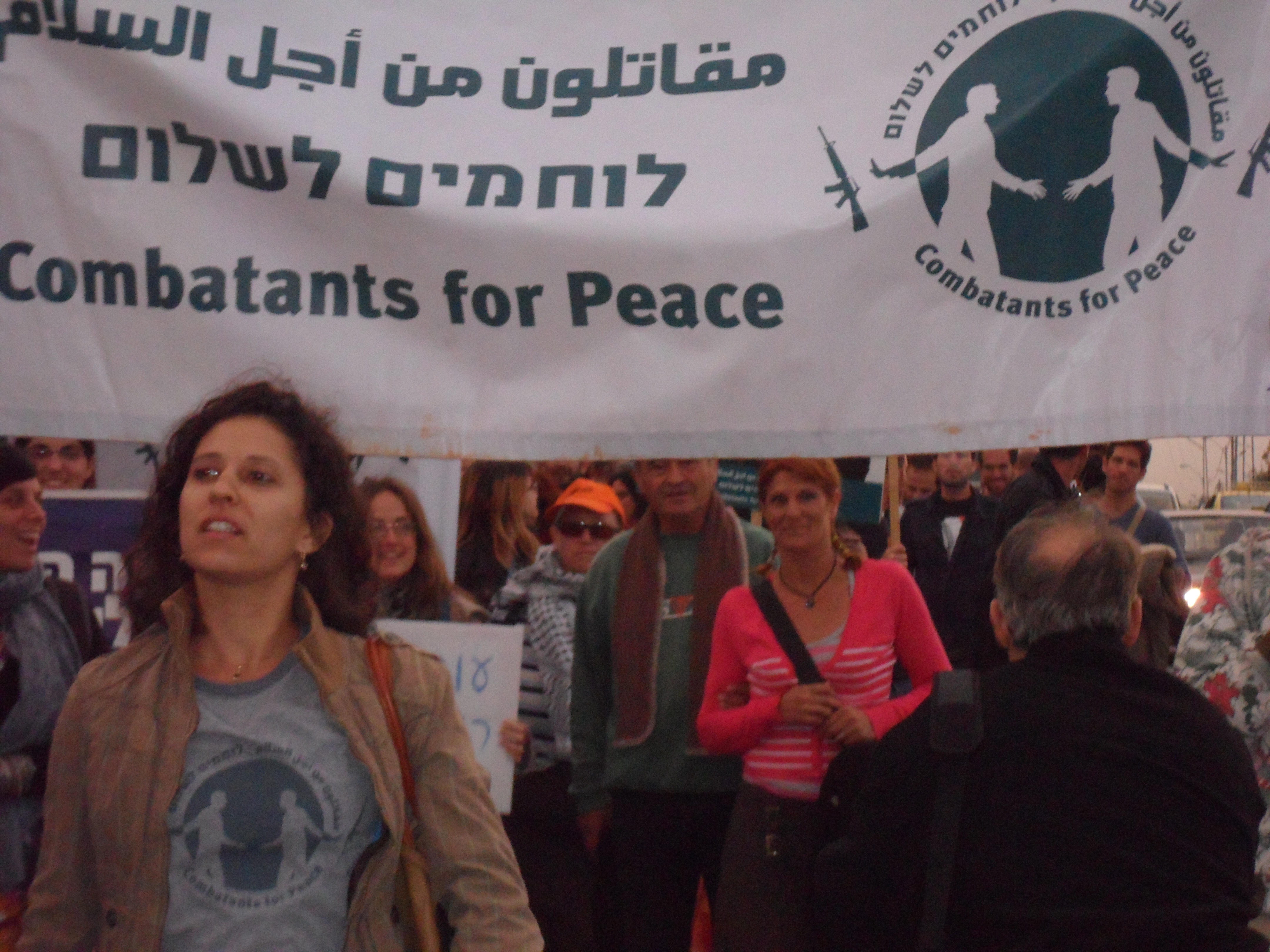
Composing peace as a picture

Combatants for Peace rally in Beit Jala

Peace-making is an art, an art that demands much skill, patience, a deep, empathetic understanding of the human material of which is peace is made, and willingness to try and fail many times before succeeding. The bi-national Israeli-Palestinian group Combatants for Peace practiced its art of peace-making in its rally against the “Pillar of Cloud” war on Saturday evening, 17thNovember 2012. The movement was started jointly in 2005 by Palestinians and

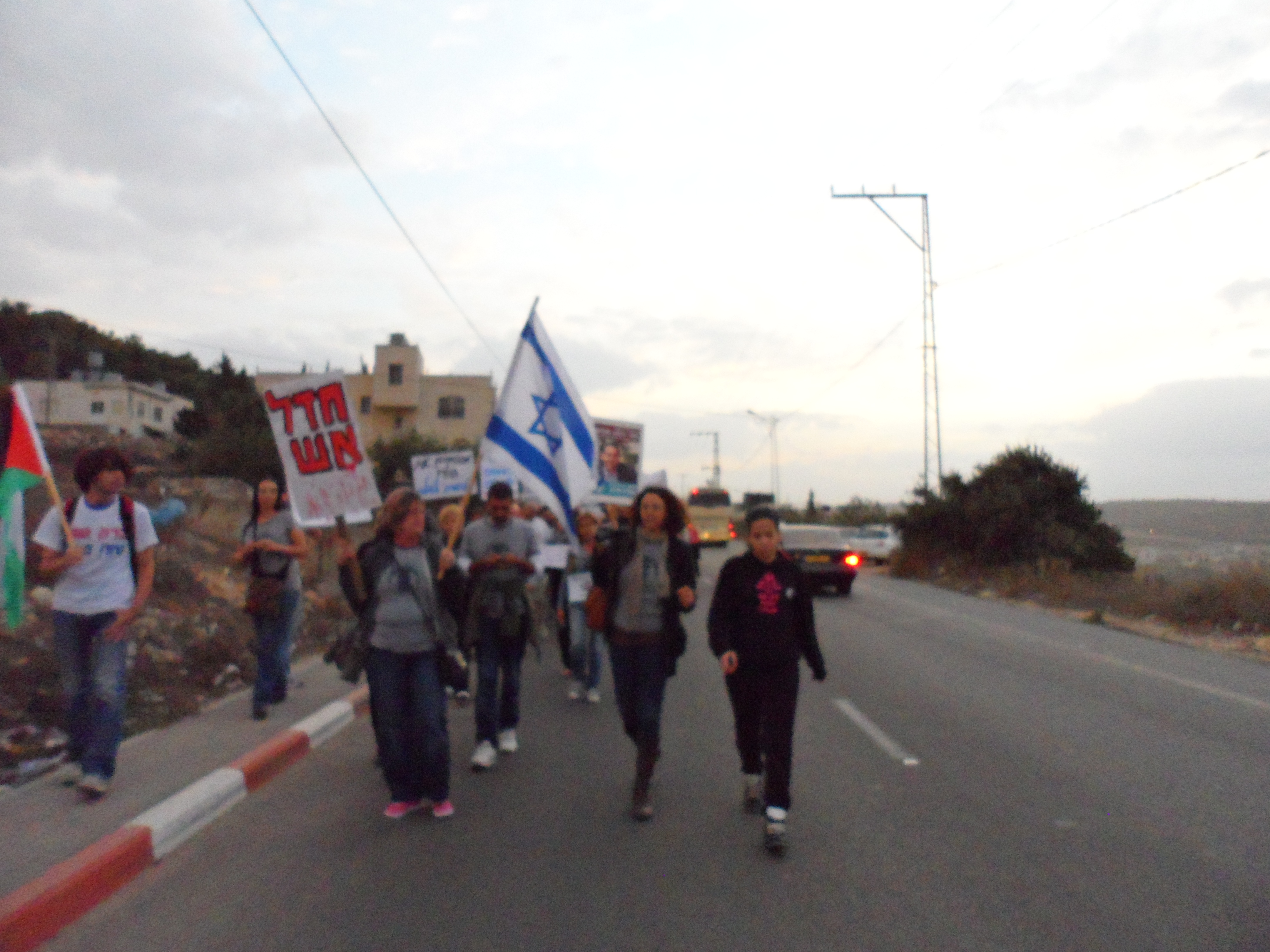
Israeli contingent marching to Beit Jala

Israelis, who have taken an active part in the cycle of violence; Israelis as soldiers in the Israeli army and Palestinians as part of the armed struggle for Palestinian freedom. Not only have members of the group renounced violence in favour of dialogue and reconciliation, but they have also committed to working together, as former enemies, to achieve an end to the occupation and independence for Palestine alongside Israel.

Before the latest Gaza war broke out last week, Combatants were planning a remarkable event for that evening, a screening on the separation wall of Shelley Hermon’s documentary film, Within the Eye of the Storm. I blogged on another occasion about the Tel Aviv premier of that film. But to show a film about how two former fighters, bereaved by the violence of the occupation, came to be close friends on the very structure that embodies all the forces separating Israelis and Palestinians will be a deeply symbolic event. The war caused the postponement of the event, and in its place Combatants organized a joint demonstration calling for a cease fire and a peaceful resolution of the conflict. Organising such an event in short time is no easy feat. Israelis may not enter Area A of the West Bank, which is under full Palestinian Authority control, without a special permit, while the movement of Palestinians other than within the “islands” that Area A is composed of is restricted by the Israeli military. But a point was found in Beit Jala, by Bethlehem, that enabled access to the Israelis coming for the Tel and Jerusalem area as it is in Area C and which the Palestinian members of Combatants could also reach.

So, we marched separately, about 100 Israelis from where the buses dropped us off on a rural road on the outskirts of Beit Jala in the hilly countryside around Jerusalem, and about 100 Palestinians from within Beit Jala. With only a few onlookers, we Israelis (and others) chanted in Hebrew to those ancient hills: “The people demand a ceasefire,” and “War is a disaster, only peace is the solution.” But along the way, a little peace making had to be done. A couple of Palestinians saw the Israeli flag one member of the group was carrying, and signaled that it be taken down. The Israeli and Palestinian organisers had it seems agreed between themselves that an Israeli flag would be there, but not everyone present was happy with that, or knew about it. The Israeli flag is a symbol of occupation and oppression to Palestinians, not a symbol of Jewish freedom. But by the time we arrived at the meeting point, an acceptable arrangement was found: the two flags were held together. Yet, they were both dwarfed by a huge Palestinian flag being held by the youth across the road at which we met, a fabric affirmation that we were now in Palestine.

Short speeches were read out in Hebrew and Arabic, calling on both sides to cease fire, stop targeting and hurting civilians, stop the incitement, and reach immediately the same agreement that will be reached later in any case but after more casualties and pain. Then the chanting began again, the drummers got their rhythm going, and bodies began to move to it, relaxing the stiffness of two sides standing with placards, banners and flags. One Palestinian kid who was enjoying the rhythm was holding a placard with Netanyahu’s picture and the slogan “Peace refusenik”. Waltzing with Bibi. Maybe the bored Israeli soldiers standing in a line to stop us spilling over into other roads wanted to dance too. It was a Saturday night, after all.

One can’t say we all made peace with each other that day, or had a chance to make friends. The activists of Combatants in their grey tea shirts already knew each other, had worked together, consulting each other frequently to keep the event running as planned. But there we were together, Israelis and Palestinians, at a time of war when it is easiest to care only for one’s own pain and injured and dead, to use it as ground to hate the enemy, to demonize them, to believe that they don’t love their children as much as we do, or that they won’t stop until they’ve killed all of us. There we were, determined to find a place to insist together that the violence stop. But even before it stops, Combatants continue the painstaking work of making peace out of the ruins and desperation that the conflict and occupation have left. Last Saturday night, they another added another quick sketch to their portfolio. With much effort, many more helping hands, disagreements about flags and colours and exactly where to place lines, these sketches could become a tapestry of peace across those hills.