Tag Archives: middle-east

This is what “conflict management” looks like

Once again the ongoing tension between the Israeli government and Hamas has deteriorated into a massive, asymmetrical exchange of airborne explosives inflicted mostly on civilians. Last time, in November 2012, the Israeli military code for the “operation” was Pillar of Cloud/Pillar of Defense. Then as now the terminology varied between Hebrew and English, so now we have tzuk eitan (steadfast cliff) in Hebrew and Protective Edge in English. Who knows why. The current outburst of violence punctuates the persistent variation of armed conflict between the Israeli state and the Palestinian enclave of Gaza since the first mortar shell was fired from Gaza into Israel in 2001. We’re now up to the seventh Israeli operation to contain the launch of more than 8,500 Palestinian rockets, resulting in 4845 Palestinian dead and 174 Israelis, according to Ha’aretz. Probably somebody could estimate the mass of Israeli ordinance that has landed in Gaza, but the number would obscure the extension of destruction to Gazan property and prosperity brought about the Israeli-Egyptian siege. The siege hasn’t fulfilled its stated purpose of preventing the build-up of rockets in Gaza, only the rebuilding of homes and infrastructure after each explosion of destruction.

The code names of the Israeli military operation are much less significant than the conception of the Israeli-Palestinian conflict in which they occur: conflict management. Sage “realists” who live in think tanks have concluded that the conflict is too intractable to be “resolved,” as the Oslo process has collapsed and subsequent efforts to revive it and the associated “two state solution” such as the Kerry initiative have failed too.  The best we can hope for, they tell us, is that temporary accommodations can be found that minimize the degree of armed conflict. No more wars between states, only “low intensity conflict” between Israel and its chief current enemies, Hamas, Islamic Jihad, Hizbullah and other “non-state actors.” So, you see, peace may be impossible, but war has been rebranded. The logic of conflict management shapes Prime Minister Netanyahu’s and the Israeli government’s relationship to Gaza and its Hamas leadership. Absent the option of a peace agreement with the Palestinians (which is blamed on the Palestinians), the best alternative is to deter the “non-state actor” Hamas from, well, acting other than as Israel wants, which is to disappear. So it’s within the rules of conflict management to punish Hamas as a whole, and any inhabitants of Gaza who are unfortunate enough to get in the way, with a dose of “low intensity conflict” for the murder of the three Israeli teenagers kidnapped in the occupied Palestinian territories. And as Hamas responded with some “low intensity conflict” themselves, the conflict requires some more intense conflict management from the Israeli side, and so on, until things calm down for a while. Neither side really wanted the escalation, we’re told, so it’s just a question of time until they manage to find their way out. Sorry about the death and destruction until normal management is restored.

IAF strike on Gaza (Photo: EPA)

IAF strike on Gaza (Photo: EPA)

The “realists” who adhere to the doctrine of conflict management are not realists at all. The reality of conflict management is what is happening now. It is families in Gaza buried under rubble, and a lot more rubble. It is enormous and inevitable “collateral damage” (dead and injured people) of an Israeli operation that treats homes as legitimate military targets (“terrorist infrastructure). It is an Israeli pensioner who suffered a heart attack trying to get to shelter from indiscriminate rockets fired by Hamas and Islamic Jihad. It is civilians in fear of what is falling from the skies. This is what conflict management looks like.
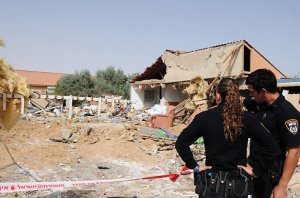
House destroyed by rocket in Beersheva. Photo by Herzl Yoseph

House destroyed by rocket in Beersheva. Photo by Herzl Yoseph

The asymmetry between the Palestinian and Israel casualties is immense, but it’s not a question of arithmetic. This low intensity conflict isn’t tolerable for Israeli civilians. It’s not so easy to manage shock and trauma, let alone physical injury, when you don’t live in a think tank. If you live in the confines of Gaza, there is nowhere to escape. This is what conflict management looks like.

Parents Circle Families Forum - Peace Square, July 2014

Parents Circle Families Forum – Peace Square, July 2014

There are some realists around, among the few voices in Israel that dissent from the mainstream discussion about how much military force should be deployed to manage the “non-state actors.” They might not look like realists at first sight. When everyone else is thinking about shelters that can withstand rockets, they put up a tent in a square. The Israeli Palestinian Bereaved Families for Peace, also known as The Parents Circle – Family Forum, have created a public space for peace in the midst of the war.
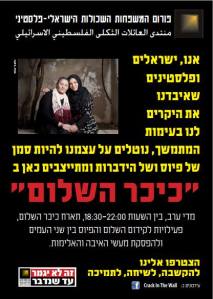
Poster for Parents Circle "Peace Square"

Poster for Parents Circle “Peace Square”

“We, Israelis and Palestinians who have lost loved ones in the ongoing conflict take it on ourselves to be a sign of reconciliation and dialogue.” They invite the public to join them, to listen, to discuss, for support. Based on their own experience of finding a way from their deepest pain to the pain of their enemy, they express their conception of conflict resolution in a slogan: “it won’t stop until we talk” (in Hebrew this rhymes as: ze lo y’gamer im lo n’daber). The horrific episodes of death falling from the skies won’t stop until there is a negotiation peace, a peace that the “realists” have given up on. The Parents Circle enact the difficult, painful reconciliation on the ground that is peace itself and paves the way for negotiation peace. That sounds realistic to me, a reality in which people can live.

 

Remembering the Yom Kippur War by demanding peace

Scene from Amos Gitai's "Kippur" (2000)

Scene from Amos Gitai’s “Kippur” (2000)

Today (10/6/2013) marks the 40th anniversary of the 1973 October War fought between Israel on one side and Egypt and Syria on the other. The war is also known in Israel as the Yom Kippur war, because the Arab states launched a surprise attack on the Jewish Day of Atonement. At the time I was a 12 year old boy living in Manchester, England, and spent the day in Heaton Park Synagogue, a nominally Orthodox institution, most of whose members were non-observant. By 1973 I went to the club house of Habonim, a Labour Zionist youth movement, twice a week (along with my two older siblings), and after being a pupil at King David Primary school for seven years I was thoroughly immersed in a Zionist environment that resonated with my home life, where souvenirs from Israel adorned the walls and the Hebrew records played on the hi-fi. So, when Israel was attacked, I took it personally. If Israel was in danger, so was I.

I find it instructive to return to my feelings of forty years ago, because though now strange to me, they are familiar to so many others. Then, I felt an existential fear, a terrible dread on that day of awe. I should remind myself when I confront and engage with Diaspora and Israeli Jews, who say they are worried that the Arabs want to wipe out Israel, that they’re probably experiencing something close to those old emotions of mine. I should remember how tangible my worry was, how the terror of annihilation tasted dry like my fasting mouth, how the anxiety felt like my empty stomach. The news of what was happening that day filtered through the congregation slowly. Nobody was supposed to be listening to the radio, but Manchester City were playing at home against Southampton, and a few people had gone outside to hear the score (the match ended in a draw). Seated some distance from my father on this crowded day in the synagogue, I turned to the authority of the Rabbi, also my Hebrew school teacher, to confirm the rumours. The news we heard and watched when we all returned home was dismaying. Was Israel about to be destroyed? Were the Jews going to be thrown into the sea? Was this somehow God’s judgment? What sin had I or we committed that deserved such punishment?

The intense fear gave way to apprehension as the days passed, and the Israeli armed forces turned the situation around. Within days, our youth leaders in Habonim took us out knocking on doors to gather donations for some sort of medical aid for Israel. Soon, we had a new song to learn, Naomi Shemer’s Lu Yehi (Let it Be), which had been quickly rewritten when her husband came home from his military reserve duty, and was then adopted as Israel’s popular anthem for the post-war period. It’s a mournful song, a secular prayer whose chorus beseeches: ‘All that we seek, let it be,” and the final verse of which implores: ‘grant tranquility and also grant strength to all those we love’. Even today, the song feels comforting.

The terror passed, replaced by the relief of Israeli success on the battlefield, a cease-fire, and the beginning of disengagement talks that would eventually lead to the Camp David peace agreement between Israel and Egypt, concluded in 1979. I should always remember my fear of forty years ago, but I should not forget that fear can be overcome. Fear is not a state to dwell in, not an emotional homeland, but an uninhabitable exile.

For Israel, the 1973 war was traumatic, not simply because of the surprise attack, but because of the series of military and political failures that led to the attack. The Agranat Commission (1973-75) looked into shortcomings on the military side, and by 1977, the Labour-led coalition that had dominated Israeli democracy since 1948 had paid the electoral price, paving the way for a government led by the right. The 1973 war is an unhealed wound that Israel is still picking at, and which it has barely begun to reflect on its public culture. One exception, Amos Gitai’s semi-autobiographical art-house film about the war, Kippur (2000) leaves the viewer with a sense of disorientation and detachment, its minimal action focused on a helicopter rescue unit that flies over muddy scenes of labyrinthine tank tracks as they ferry back the injured and leave the dead behind until the rescuers too become casualties, prey to the purposelessness of the war.

For the generation of Israelis who fought the war, their fear gave way not to despondency but to anger at the ineptitude and negligence of the country’s leaders. While for some the Labour establishment remained the focus of their frustration, others came to understand that as citizens they could no longer trust to their government to do what is best for Israel. Following President Sadat’s visit to Israel in 1977, a group of the ‘1973 generation’ wrote to then Prime Minister Begin in the famous ‘officers’ letter’ to argue for a path of peace rather than settlements, and the Peace Now movement was born. That generation, also central to the civil opposition to Israel’s First Lebanon War in 1982, overcame their fear, and frustration, through activism. Their activism figured Israelis not as the inevitable targets of unfounded Arab hatred, condemned to fight one war after another, but as partners for peace who wanted “No more war, no more bloodshed’ and that ‘the October War will be the last war’, as Begin’s and Sadat’s words repeated in a jingle on the Voice of Peace radio station.

In 1973, the founders of Peace Now could not know as soundly as they do now that the disaster of the war was not only that Israeli forces were caught off guard but that the war happened at all. By October 6th, there was no choice but for Israeli soldiers to fight back, but leading up to that point there were significant opportunities for Israeli governments to negotiate over the Sinai Peninsula and Golan Heights which had been captured in the June 1967 war. The war was an example of politics fought by other means, when diplomacy would have been far preferable.

Peace Now logo, designed by David Tartakover

Peace Now logo, designed by David Tartakover

Diplomacy seems to be breaking out all over the Middle East now – in the case of Syrian chemical weapons, and Iran’s nuclear programme. As several commentators have noted, this outbreak has made Benjamin Netanyahu anxious. In his UN speech on October 1st he referred to Iranian President Rohani as a ‘wolf in sheep’s clothing’, thereby directing not only Israelis but the whole world to be wary of the new mood blowing from Tehran. Netanyahu is a salesman in statesman’s clothing, a merchant of fear whose domestic political standing is directly proportional to the terror he induces. He is a political Mafiosi, promising Israelis protection in the form of armed might against a threat that he magnifies in order to sell his wares more effectively. He makes offers of ‘defence’ and ‘security’ that the voters can’t refuse. Netanyahu is a politician of fear, an orchestrator of powerful emotions who constantly builds them into renewed crescendos. It is not that there are no threats at all to be concerned about, but the politics of fear need to be confronted with a politics of different emotions, including hope. The fear of extinction that is shared by so many Diaspora and Israeli Jews is not unfounded but palpable. It cannot be dismissed, but nor can we remain hostage to it. The generation of 1973 found in Peace Now the best counter to the politics of fear in their activism, in giving voice to a demand for a better present. Their demand remains the best memorial to the Yom Kippur war.